
Haven
by despairsyndromeworld
Per my last posts, in which I compared the 1st and 2nd trials as antithetical in regards to their use of love as a redemptive force. In this post, I aim to something similar, except moreso between the 1st and 3rd trial, and a comparative analysis for their respective "antagonists", Komaeda and Tsumiki.
There is both an initial symmetry with how each "antagonist's" unmasking plays out, but also a contrast.
Komaeda's was partly willing, because it was planned, but noone really came to his defense after the fact. We see Hinata's conflicted monologue, but that's really it. Even when it was revealed that Komaeda didn't commit the murder and his only intention was his own victimhood, what has been done cannot be undone. It comes across as a great betrayal to the player as well; Komaeda was basically our walkthrough character. He introduced us to the Ultimates and helped us investigate the murder. It is in that usefulness that the "betrayal" takes its toll: if not only can he investigate the crime scene he took part in but also almost mislead us in the voting, how can we really trust him again to such an extent? From all trials since, the main insult aimed towards Komaeda is of him as a "confusing" force.
Meanwhile, Tsumiki ardently denies her guilt to the very end, using her innocence and clumsiness as a shield, and she's not alone in this endeavour. Multiple people come to her defense, with a special standout being Akane, precisely because Tsumiki was the one that took care of her during her Disease. Even Hajime doubts himself and backs off, untill Nanami encourages him. Inversely, it's Komaeda, though another one of Tsumiki's patients, that pressures her and more easily accepts and promotes the possibility of her being the killer, with emphasis on her capabilities as a nurse.
When it comes to Tsumiki, its not only that people don't want to get rid of her just because she's innocent or soft spoken, though that is the main point of defense used, but because her talent makes her incredibly useful in the investigation and trials, in conjunction with the competency in which she undertakes it. Her mannerisms also help in easily extracting information from her and making her cooperate.
The cast moreso don't want to believe that the 'useful' person they trusted was a bad guy, but the 'useless' person that seemed to obstruct them ended up being the good guy. Or more like, they didn't want to lose the former due to the latter; its cognitive dissonance at its finest. (Un) fortunately for them, it is the overlooking of how such a person can manipulate vital information that leads to the trial's stagnation, untill Komaeda is the one to bring forth the rope as the decisive piece of evidence.
When Tsumiki gets backed into a corner, her main defense is a plead to forgiveness. Even if she did do x,y,z it doesn't matter, because it was a mistake, because she was clumsy, because she didn't mean it that way, because it wasn't the crime itself. Some of the things she says during her trial are very interesting:
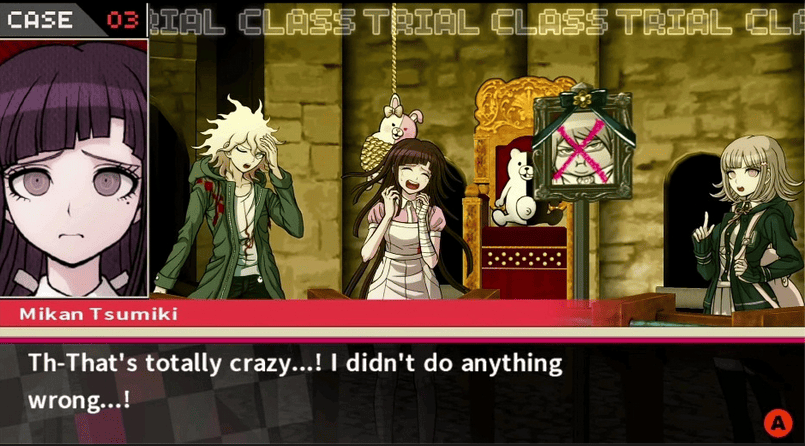
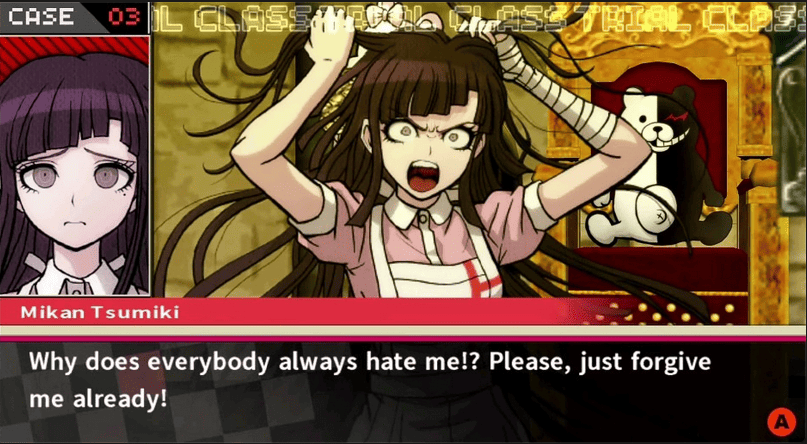
These pleas for forgiveness, for everyone to stop bothering her anymore, that this is all long done and that everyone should move on already... Doesn't that sound like it could be applied to another character too?
Tsumiki is verbalising some emotion during her breakdown that could also apply to Komaeda, especially the begging for forgiveness to a crime that she (claims) she didn't commit.
At this point, multiple weeks have passed since Komaedas "betrayal" and the only improvement in his situation is that he isn't still tied up in the old building or that his classmates didn't let him die during the Despair Disease. Even if he's the one that's spearheading this trial and helped highlight Tsumiki as a suspect, he's still treated with the utmost of suspicion, even on his deathbed.
Except Komaeda himself never asked for forgiveness. His moral compass, in contrast to Tsumiki, never revolved around interpersonal acceptance. Both his strength and major flaw, in the eyes of his classmates at least, is that he never cared about forgiveness on an individual level more than doing what he deems as 'the right thing', untill things get actually personal.
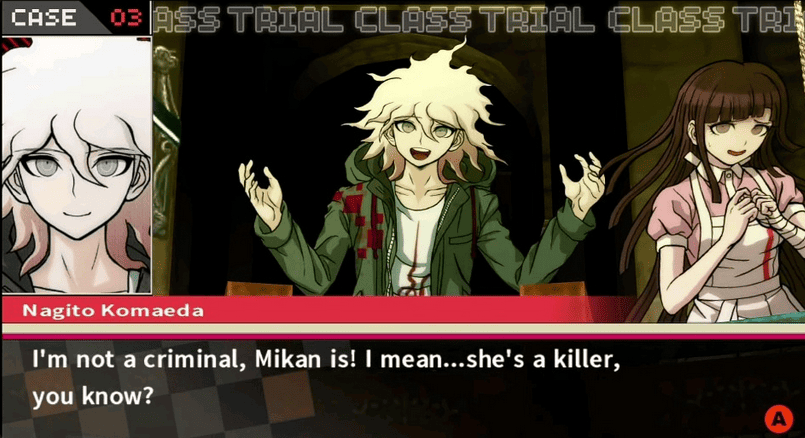
He never demanded anyone's forgiveness, not even Hinata's, even after the tying up incident; at every opportunity, he either helped move the case along or tried to further explain his reasoning. Most of the critical things he says about Tsumiki during the trial never pass the realm of the personal, it's always about her giving into despair. But what does that even mean in this case?
So, why did Tsumiki even commit the murders? She elaborates:
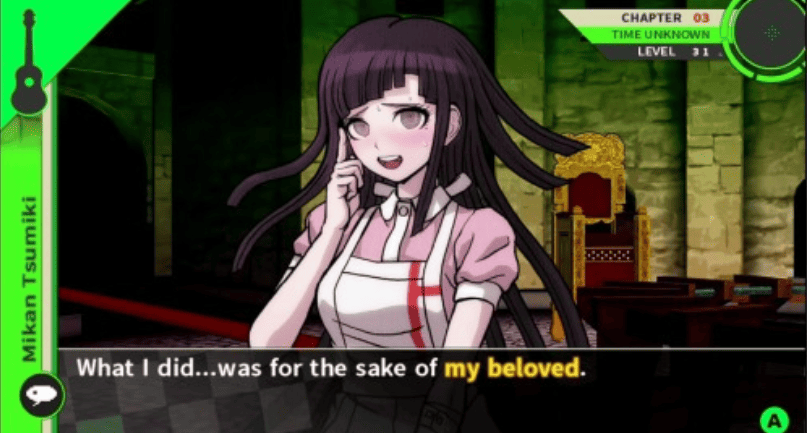
Even if the thing that made her "awaken" and commit the murders was despair, she explains that it was only because it was that emotion that connected her to her "beloved". The true reason was love itself.
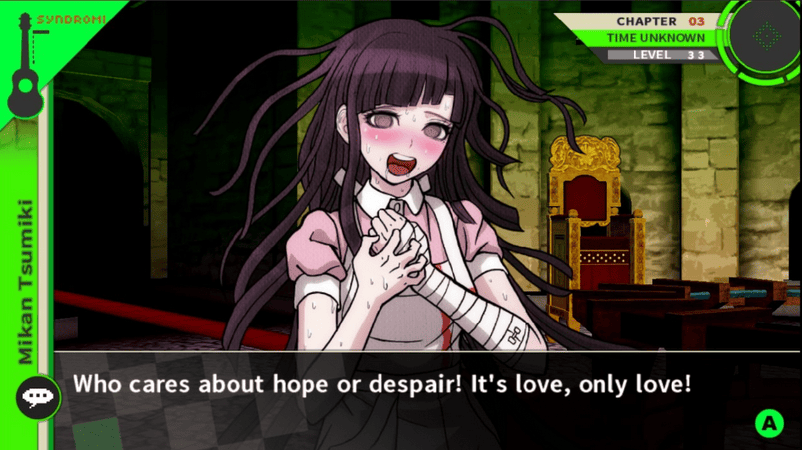
There is an interesting contrast between her and Komaeda here: while Komaeda positions his love for the Ultimates and hope as pure and selfless due to its unrequited element, Tsumiki's love is 'selfish' due to it being requited.
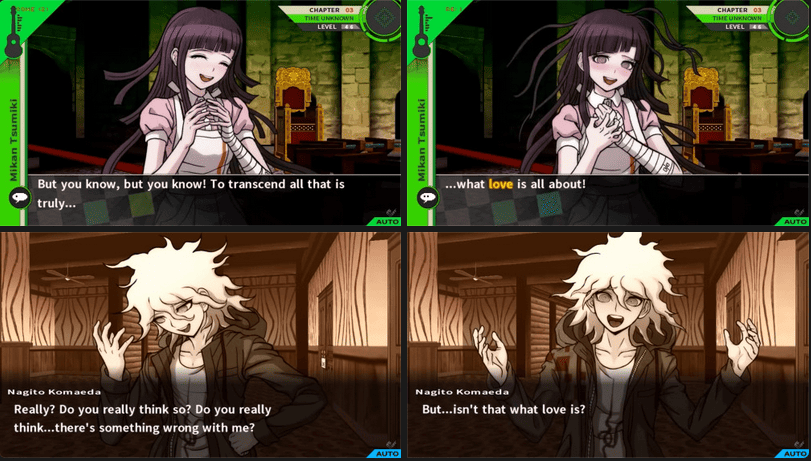
Tsumiki herself explain was that the reason she committed the murders was to uphold her own side of the deal, to show her own reciprocation.
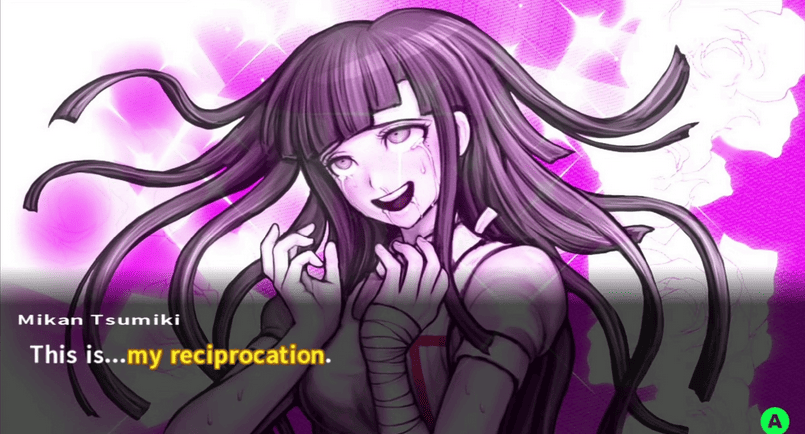
Obviously, this type of thinking is completely antithetical to Komaeda's. When it comes to 'hope' and 'despair' in this trial, Komaeda's main goal is to forgo the things that don't bear meaning. Komaeda himself at one point outlines the difference between despair and the "lesser" hope; despair is merely an obstacle to the true hope, while lesser hope directly leads to it. So, seeing Tsumiki's motivation as meaningless, it is an obstacle; therefore, to him, it is despair.
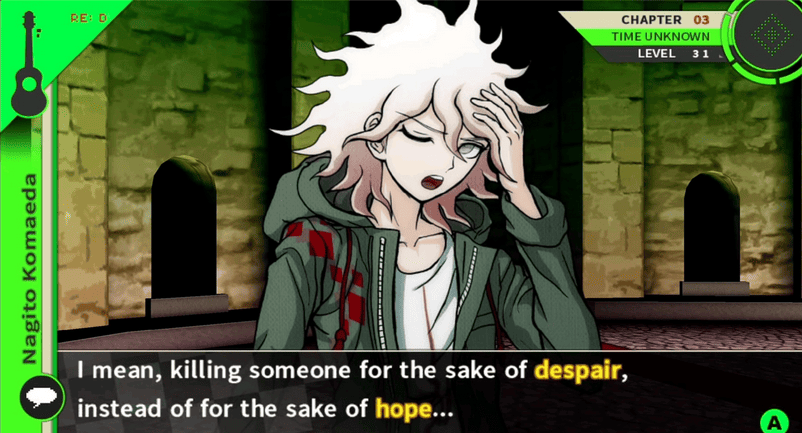
There are similarities to how both of them talk about their love, especially accentuated by "the bottom of my heart" comment:
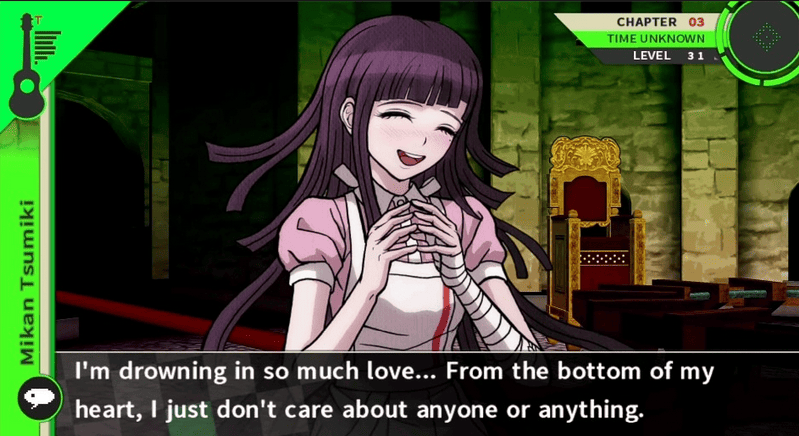
However, the main difference is still the one that was underlined in the previous trial. Komaeda continues to assert thematically speaking of Tsumiki's love being for despair, in the same way that his is for hope. But Tsumiki's is still interpersonal. She marks her success by her beloved's acceptance, and her murders become only an extension to her love. In a way, she doesn't need the rest of the cast's forgiveness anymore, but she doesn't trade it out for a completely faceless concept. This is also seen by Komaeda's failure in the interpersonal department; even while he's on the brink of death at the hospital or even when he extinguishes despair in the face of Tsumiki, she still gets the last laugh:
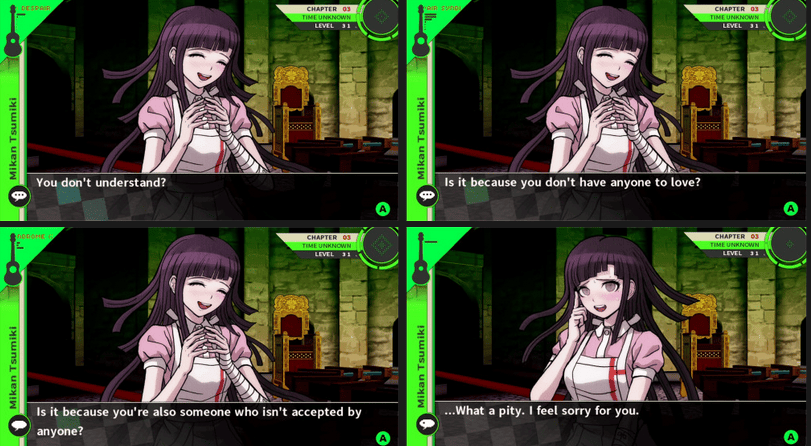
Of course, in the face of some of Tsumiki's insults, Komaeda waves them off or states that he doesn't understand, but that is an indictment of his character. Even when confronted with an unrepentant and unforgiven killer, he still ends up represented as less than human.
Once Tsumiki reveals herself, everyone immediately turns against her, much like they did Komaeda. If anything, there's more hurt and betrayal, more desire to think of Tsumiki sympathetically than they collectively did for Komaeda:
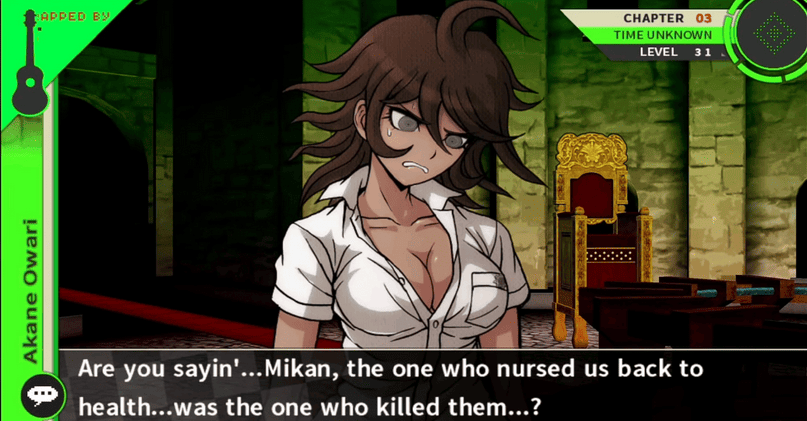
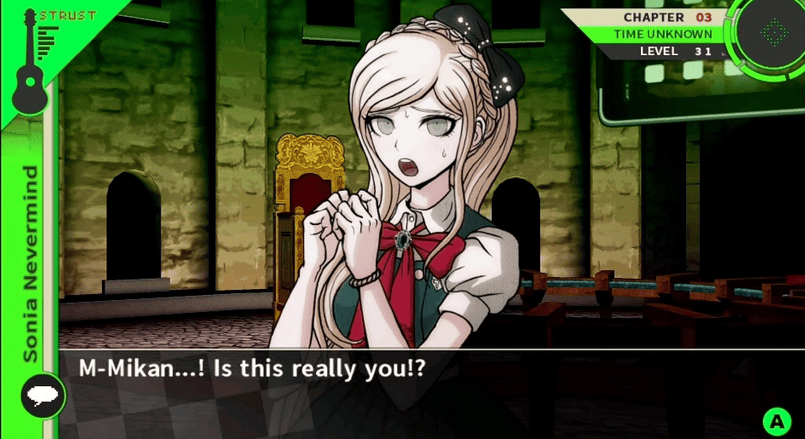
Most of the confusion and loss of sympathy lies on her mental state and lack of sanity. Kuzuryu even quips:
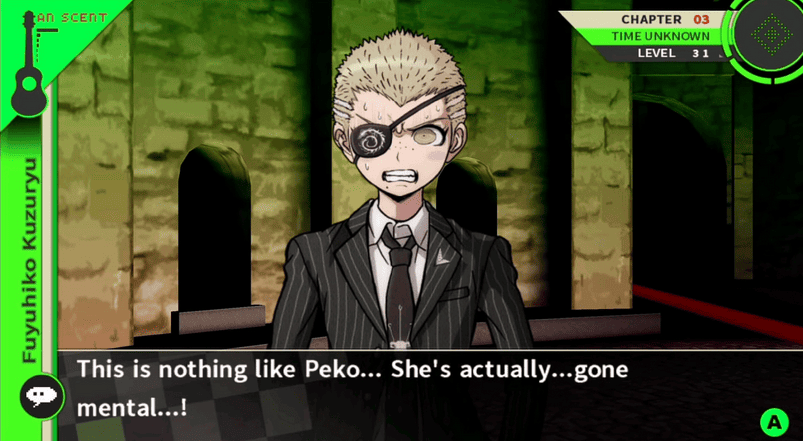
The question on their minds is clear: Is that the real Tsumiki, or just the symptom of the disease? There's even a parallel with Hinata:
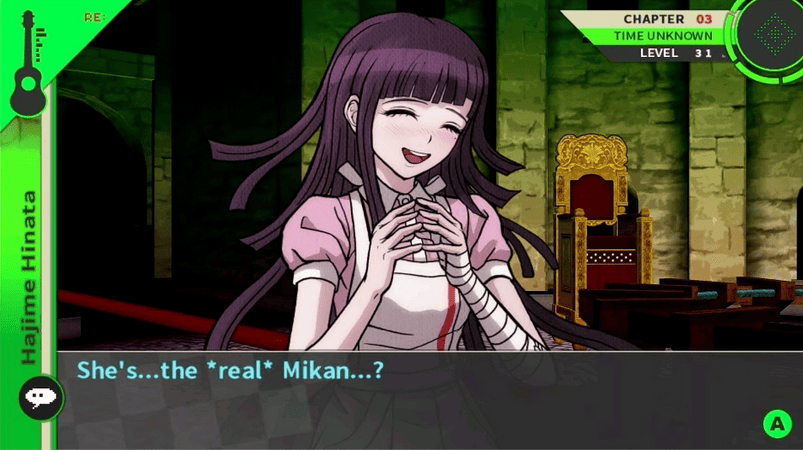
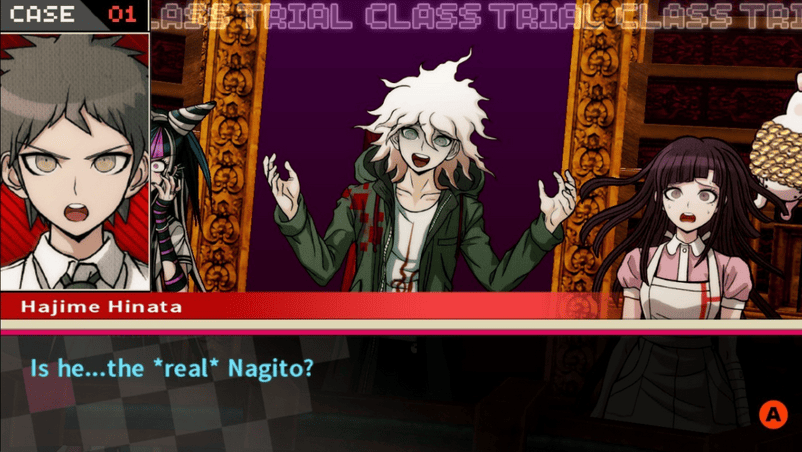
The murkiness comes from the fact that though a disease, not only it doesn't exactly impact a direct personality trait, it leads to directly uncovering her personality. Of course, it's left ambiguous how much the despair by itself has affected her or even if it's altered her perception. She explains:
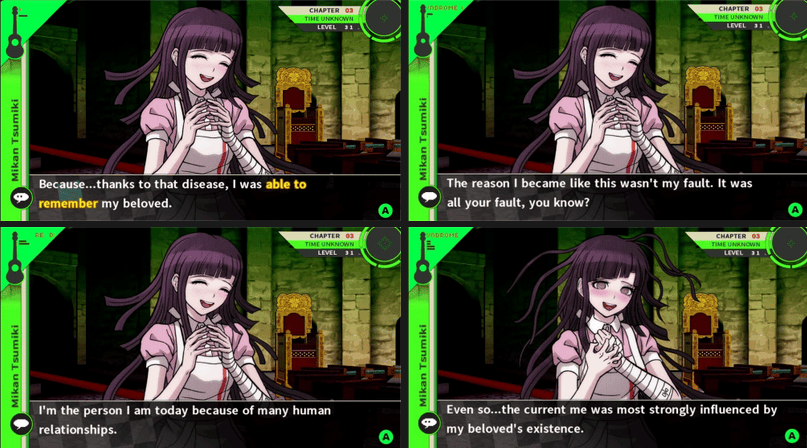
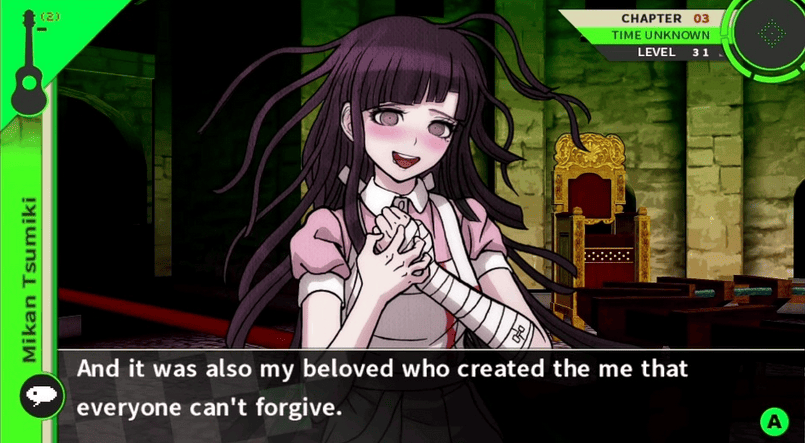
Sure, maybe it was due to the disease that those intentions were revealed. But if those were her full intentions from the start, but they were just hidden from her, its not just that she changed, but was she ever the person the others believed her to be? If she ended up that way by the way her life turned out, by her upbringing, by the way everyone else treated her, was it really her fault? Was it really her "nature"?
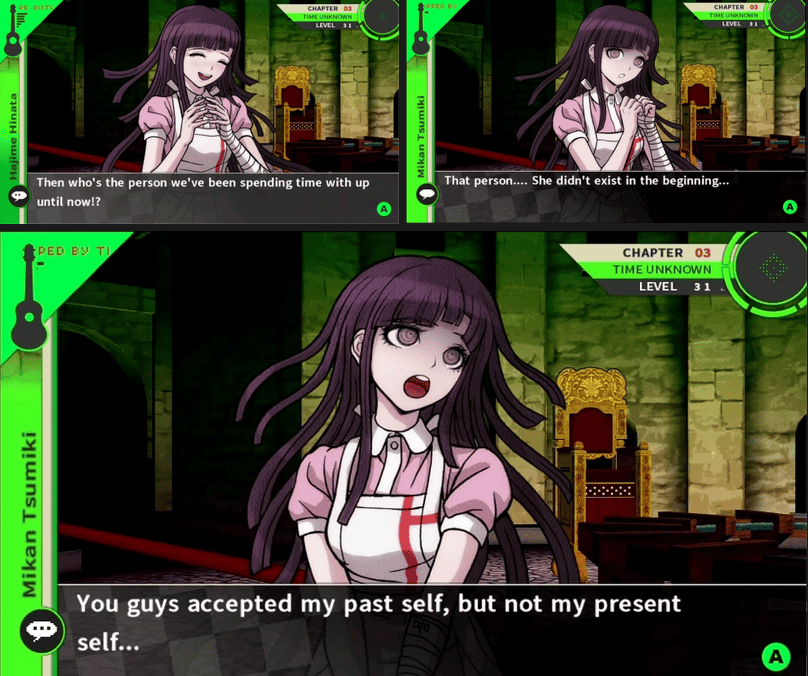
This is another parallel to both the previous trial, and a theme that stretches out throughout the game. Is it nature, nurture, or pretending?
This is also something that calls into question Komaeda's role, especially in the last parts of the trial. Even if he was one of the reasons she was discovered, even if he's on the same side as everyone else on the island, due to the subject of despair he takes it even more harsh and personally, though all others end up with a more mixed view of things. At the end, he says:
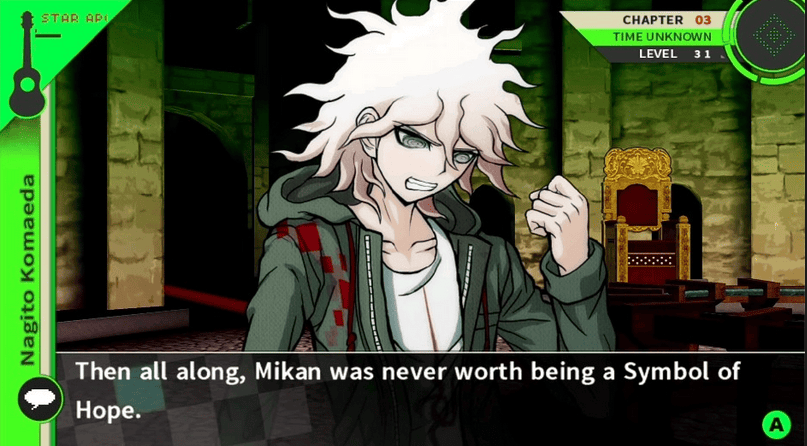
Even if by all accounts he should be on the same page as everyone else, the self-righteousness he also acquired by many events in his life, just like Tsumiki, ends up indistinguishable than cold, hard-wired "nature".
There is a theme serving as the connective tissue between Tsumiki's and Komaeda's love though: The instrumentalization of it.
From every trial we've seen since this point, there is the theme of a "wrong love", a love that has been tainted to serve a harmful cause, a love that has been instrumentalized to serve the oppressive system.
Komaeda's love for hope, Hinata's love for Hope's Peak, and Pekoyama's dehumanization in service of Kuzuryu as the yakuza heir; In part, all of them serve talent most of all and thus serve society's oppressive system.
Tsumiki's love is complicated when it comes to categorisation because it goes against that pattern somewhat; in her FTE's it is revealed that she uses her talent as a form of power but she doesn't love because of it, much less love her beloved. If anything, she loves her beloved despite herself, the way she assumes her beloved does for her. Even though it is a "wrong love", it is also a "true love".
But on the part of said beloved, Enoshima, Tsumiki's love is something for her to exploit, but to serve despair instead. Even if from the point of love of Tsumiki it is a true interpersonal love, it is very much instrumentalized to serve a corrupt interest, the same way Komaeda's more abstract love is for Hope's Peak.
In a way, it is the dark mirror to the game's final choice.