
Haven
by despairsyndromeworld
ABSTRACT: The aim of this post series is the analysis of certain thematic parallels and thorough lines between Chapters 1 and 2 in Super Danganronpa 2: Goodbye Despair, with particular focus on the themes of action, intent and forgiveness. In this part, we see the case for redemption of Peko, Fuyuhiko and Hiyoko, alongside the lack of it for someone like Komaeda.
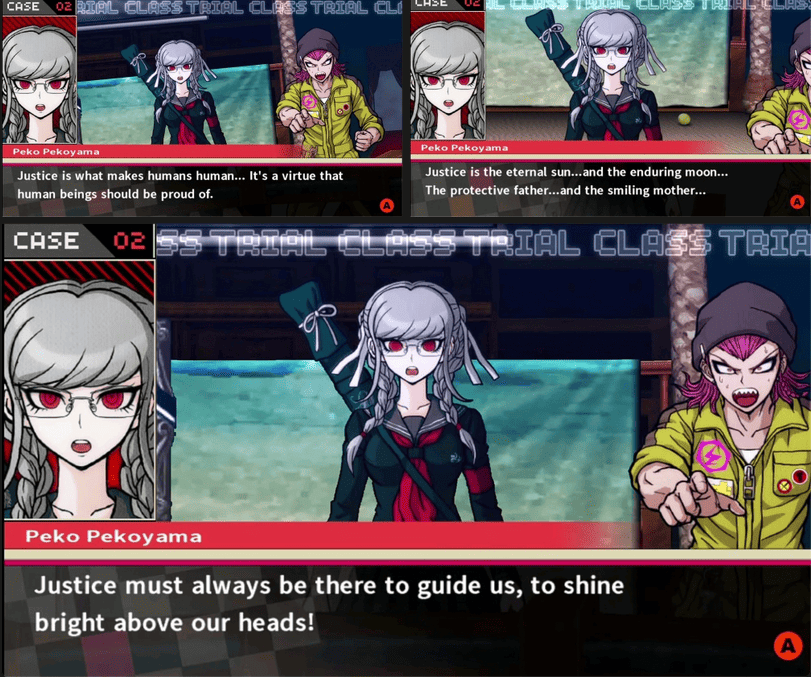
Justice is still used here as a melodramatic abstract concept, but it is more anthropomorphised: it is "the protective father" and the "smiling mother" that guide us (much like the ones she never had). An innate quality that imbues us with humanity Just before this, she said:
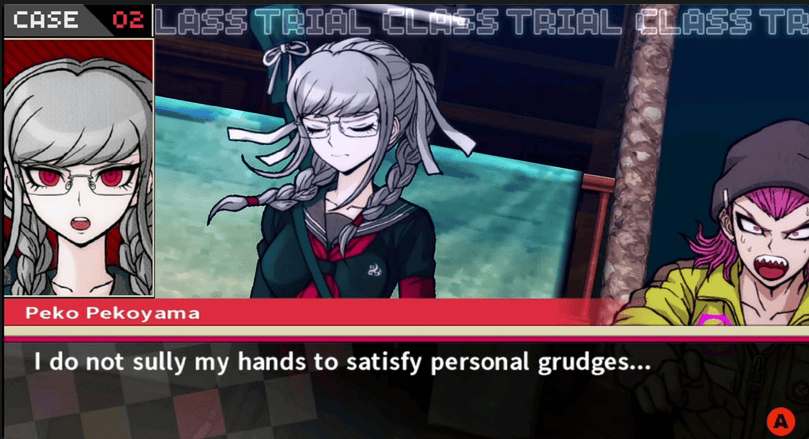
Let's add some of the things she said as a "tool" here too:
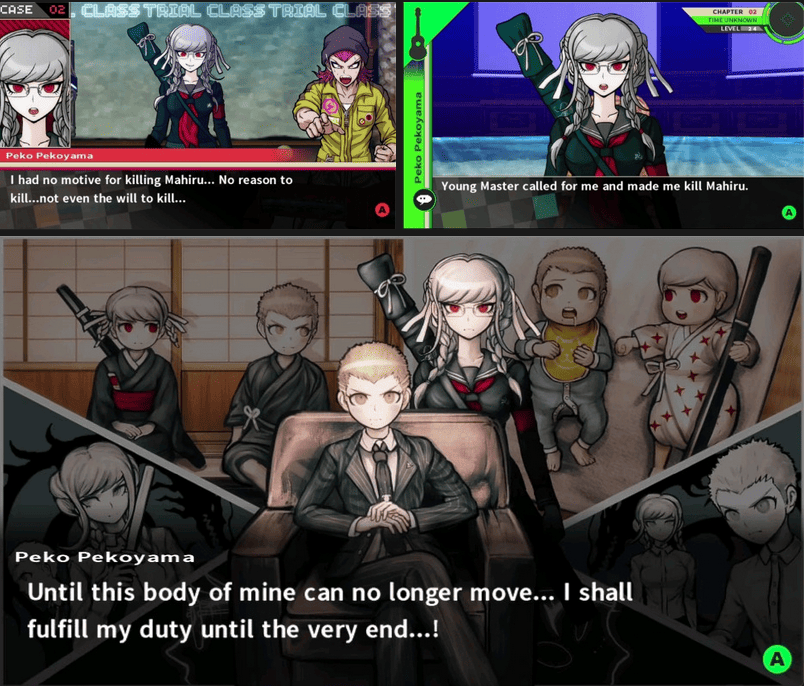
A lot of the things she says as a "tool" are recontextualised by the fact that she was the one that jumped in at the last moment and attacked Mahiru. It is the single defining thing, other than Fuyuhiko's own verdict, that turns her into an active agent culpable for the murder. Though she still tries to frame it as purely an act of duty even moments before her death, the thematic parallels are clear; it was an act of love. And in the end, it is what redeems her:
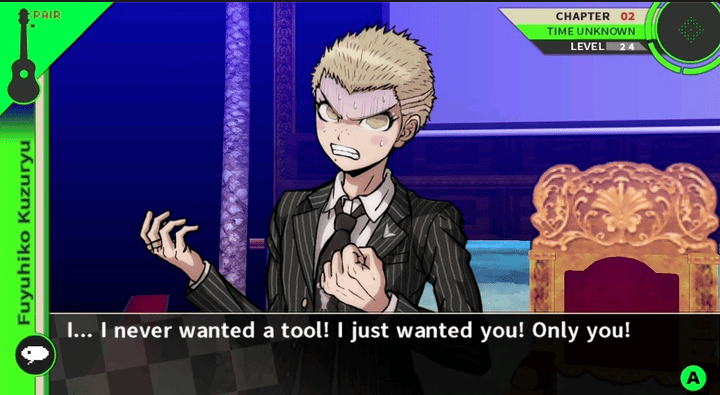
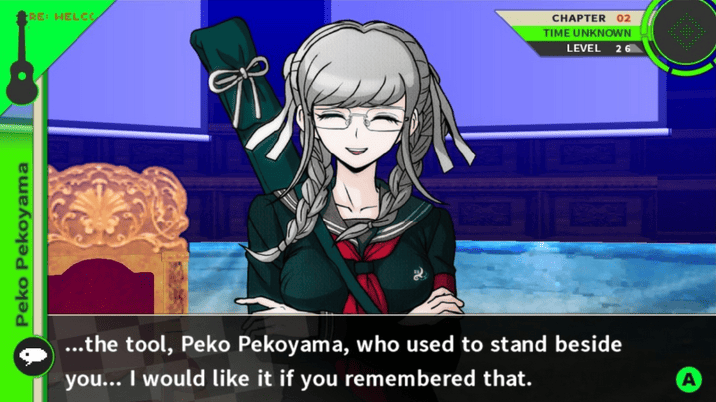
Speaking of thematic parallels:
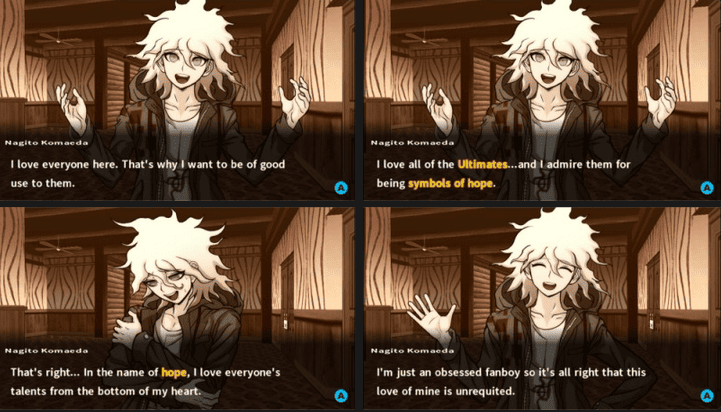
And he seems to agree! But not everyone sees it that way:
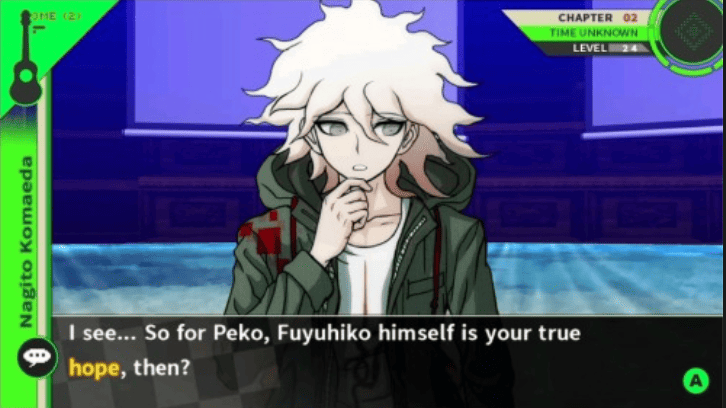
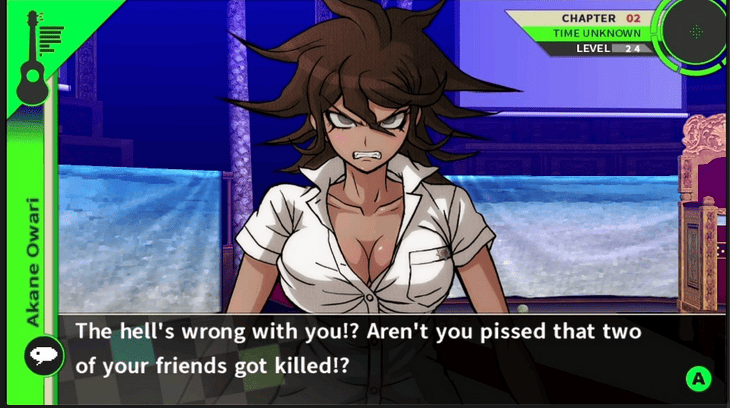
Peko's love and self-deprecation are framed as a tragedy of extraneous circumstances and her main redeeming factor, even if she was the culprit and even if that love was the reason that made her commit Mahiru's murder of her own free will. Meanwhile, Komaeda's self-deprecating love is seen as an intrusion, a self-imposed presumption, that the others don't even try to refute or even actually care that it is what he's actually saying. As seen with Akane's reaction above, they basically see it as the same type of white noise that comes out of Komaeda's mouth every other time, even if he's trying to relate to Peko, even if she ends up using the same vocabulary.
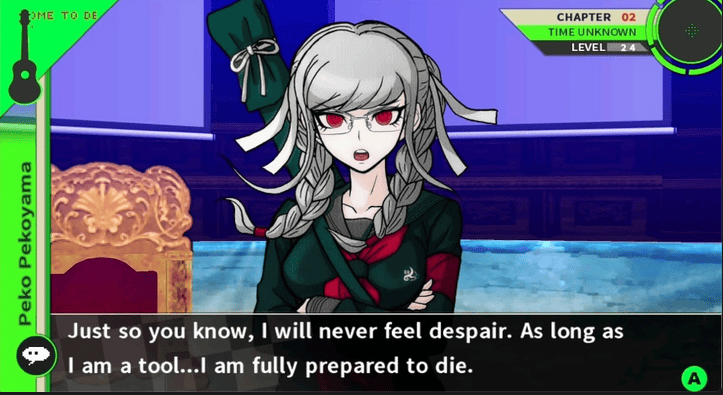
Love redeems Peko, no matter the phrasing. For Komaeda however, love seems to further distance him. "But wait!" you might say "Komaeda might not have been planning on any murder but his own, but he did instigate it!". Indeed, it means we must take a look at the treatment of the instigator of the 2nd chapter's murder, Fuyuhiko, as well.
Peko already had redeemed herself through her love, and her execution just furthered cemented that. In that execution, it was Fuyuhiko's turn to prove his love; and he succeeded.
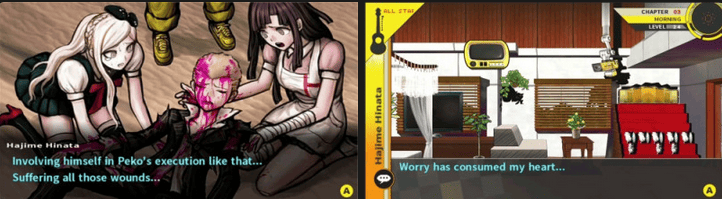
Already by that sheer act, he seems to have gained (most of) the rest of the cast's goodwill. But first, let's take an adjacent detour:
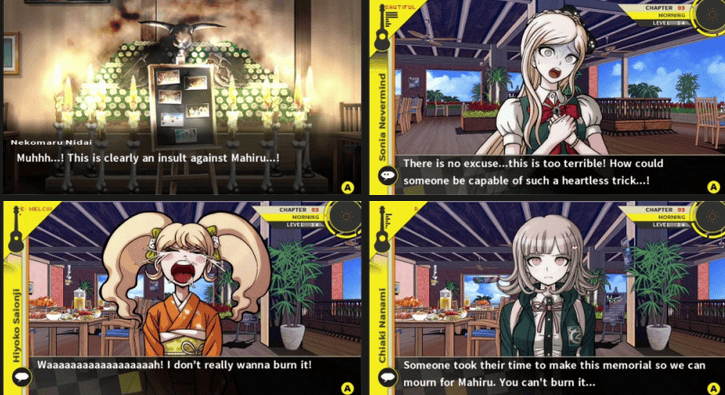
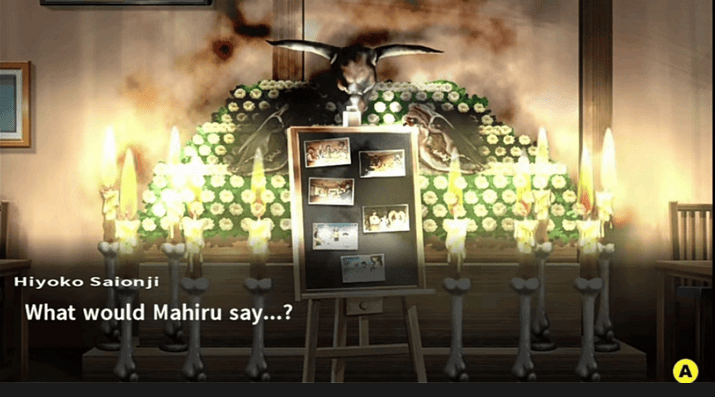
Hiyoko tries to make a shrine to honor Mahiru's memory, unfortunately looking extremely creepy. While the rest of the cast notices it, everyone immediately assumes it must be a mocking, off-putting prank, causing Hiyoko to cry and everyone to briefly self-reflect and comfort her. While this isn't outright a redemption, this is how Hiyoko, a person who has no blame in the previous murder but is harsh and easy to turn against, at least earns the cast's sympathy. And then after everything seems settled, Gundham and Komaeda walk in. Gundham merely looks horrified and spouts his usual melodramatic sayings, while Komaeda makes a much more scathing comment, immediately dissipating the peaceful atmosphere:
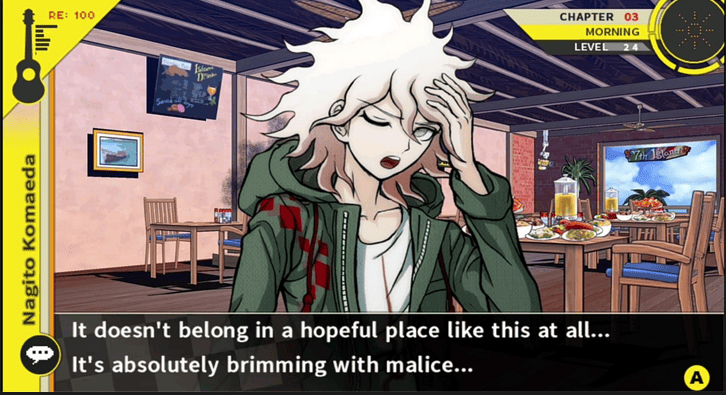
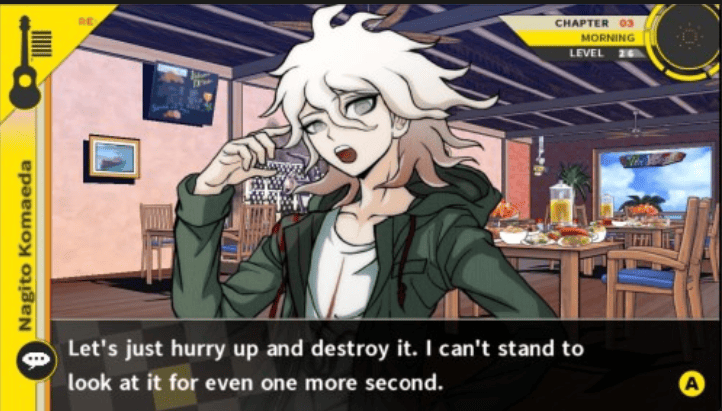
As Fuyuhiko, and more importantly Hiyoko specifically, earn their goodwill in each respective situation, Komaeda just seems to lose it.
After the cast visit Fuyuhiko's ward, the feelings of togetherness seem to just ramp up, even though he was the killer in motive, and could've easily been condemned just an in-game day ago. Everyone's attitude towards him seems to have gotten much warmer after the trial than before:
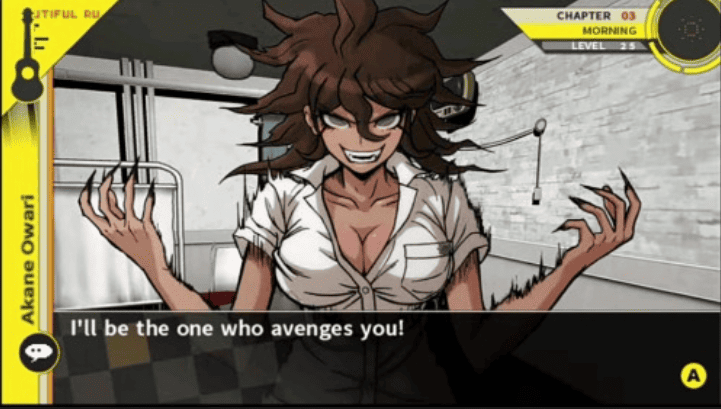
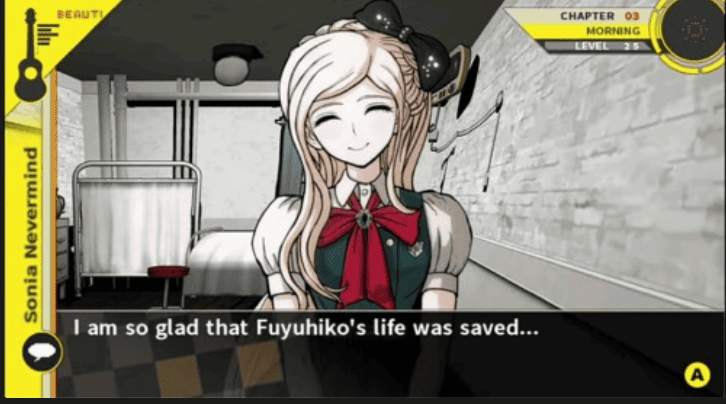
Afterwards, his making of amends through his seppuku seems more as a way for the writers to emphasise his redemption, especially to an irate Hiyoko, who wasn't treated like a voice of reason anyways. The cast immediately rush to his side once they realise what's going on:
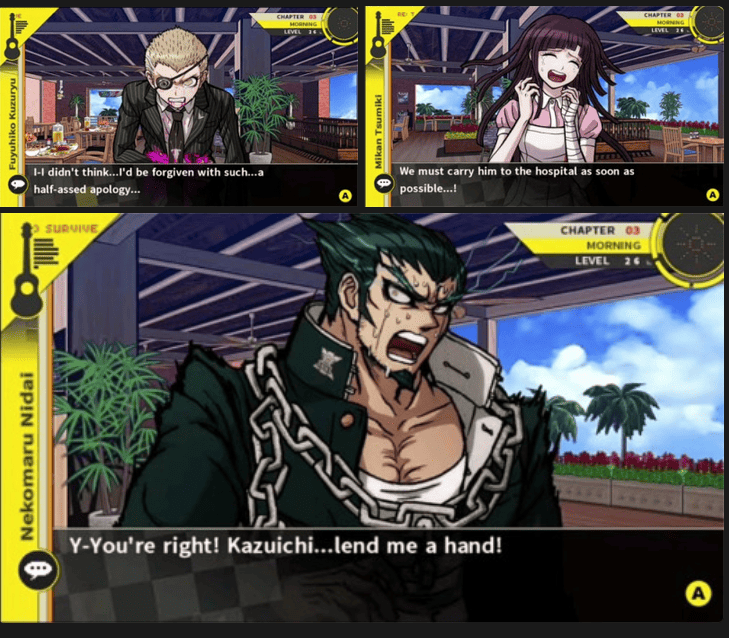
(Note the contrast in how Nekomaru and Souda treated Komaeda, as a non-killer or culprit, and neither specifically for his instigation versus Fuyuhiko)
Through nudging from Nanami, even Hiyoko forgives him:
His last apology attempt was a redundancy in terms of forgiveness, because almost all the cast had perfectly forgiven and understood him. So why is that the case for someone like Fuyuhiko to instantly earn his redemption in the eyes of not just the cast but the viewers, but Hiyoko and Komaeda, who technically haven't actually done something, also needed to earn it, or not be given it at all?
The truth is that all three characters that are given fairly straightforward redemptions are shown to have one thing in common; their capacity for love, or at least, enough humility to turn towards the one they love. The reason for Peko killing Mahiru, as much doomed her in body, as saved her in the eyes of her classmates. Fuyuhiko wasn't just forgiven and taken care of merely in his proximity to Peko, but because he showed that as ruthless as he was, he was ruthless enough to even sacrifice himself for her. Hiyoko, when she forgives Fuyuhiko, who does she turn to? Mahiru.
All of them have shown love towards their fellow classmate(s), their fellow human(s).
In contrast, where is Nagito, shown above, to utter the word love?
Towards an abstract concept. The game, even if you play through his FTEs, in the main story, collapses his capacity to love purely through his capacity to love hope. Komaeda's love is seen as incomprehensible, facetious, conceited, one-sided in more ways than one, fake, harmful, not even worth considering. Even if Komaeda didn't technically do anything, even if a chance for redemption for him can be inferred from Hiyoko's own arc, he is automatically excluded from the category of forgiveness untill his death, if not the end of the game. He has not adequately shown his love in a human enough way, and thus, he is ostracized even from the ranks of people that did plan and commit a murder. By being excluded from the capacity to love, and be loved in turn, he isn't just excluded from 'redemption', forgiveness and sympathy, but also the capacity for understanding. By being excluded from the capacity to love, he is excluded from being human.
by despairsyndromeworld
ABSTRACT: The aim of this post series is the analysis of certain thematic parallels and thorough lines between Chapters 1 and 2 in Super Danganronpa 2: Goodbye Despair, with particular focus on the themes of action, intent and forgiveness. In this part, we see how the case made for the red herring suspects of the two cases are developed mainly through the aesthetics of their behaviour, a myopic viewpoint that was used in favor of the perpetrator in both trials, barely succeeding in the 2nd.
Almost every trial in Danganronpa thrives on the misdirection of the identity of the actual suspect, making it more shocking when the real killer and their motives are revealed. To present a person with suspicious behavior, only for them to turn out not to be the culprit, is called a 'red herring' and is a well known staple in the mystery genre. So why am I focusing on the use of this convention on two very particular trials of the second game of the Danganronpa series, considering that this wasn't the first, neither the last time even the series would employ this trope? Because I believe the way that not only that trope, but the way in which the trope was employed, has a very clear thorougline between the two trials that actively prey on the characters' (and by extension, the players') prejudices in an almost self referential manner from and to one another.
*Note: By 'culprit' in a Danganronpa context, I do mean the blackened, not necessarily the one and only killer as per the title.
All the red herrings in both trials (and even the culprit of the 2nd which we will get to later) are initially pinned as the prime suspects mostly due to their unsettling or "creepy" behavior.
For example, in the 1st trial Komaeda starts laughing maniacally, accentuated by the big cg with the spirals, and uses ambiguous wording to say that "it was all his doing". Immediately, Ibuki perks up to say that "he looks kinda nuts": cue Hinata spiraling himself and everyone being convinced of Komaeda's guilt, needing Mikan to intervene to point out the contradiction of the murder weapon.
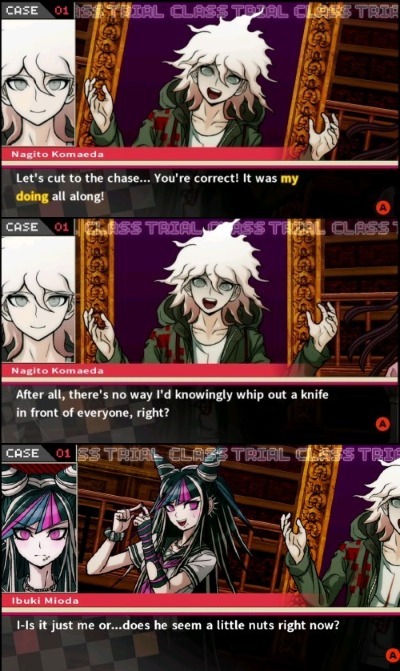
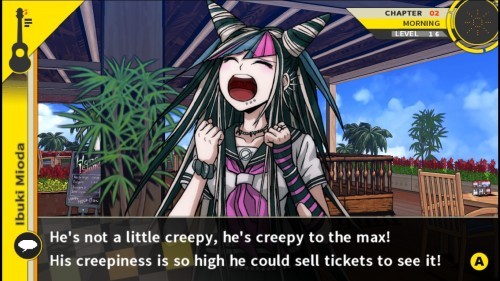
Though if one is paying attention, they can see Komaeda never outright admits his involvement in the murder as a killer directly or further than that; if anything, the way in which he relayed that information, his presentation and phrasing was enough to lead the rest of the cast, even Hinata, to immediately assume his guilt. Even when absolved of it, Ibuki continually emphasizes his "creepiness" and even the reason why Nekomaru and Souda knocked him was simply for him to stop talking, which leads to why they aim to conceal it later; they fail to actually justify it on his views directly.
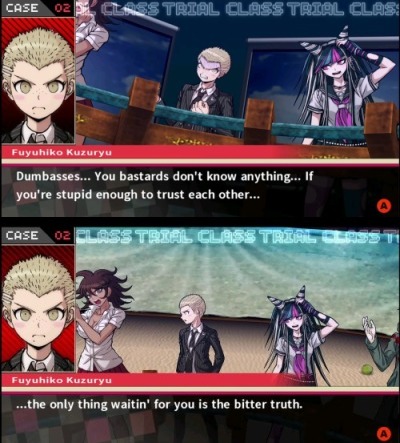
In the 2nd trial, there are mainly two red herrings who are treated in a similar manner: Hiyoko and Fuyuhiko. However, unlike Komaeda, neither of them outright oust themselves or deemed as outright insane. If anything, their already ingrained anger issues and well known 'nasty' behaviour among the cast was already reason enough for their condemnation. In a darkly ironic manner, both of them blame one another at one point, because if not their own, they are at least aware of the other's poor reputation.
Reactions towards Hiyoko's presumed guilt:
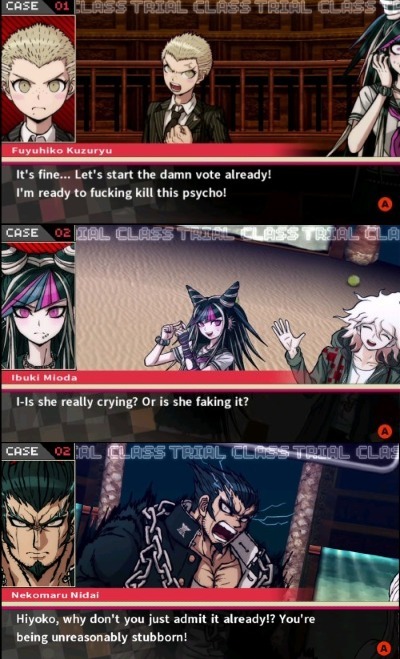
Reactions towards Fuyuhiko's presumed guilt:
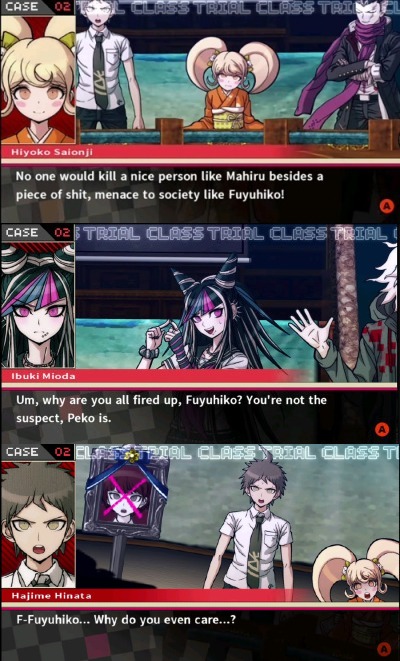
Theres also another reverse similarity between the two of them: Even if Hiyoko was innocent, the case against her was well structured, and even if Fuyuhiko had more involvement than he let on, the things he said that aroused suspicion were pretty ambiguous tough guy things that he could have handwaved if he insisted more on his role in the game being purely Monokuma's invention. Nevertheless, on both cases people immediately got swept up and asked for the voting to start. Hell, Fuyuhiko even got the Panic Talk Action!
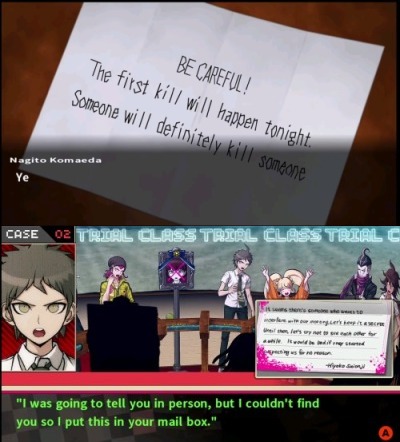
We continue into more of the similarities between the two trials: both included letters that aimed to misdirect the people involved into constructing the killing, both involved a monokuma theater after the supposed reveal of the true killer that aimed to highlight the supposed killers unpredictable nature but also that it might not be telling the whole story, and that the two most memorable suspects from each trial were partly lying to protect the (other) killer.
Considering the 2nd trial follows the 1st, it is not without merit to assume that the similarities weren't merely intended outside the game's scope for analysis of thematic parallels, but were also used by the characters themselves, drawing on the reception of their previous uses. Case in point: Sparkling Justice.
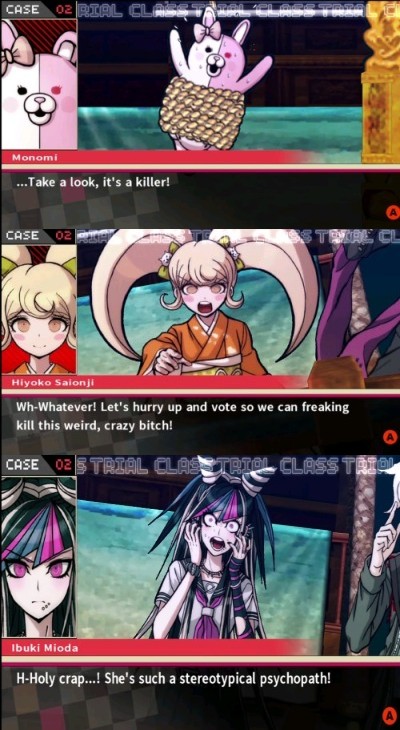
Sparkling Justice could be seen as a short of non-sequitor; even if her true purpose gets revealed later in the trial, her role within it is pretty random. However, if one looks closer they can see parallels: her theatrical performance, the way she constantly repeats the abstract concept of justice, the fact that she still didn't actively admit her being a murderer, the way the rest of the cast clamored to vote her off without hesitation, even if conflicted calling her crazy, that Peko didn't actually know anything but the two most basic facts about Sparkling Justice even if she was right there when Sonia was explaining them to her. Peko's performance wasn't drawing from Sparkling Justice: she was drawing from Komaeda.
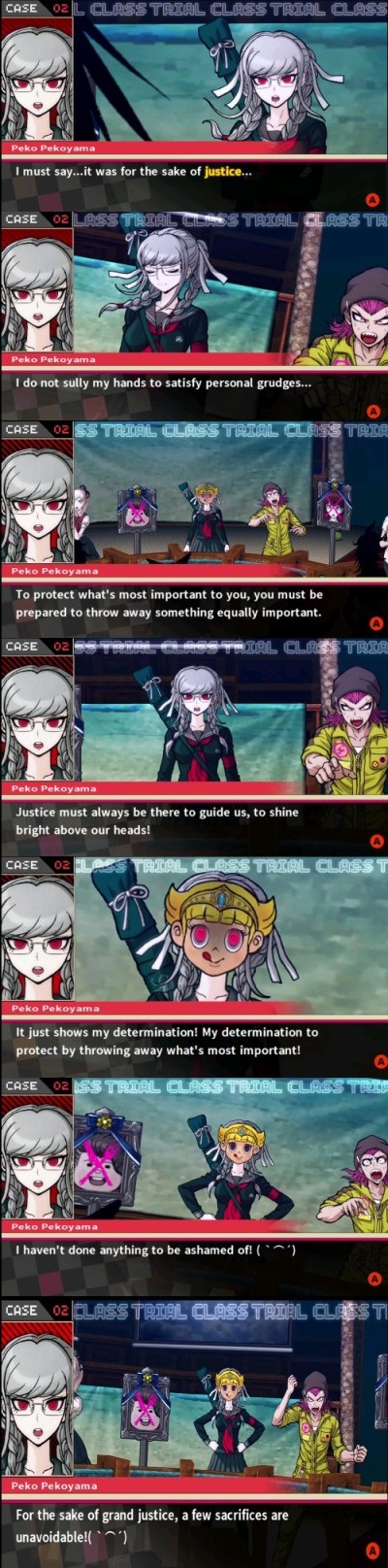
Even from her letters, and even from the way she used the performance to shield Fuyuhiko, from the way she was initially mild-mannered and helpful in the investigations and her reveal blindsiding everyone and yet them immediately voting from her, it's clear that Peko took a lesson from the first trial, and used the panicked atmosphere and her classmates myopic assumptions to her advantage.
Reactions toward Peko's presumed guilt:
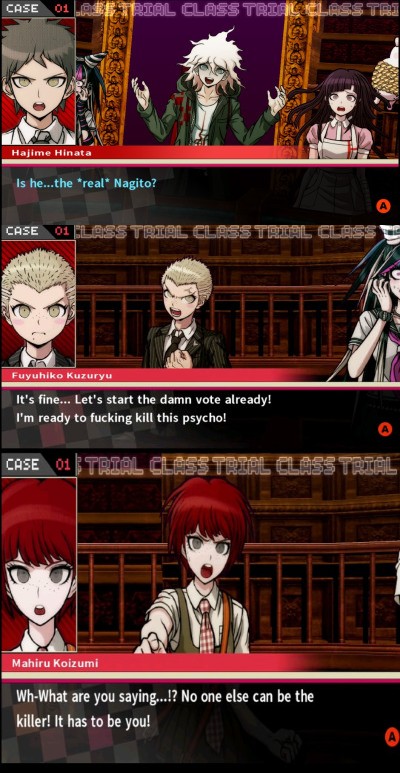
Reactions towards Komaeda's presumed guilt:
For this to make more sense, let's go back to the Komaeda segment of the 1st trial: First of all, a lot of what he said in the first trial and to Teruteru was also partly a performance. In both cases, that he was an unstable threat to be quelled. Though his wording was ambiguous and threatening, he never actually said he murdered or wanted to murder someone, he never actually lied about his intentions, he just obfuscated them to achieve them accordingly in both situations.
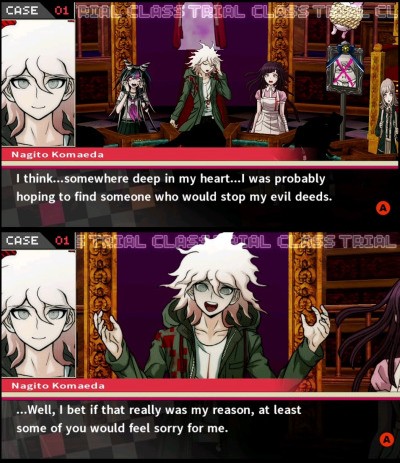
However, the damage had already been done: Even if the only, or at least main casualty he had calculated was himself, even if Teruteru did kill and afterwards take his offer for cover up, Komaeda's position was somehow more detested than if he was the culprit, or maybe precisely because he wasn't the culprit. He wasn't killer neither in execution... Neither really in intention. Semantics, semantics, but since the main separation between those two types of killers being the climax of the 2nd trial, I do feel somewhat justified in making that assertion.
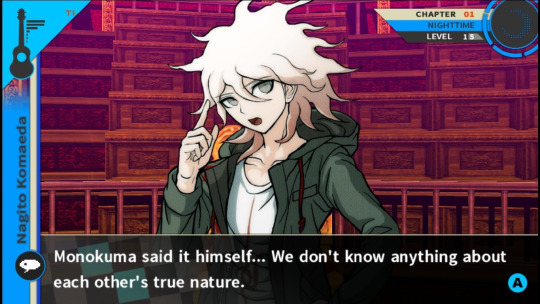
Although, there is a main difference between Hiyoko/Fuyuhiko/Peko and Komaeda, even if him and Fuyuhiko/Peko occupy a similar grey zone: Hiyoko/Fuyuhiko/Peko get humanised and 'redeemed' in the eyes of both the characters and players... While Komaeda does not.