
Haven
by retrorats
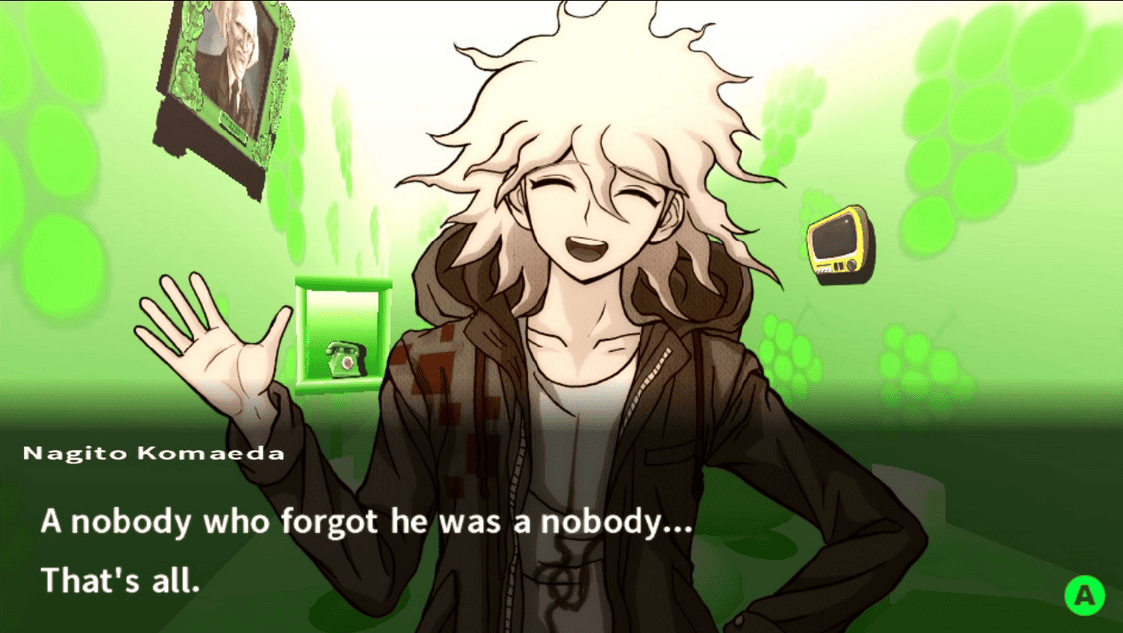
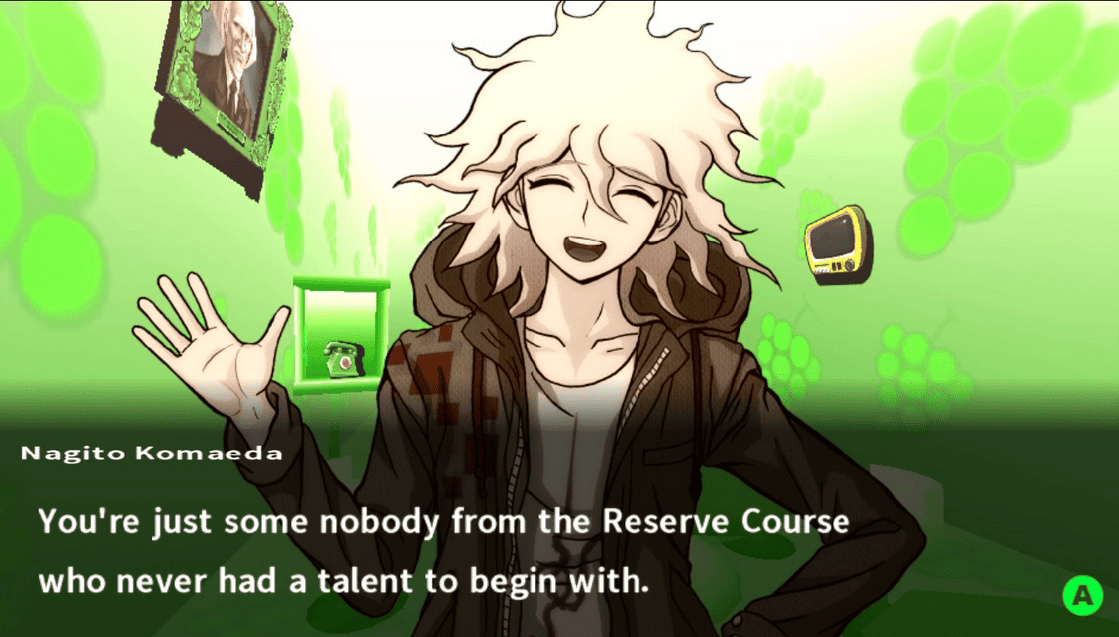

Some parts of these are very badly translated and affect how they are read. To start, they translated Komaeda to be way more cruel to Hinata than he is in the original. Komaeda never calls Hinata a nobody, and what he says is way less crude. These are the two dialogues that Komaeda says in japanese:
Komaeda never calls Hinata a nobody, and when Hinata says his dialogue, he also never says anything about being a nobody. This is what he says:
by retrorats
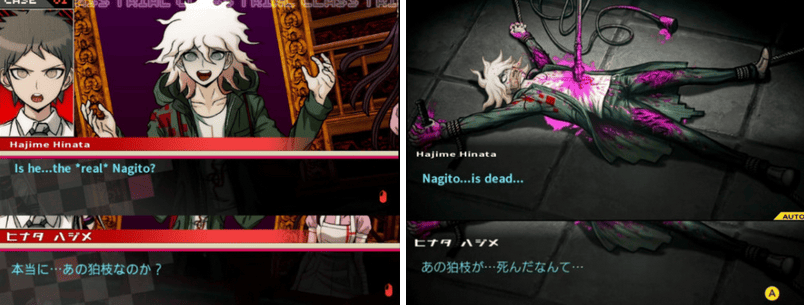
While I was checking how Hinata's reaction to Komaeda's death was in its original language, I noticed some interesting details in the wording Hinata uses when referring to Komaeda in that scene that seem to recall to mind his reaction to Komaeda's "reveal" in chapter one.
When the characters say their first reactions to Komaeda's corpse, Owari questions whether Komaeda is truly dead or not, and Hinata says in his mind in the localization, "That's right, it's Nagito..." It's not exactly a mistranslation, but it ignores that in the original version Hinata doesn't just say, "It's Komaeda"; he says, "It's that Komaeda." As some of you may know, one of the most interesting details of Hinata's reaction to Komaeda's breakdown in chapter one in the original language is how he starts referring to the Komaeda he knew before as "that Komaeda" (あの狛枝), and curiously, he starts to refer to the once-alive Komaeda the same way here.
An important clarification: I'm still learning Japanese, so I may make some mistakes. I try to research what I say as much as I can, but it's always possible I may say something that is wrong. Please don't take what I'm saying as the absolute truth.
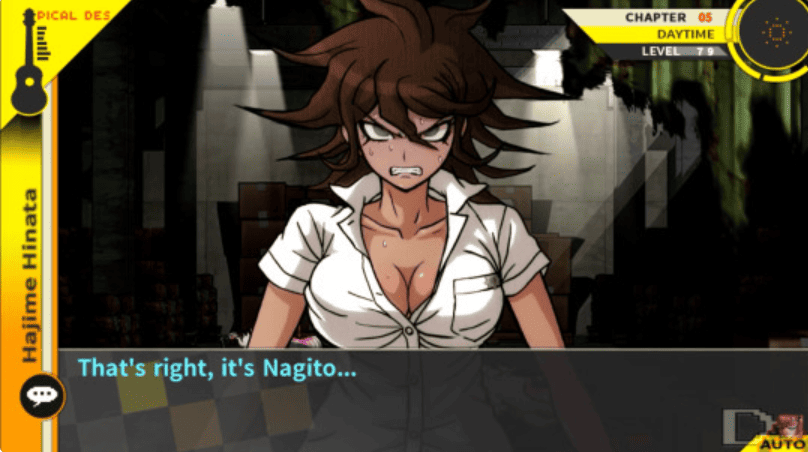
Hinata refers to Komaeda here as "that Komaeda" (あの狛枝).
But this is not the only time he refers to Komaeda as "that Komaeda" in his internal thoughts. After discovering Komaeda's body, he does that multiple times. The second time he does that is right after he says it the first time. In the localization it was translated as "He always messed with us, he always tried to confuse us...that's why..." In Japanese the line is as follows: [俺達を散々引っかき回して、いつも混乱させ続けてきたあの狛枝だからこそ・・・] While there are some differences apart from the omission of "that Komaeda," in general lines, the localization works well in transmitting the overall message. But for visualization purposes, a literal translation of the line would be something like:
"It's precisely because it'sthat Komaeda , who's always been stirring things up and keeping us in a constant state of confusion. That's why…"
When we see the original line, we will notice the "that Komaeda" Hinata is talking about here has a completely different meaning than the one he mentions in the first chapter. Originally, Hinata used that term to refer to the Komaeda he knew at the beginning: the one who helped him investigate, the one that was so kind. So it's curious how now that Komaeda is dead, he uses the phrase to refer to the opposite of what Hinata was talking about originally: the "malicious Komaeda.
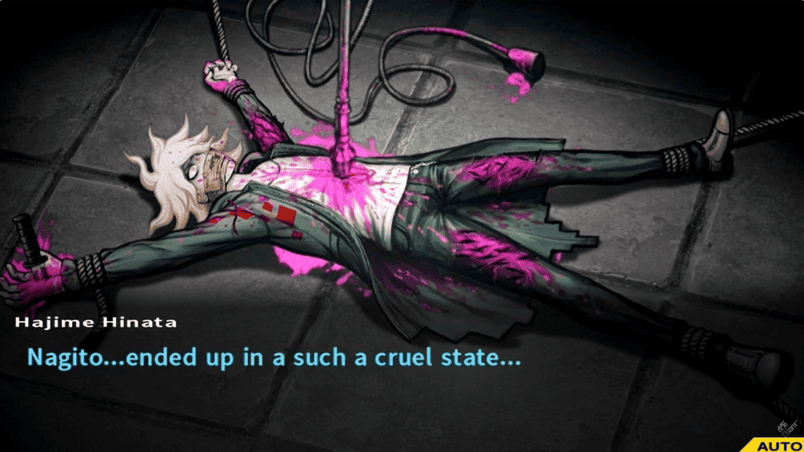
When Hinata says the dialogue depicted above in Japanese, he refers to Komaeda again as "that Komaeda," meaning that he can't believe that the Komaeda who confused them so much and caused so many problems got killed by someone, especially in such a horrible way. After this, in the localization, Hinata repeats something he said before: "Nagito...is dead..." A lot of people will be interested to know that in the original language, Hinata doesn't repeat word for word his first "Nagito...is dead..." line; in fact, the two lines are quite different. The first time Hinata remarks Komaeda is dead, he says: [ 狛枝が・・・死んだ……………………………]. This first line is characterized by not only having an ellipsis after Hinata says "Komaeda is" but also a very, very long one after he remarks "dead." This first line is characterized by a feeling of unbelief. It's the first time where the realization that Komaeda is dead dawns on Hinata, and he clearly seems to be in a complete state of negation.
The second time has a different feeling. Hinata says: [あの狛枝が・・・死んだなんて・・・ ]This time the sentence doesn't have as many ellipses, almost as if this time, Hinata is more sure of the fact that Komaeda is truly dead. Another big difference is that the sentence ends in [なんて] to remark emotion. But the biggest difference is that here, Hinata refers to Komaeda as "that Komaeda," something he didn't do the first time he remarked that Komaeda is dead. This time Hinata is not only remarking that Komaeda is dead with less doubt but also specifically remarking that it is "that Komaeda" who is dead.
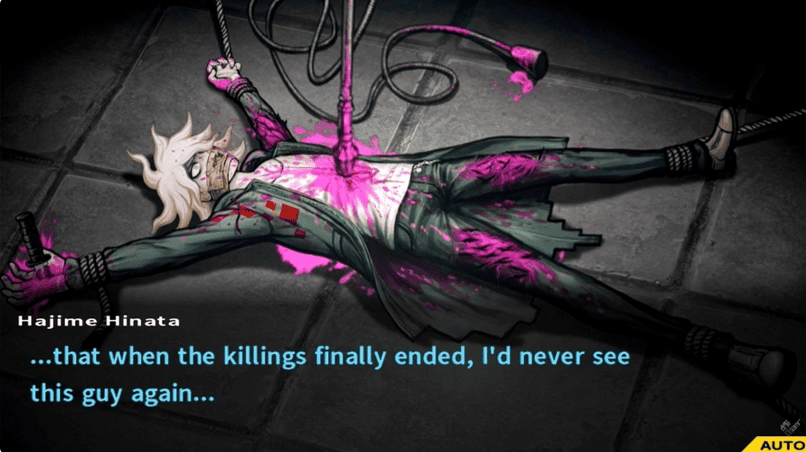
There is something very interesting in how the line above is worded in Japanese. Hinata says: [こいつがいなくなるのは,このふざけたコロシアイに終止符が打たれる時だと・・・] I'm not going to retranslate the line, but what you need to know is that here Hinata is referring to Komaeda as "koitsu" (こいつ), which is very curious considering Hinata referred to Komaeda just before this as "ano Komaeda." This is very interesting at a grammatical level because "ano komaeda" (あの狛枝), because of the demonstrative "ano," implies that the Komaeda Hinata is talking about is someone who is far away, but "koitsu," which he uses later when talking about him, implies that Hinata is talking about someone who is near him. It doesn't make sense to say the Komaeda Hinata is talking about is simultaneously near and far at the same time, so this means that Hinata has to be referring to two Komaedas: one that is near (the corpse) and another one who is far away (the Komaeda that once was alive).

If Hinata's use of "that Komaeda" wasn't enough to make the chapter 1 parallels clear. The fragmentation of Hinata's perception of Komaeda being separated into Koitsu (Komaeda) and Ano (Komaeda) also happens in chapter one when Hinata is questioning if the Komaeda who is acting like that (Koitsu) is truly the Komaeda he knew before (Ano Komaeda).
After all is said and done, what does all of this mean? Why is Hinata referring here to Komaeda as "that Komaeda" again? Why is Hinata shifting the meaning of "that Komaeda" to mean the Komaeda who tormented them when that term was originally used to describe the kind Komaeda Hinata knew in the first chapter? I think Hinata's feelings here are very complex and have a lot of different reasons and interpretations.
I think one of the main reasons Hinata starts referring to the "malicious" Komaeda as "that Komaeda" and consequently abandoning completely the idea that a "kind Komaeda" once existed fits the plot point of how in chapter 5 Hinata gets completely disappointed in him. While I don't think Hinata ever completely lost the love he felt towards Komaeda, it is also true that in chapter 5 the resentment and anger Hinata had towards Komaeda multiplied. It is fitting that in a chapter where Hinata becomes completely disillusioned with Komaeda and starts referring to him as "malicious" to the point he demonizes the person he was to an almost cartoonish degree, Hinata rebrands a concept that was used to refer to the Komaeda he held in high regard and uses it to refer to the Komaeda he feels conflicted about.
But while what I described definitely is one of the main reasons why Hinata uses that wording, I believe there are also other reasons. I think Hinata also starts referring to Komaeda as "that Komaeda" after his death because of the unbelievability and negation Hinata feels about the fact that he has died. Hinata separates the Komaeda that tormented them (that Komaeda) from the dead Komaeda (koitsu) because he is unable to process that someone like Komaeda, who was so troublesome and also someone he loved, was murdered. The negation shaping Hinata's dialogue is even more accentuated when we remember that even the first iteration of "that Komaeda" is already based on disbelief. Hinata separated the Komaeda he was seeing from the Komaeda that was kind becausehe is unable to accept the reality that they are the same person.
Last but not least, I think that while Hinata mainly uses "that Komaeda" here to refer to the Komaeda he would later call "malicious," I don't think it is incorrect to say "that Komaeda" also refers here to the same Komaeda Hinata talked about in the first chapter, at least to a certain extent. When Hinata says, "That Komaeda... is dead" He isn't just expressing surprise about how the troublesome, problematic Komaeda was able to be killed by someone. When the reader sees Hinata use "that Komaeda," while it may be used here to refer to the opposite of what it meant in the beginning, it still evokes the image of what it was originally used for: the Komaeda Hinata knew. Hinata may be talking about the "malicious Komaeda," but the association that term has in the reader remains intact. When Hinata says "that Komaeda is dead," the reader's first association will not be that the "malicious Komaeda" is dead: it will be that Hinata is talking about how the Komaeda he once thought he knew is too. Hinata may shift the meaning of "that Komaeda" in chapter five, but the association the reader has with the term reveals to us another underlying implication of Hinata's painful remark about the death of that Komaeda: it's not just the "malicious Komaeda" who has died; the kind, helpful Komaeda that Hinata loved so much also did.
by retrorats
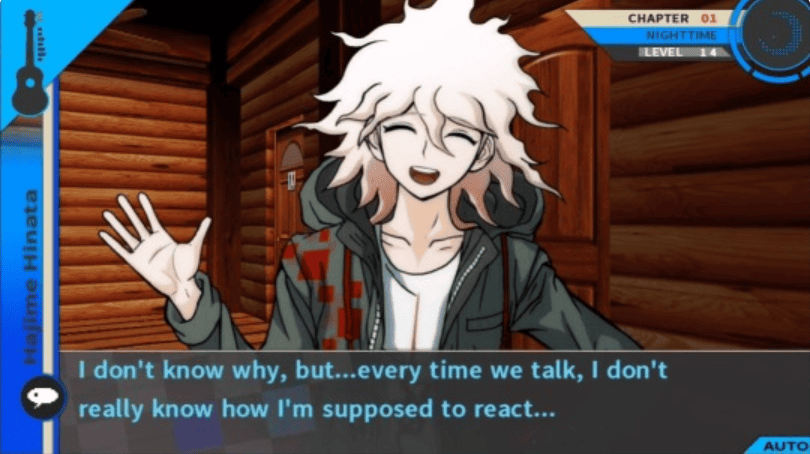
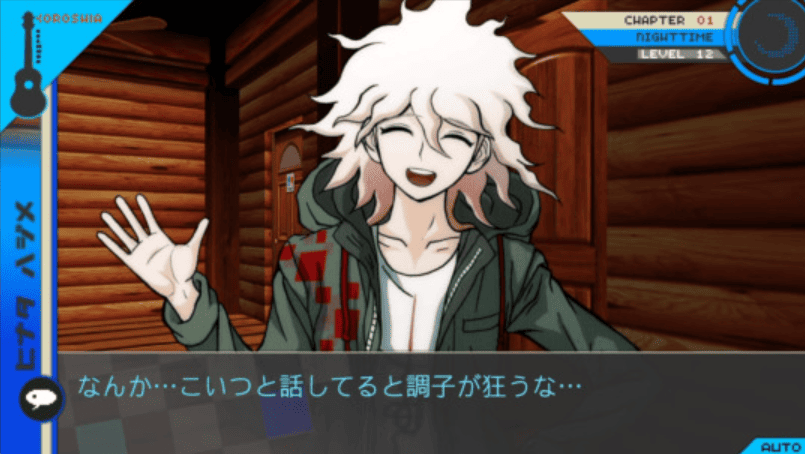
I remember that some time ago, there was a discussion about whether this line Hinata says here has romantic connotations or not. The confusion seems to stem from the fact that the line is very vague in itself, and while the line is used with a romantic connotation in some Japanese forums, even the information those forums give is very confusing. It's hard to understand if the phrase is really used commonly on that way or not since there is not a lot of information online.
I don't remember how the discussion ended, and maybe I'm saying something everybody already knows. But In any case, I want to talk a little about this line, and also share a dialogue that I found with that expression being used in a romantic sense. I found this dialogue more reliable to confirm that this expression can be used in that way than the forum entries.
To start, as you can see in the screenshot, this is the line in Japanese: [なんか・・・こいつと話してると調子が狂うな・・・ ] let's break it down:
なんか(nanka)・・・ = somehow/for some reason
こいつ(koitsu) = that guy/this person (very informal and sometimes rude, but that's how Hinata speaks, so it's not meant to be rude, I think)
と(to) = particle, used in this case to indicate "together with."
話し(hanashi) = talking.
てる(teru) = indicating that the action is ongoing or continuous.
と(to) = particle, explained before.
調子が狂う(choushi ga kuruu) = this is the phrase that generates the confusion. This is how it is defined:
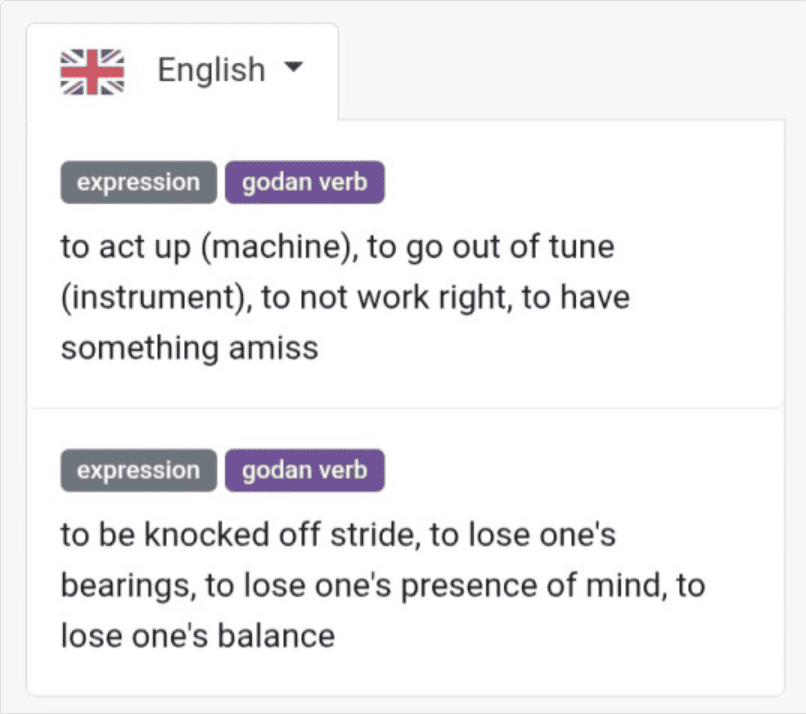
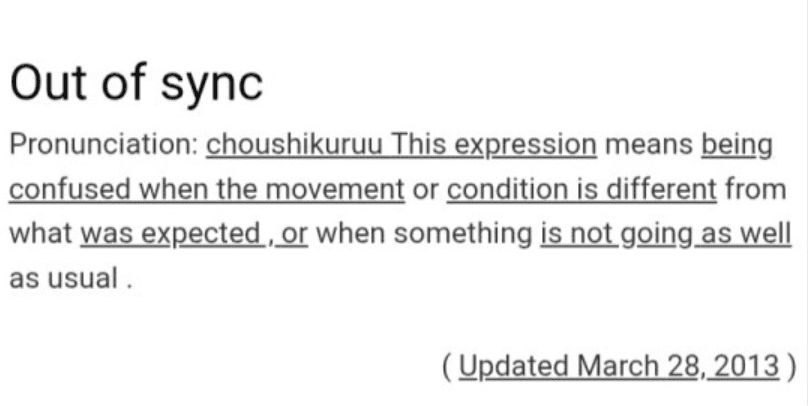
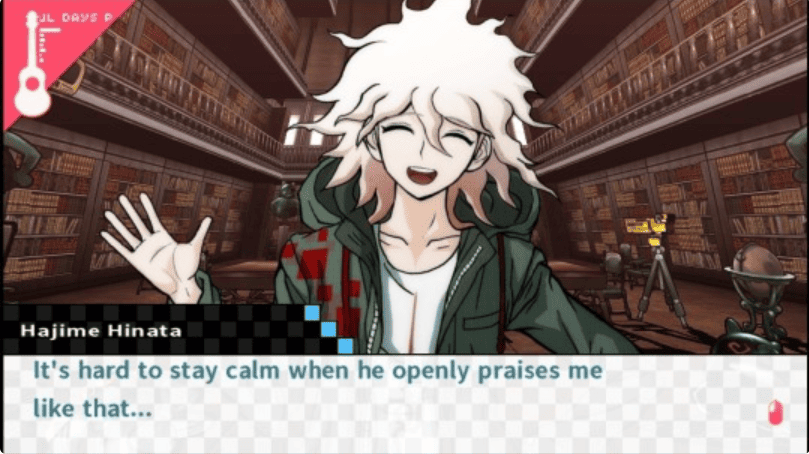
The phrase can be used in a lot of different situations, so it's hard to know exactly in what sense is being used here. I would argue, like the first post that talked about this line, that the use in here has a romantic connotation since it's being used by Hinata after being praised by Komaeda. But I also can not completely discard that this wasn't used with some kind of negative connotations here. It may be possible Hinata saying this was a way to “foreshadow” that something was “off” with Komaeda, but it doesn't really convince me. Hinata says so after being praised, and when he was praised by Komaeda in island mode, he said something that was kind of similar:
It's also worth to note, that Hinata says he feels that way every time he talks to Komaeda. And if he meant that negatively, it would be contradictory towards the other pieces of dialogue that imply that Hinata feels calm around Komaeda and enjoys his company.
な(na) = Sentence ending particle, used to soften the sentence a bit. It's a more masculine/rough version of ね(ne).
So the English translation would be something like: “For some reason… always that I talk with this guy, I get thrown off balance”
As I mentioned earlier, I found out something that assured me that this phrase could have romantic connotations. It was this dialogue from the gameAngelique trois (2000) where one of the characters, Zephel, uses the same phrase Hinata used, but with some grammatical differences. Let's look at it:
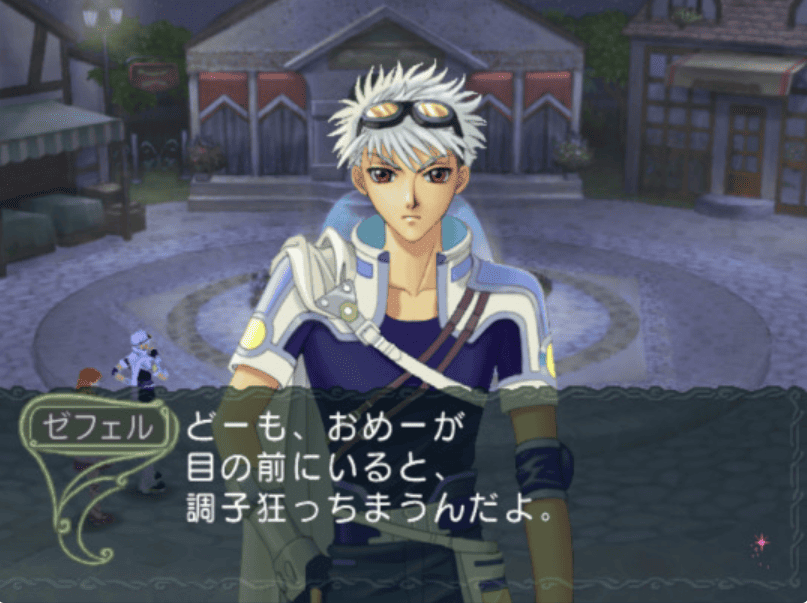
“Somehow, when you're right in front of me, it messes with my head.”
The phrase Zephel uses here (調子狂っちまう) is the same as Hinata's, just with some differences in the level of formality (Zephel is much more informal) and also Zephel adds “shimau” As a way to signal he acted in the way he did unintentionally. The context of this is 100% romantic. This dialogue happens in one of the more advanced love events in Zephel's route, and not only this dialogue but all the other things Zephel does and say indicate that he is in love with the protagonist, Collett.
Obviously, having an example of the phrase being used in a romantic context doesn't indicate that Hinata said so in that way, but it does give us a reliable precedent to say that it is a possibility. It's good having a precedent like this since the forum entries that were usually used when discussing this weren't very clear, and even the people commenting weren't sure if the phrase meant something romantic or not. But in this case, we know that this character was definitely saying it in that way.
by retrorats

I remember a long time ago I saw a post (that I sadly cannot find again to credit the person) talking about how this line of dialogue, specifically the part of "the guy you hate" is talking about Komaeda and referencing specifically the relationship between Komaeda and Hinata. I really don't know what to think about this. If I'm honest, there's not enough evidence to say this is about Komaeda, but also not enough to say this isn't about him. But, I do really like to entertain the idea, even if I find it may be unlikely, so here are some various thoughts I have regarding this line of dialogue:
《大好きな彼女は動かないまま衰えていって、 大嫌いな彼も動かないままやせ細っていって…》
Daisukina kanojo wa ugokanai mama otoroete itte, daikiraina kare mo ugokanai mama yasehosotte itte…
My English translation (remember that I'm not fluent or a professional, so take this with a grain of salt):
"The girl you really love remains still and keeps getting weaker. The guy you really hate also remains still and keeps getting skinnier. "
As we can see, there are a few differences between the two versions. The Japanese version makes more clear the comparison between the man and a woman by making two different sentences that are very structurally similar, if not almost identical. They are also paralled by making the feelings associated with these characters both have the word dai [大] that means big, that in this context is used to indicate that they really love/hate that person.
But by far, the most interesting part of the original version, is that the things that are happening to each person are different. Yes, they are both immobilized, but the girl is getting weaker, and the guy is getting skinnier. The sentences are so similar that this being one of the only differences seems honestly very curious, and it almost feels like the text really wanted the reader to notice that detail. I'm aware I'm probably reaching, but it makes sense the emphasis on getting weaker and getting skinnier if we assume Junko is talking about Pekoyama and Komaeda, respectively. It makes sense that she points out that Pekoyama is getting weaker since she is a very strong person, and it makes sense that she points out that Komaeda is getting skinnier since he already is quite skinny due to his poor health.
I'm not that convinced of this theory, but it is quite entertaining to think about, so I wanted to share my thoughts about it. I'm very curious about what you guys think. Do you think this is about Komaeda? If not, then who is it about? Or do you think Junko is not talking about anyone in particular? We have very little evidence to work with, and the answers could be many!