
Haven
by retrorats

Replaying SDR2 after two years, one in which I was almost completely disconnected from the game, has made me feel a complicated variety of emotions. On one hand, I feel like I fell in love again with the game and the characters again and confirmed it is a story that is more thematically complex and well-written than people give it credit for, but on the other, I also realized it is a story that has a fatal flaw that almost completely ruins it.
SDR2's first five chapters are overall great, not perfect, but still good in general lines. Some people hate chapter 3 and believe it is the worst chapter, but I really disagree. I do think chapter 3's murder mystery is not really that great, but chapter 3 contributes so much to the themes of love that I find myself ignoring that. After all, I think in SDR2 it is more important that the chapters contribute to the themes than have an extremely good murder mystery. Even if chapter 3 has a lot of mistakes, I find that it's always better than the disaster the ending of SDR2 is for me. It may be a very crappy mystery, but at least it isn't contradicting any themes of the story.
When a lot of people examine SDR2 thematically, they usually explain the story as being about how people that have done unforgivable things in the past can still, with determination, choose a different future: that is, changing and becoming better people. Don't get me wrong, that is a very important part of the story, but I find that it's a little reductionist to say that is the only thing SDR2 is about. SDR2 also explores self-forgiveness, self-love, oppression, and dynamics of power, a criticism of the education system, belief in other people, and interpersonal relationships.
To be honest, I don't even think that the thematical core of the story is even clearing a path for your own future. For me, SDR2 is first and foremost a story about love. In SDR2, love is what ties all the story together. It's love that makes the character be saved from their fates over and over again. Love is what heals people; it is what makes the characters be able to clear a path for their future, because love is survival. But even if this is mainly what the story is saying about love, I still find describing what SDR2 wants to say about it as "love is survival" a little reductionist in general terms. SDR2's message about love is a little more complicated than simply "love is healing."
If we pay attention to how SDR2 portrays love in its characters, we will notice right away that a lot of the characters who are intrinsically related to the concept have a messed-up perception of what love is supposed to be (Pekoyama, Tsumiki, and Komaeda). Usually, for these characters, love is inherently related to the dehumanization and instrumentalization of the self. Komaeda believes love is to serve hope and talent, Tsumiki believes love is to serve despair, and Pekoyama believes the only right way to love Kuzuryu is by being a tool for him. In SDR2 there is a constant theme of how love is instrumentalized, how love is changed to mean to serve something, but more than anything, love is warped to serve talent. SDR2 constantly compares the warped version of love with the right version of love. It's true love the one that is supposed to be healing; it's what saves, but a warped version of it cannot do so.
I find that the first five chapters of SDR2 are very thematically interesting in this regard, while the ending is very conservative and abandons any of the revolutionary and subversive themes the story wanted to approach in the beginning. All of the themes about how love can be corrupted and instrumentalized by society are abandoned for the milquetoast resolution of "love is healing" and "love is power," and that's okay, don't get me wrong, but this story clearly wanted to say more things about love than simply that, and it's sad how it abandons the most revolutionary parts of its story for a more conservative and acceptable ending. It could even be argued that while in the beginning the story denounces the instrumentalization of love, at the end it even rejoices in the instrumentalization of it.
A lot of things can be said about love and Nanami in SDR2, but something I really notice about it is how Nanami, and by consequence her love for her friends, is constantly instrumentalized by the story. She is supposed to suffer and die for them, and even after her death, she is supposed to resolve Hinata's issues. She dies unexpressive and calm because her pain is not hers. Not even the violence she suffers belongs to her: it's Hinata's, it's the readers'. She is constantly instrumentalized with the excuse of her nature: she is an IA, she is not a real human. But regardless of what she is, it doesn't change that she represents a woman, and the way the story treats her is a direct reflection of how stories treat their female characters. It's no coincidence that the character who is made to suffer for the rest, whose personal pain is constantly erased, who is presented as completely perfect, even inhumanly so, is a woman.
In a certain way, the way the story abandons its most revolutionary themes for a more conservative resolution can be seen in the way the story completely abandons the plotline of the relationship of Komaeda and Hinata, and by consequence, Komaeda's character as a whole. In the first five chapters, the relationship of Komaeda and Hinata, and by consequence Komaeda, plays a central role in the story. Most of the plotlines of those chapters revolve around the two of them, especially Komaeda, and the themes of the story, especially love, talent, and belief in others, are intrinsically related to them. One could even argue that for most of its run time SDR2 is the story of Komaeda and Hinata. That's why when chapter 6 completely forgets about that relationship and about Komaeda as a character and instead pretends Nanami and Hinata are the true narrative core of the story, it feels extremely weird and unnatural. Hinata and Komaeda's relationship is completely abandoned by the end, and even some of the themes their relationship was supposed to explore, like the messed-up perception of an instrumental love vs. a personal love that is inherently healing and subversive, are abandoned by the story. I cannot help but wonder then if Hinata and Nanami are the main relationship, then why not spend all the time they put into Komaeda and Hinata on them? Why put so much time into a relationship you are simply going to discard at the end? It's such an obvious writing flaw I'm surprised none of the writers decided to fix it. It makes the story feel way too incoherent.
Nanami and Hinata's relationship is written in such a mediocre way that I'm honestly surprised how bad it was revisiting it. I honestly thought I was exaggerating two years ago with how badly written I thought it was, but honestly I wasn't. It really is that bad. They barely have important interactions between them, and when they have one, those interactions add absolutely nothing to their relationship. The relationship of Nanami and Hinata in SDR2 is characterized by having no conflict and no complexities. There's absolutely nothing going on between them. They are just good friends, and the story doesn't even spend time developing that friendship or Hinata's romantic interest in her. The story decides after chapter 2 that the reader knows Hinata's main partner is Nanami and that he is in love with her and stops developing it in any meaningful way until the climax of the story comes around. SDR2 is mortifyingly scared of giving any sort of minimal conflict or complexity to them.
I feel this is because SDR2 wants to portray their relationship as perfect. That's why they have no conflicts and no complexities, because what do they have to feel conflicted about if they are perfect? But instead of feeling perfect, they feel shallow. They feel like they have absolutely nothing going on. I'm not someone who thinks there are absolute rules in writing fiction, but I think for most works and their relationships, there needs to be conflict for the relationship to feel alive. There may be a work where a perfect relationship makes sense and is well written, but I don't think that was done well here or that it suits the kind of story Danganronpa is supposed to be. In most cases conflict, even a minimal one, is absolutely necessary to write a compelling relationship.
SDR2's fatal flaw is how in the ending it puts all of its themes and the resolution of its story in a relationship that was neither properly developed nor written, and because that relationship doesn't work, the messages of the story also don't. The importance the story gives to it in the ending almost completely ruins the story and what it wants to say. It gives to what was supposed to be a subversive story a conservative ending where perfect and normal heterosexual love is what saves the day, while queer love is buried and killed, figuratively and literally, along with the character that symbolized it.
by retrorats
Something that I noticed on my most recent SDR2 playthrough and that I haven't seen a lot of people bring up is that there's a lot of interactions between Nanami and Hinata that seem to be suspiciously similar to interactions between Komaeda and Hinata and seem to make a parallel between both relationships and to the role both Nanami and Komaeda have in their relationship with Hinata.
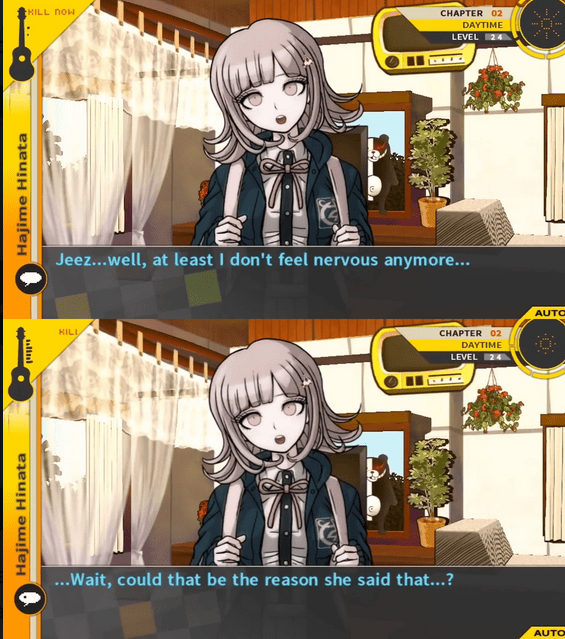
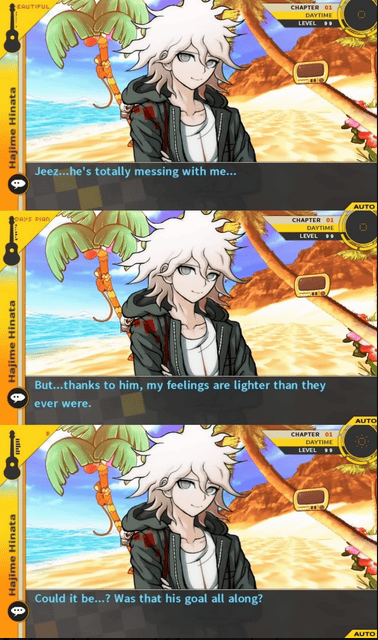
The earliest example of this parallels can be found in the Chapter 2 investigation when Nanami and Hinata are investigating Koizumi's cottage, here an interesting interaction between Nanami and Hinata can be found: Hinata is very nervous and depressed during the investigation and Nanami to cheer him up makes a joke about looking for dirty books. This scene has a lot of resemblance to the interactions that Komaeda and Hinata had during the prologue and in chapter 1, in which Komaeda made jokes (often of a similar style of the one Nanami did) to ease Hinata's mood. While it seems like a stretch, what really convinced me of it possibly being a parallel is how the structure of both interactions is suspiciously similar, in both these of interactions Hinata recognizes that the jokes that both of them made make him feel less nervous and then he wonders that if perhaps that actually was their intention.
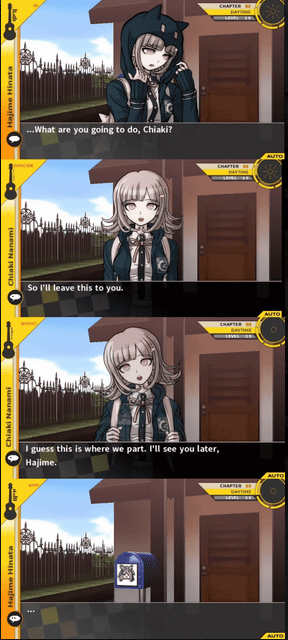
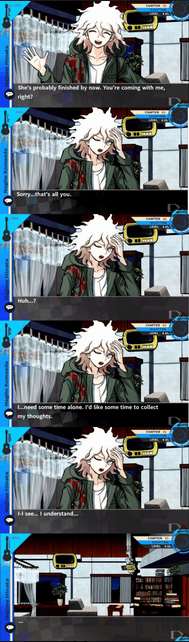
Other scene that happens with Nanami and Hinata that has a resemblance with interactions that Komaeda and Hinata had prior, is when Hinata asks Nanami if she's going to follow him and Komaeda to the beach house, Nanami answers that she isn't, she leaves and Hinata feels disappointed. This scene has a certain resemblance to a scene on chapter 1 on where Hinata asks if Komaeda is going to follow him back to the old building. Like in the other example I gave both of this scenes are structured on a very similar manner, Hinata asks if they are going to keep working with him, they say that they are going to do something else and Hinata answers with only silence indicating disappointment because he couldn't keep working with them.
While I understand that a lot of people will just classify all of this similarities as coincidences, the reason why I feel that they were put there on purpose is because it makes sense that those parallels are there because they seem to complement the narrative. The Chapter 2 of danganronpa 2 is one where the roles that we were presented in chapter 1 shift, it's a chapter where the character that we believed was going to be our investigation partner changes. Because Komaeda's role in chapter 1 gets replaced by other character it makes sense that there exist comparison between these two relationships because it helps to stablish Nanami as the new companion to the reader, as well to add more complexity to the narrative.
But even if the scenes in Chapter 2 could be justified by being pure coincidence, something that convinced me completely that this was most likely intended is a certain interaction that happens between Nanami and Hinata in chapter 4 when we make the transition from Komaeda's point of view.
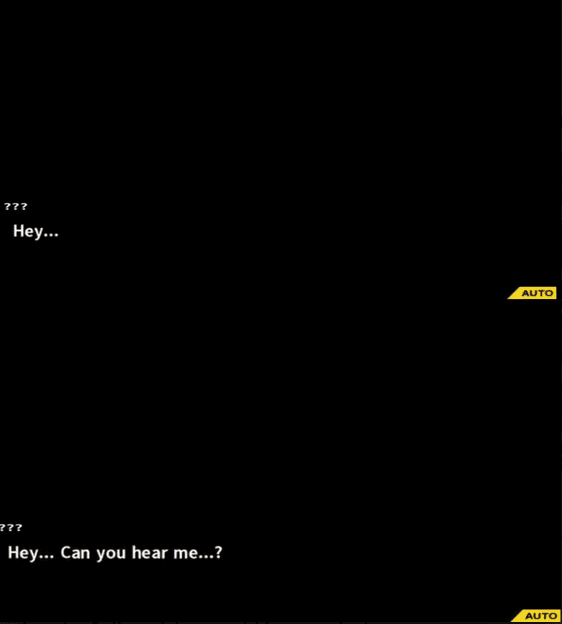
Does this dialogue seem familiar? That's probably because it is the exact same thing Komaeda tells Hinata when they first meet and is the first thing you hear on the game.
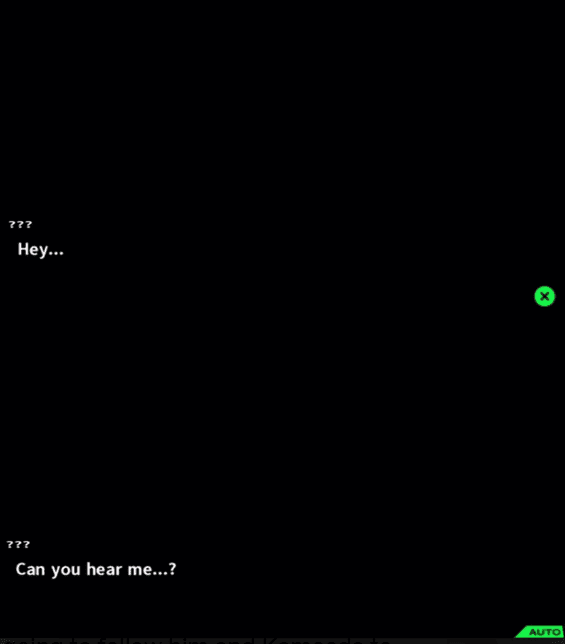
You could maybe argue that it's just a coincidence that happened and that it doesn't mean much, but just looks at what Kuzuryu says even when having the same role:
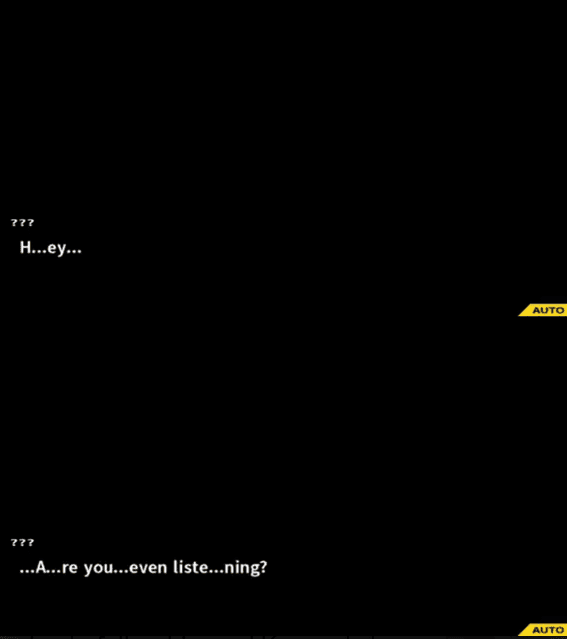
The way Kuzuryu says this is completely different from the prior examples and while this could be easily justified with the fact that he has a different way of speaking than both Nanami and Komaeda, what definitely convinced me that the dialogue was made purposely as different as possible from the other dialogues to highlight their similarities is the general way it's written. The addition of the ellipsis in all of the sentences feels extremely weird and unnatural, It seems to definitely have been made with a very clear intention on mind and not something that was added without much thought.
To finish this, I want to add the parallels that I noticed in chapter 5. I find that in this chapter is when it's more clear how much Nanami and Komaeda parallel each other in the role they take not only in the relationship they have with Hinata but in the story as a whole.
The role they take in Chapter 5 seems to have been purposely made to be two completely opposite forces, Komaeda sacrifices his life to kill the rest of the cast except the traitor and Nanami, the traitor, also sacrifices her life but for saving the same people Komaeda wanted to kill. The theme of the belief also seems to be paralleled between the two relationships. While this theme in general is relevant for trial 5 and not only for Komaeda and Nanami, I found it interesting how both of them had the concept of belief deeply attached to their characters in this chapter, specially in correlation of Hinata's belief on them.
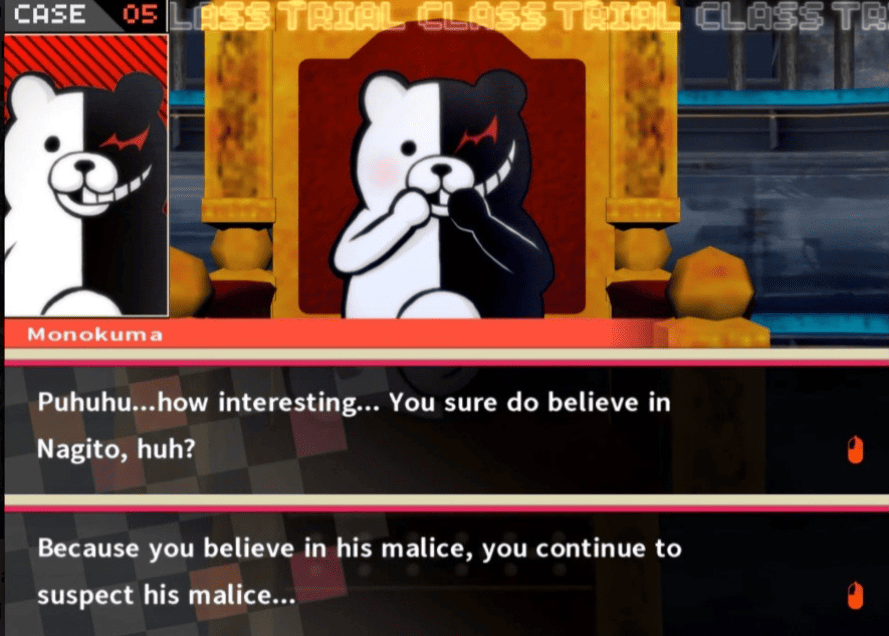

While probably there are more things out there in the text that could be used to justify this interpretation, I think these ones make well the job of explaining why I think this may have been intentional.
Since I first noticed these parallels, I have been thinking about what they could possibly mean, and while I do have an opinion about the possible meaning, I prefer to not tell it in this post since is not really a positive interpretation and it may be have been made because of my biases. That's why I prefer to leave this post as only a collection of all these possible parallels and give my opinion on their meaning in a moment where I'm more certain about it.