
Haven
by despairsyndromeworld
Per my last posts, in which I compared the 1st and 2nd trials as antithetical in regards to their use of love as a redemptive force. In this post, I aim to something similar, except moreso between the 1st and 3rd trial, and a comparative analysis for their respective "antagonists", Komaeda and Tsumiki.
There is both an initial symmetry with how each "antagonist's" unmasking plays out, but also a contrast.
Komaeda's was partly willing, because it was planned, but noone really came to his defense after the fact. We see Hinata's conflicted monologue, but that's really it. Even when it was revealed that Komaeda didn't commit the murder and his only intention was his own victimhood, what has been done cannot be undone. It comes across as a great betrayal to the player as well; Komaeda was basically our walkthrough character. He introduced us to the Ultimates and helped us investigate the murder. It is in that usefulness that the "betrayal" takes its toll: if not only can he investigate the crime scene he took part in but also almost mislead us in the voting, how can we really trust him again to such an extent? From all trials since, the main insult aimed towards Komaeda is of him as a "confusing" force.
Meanwhile, Tsumiki ardently denies her guilt to the very end, using her innocence and clumsiness as a shield, and she's not alone in this endeavour. Multiple people come to her defense, with a special standout being Akane, precisely because Tsumiki was the one that took care of her during her Disease. Even Hajime doubts himself and backs off, untill Nanami encourages him. Inversely, it's Komaeda, though another one of Tsumiki's patients, that pressures her and more easily accepts and promotes the possibility of her being the killer, with emphasis on her capabilities as a nurse.
When it comes to Tsumiki, its not only that people don't want to get rid of her just because she's innocent or soft spoken, though that is the main point of defense used, but because her talent makes her incredibly useful in the investigation and trials, in conjunction with the competency in which she undertakes it. Her mannerisms also help in easily extracting information from her and making her cooperate.
The cast moreso don't want to believe that the 'useful' person they trusted was a bad guy, but the 'useless' person that seemed to obstruct them ended up being the good guy. Or more like, they didn't want to lose the former due to the latter; its cognitive dissonance at its finest. (Un) fortunately for them, it is the overlooking of how such a person can manipulate vital information that leads to the trial's stagnation, untill Komaeda is the one to bring forth the rope as the decisive piece of evidence.
When Tsumiki gets backed into a corner, her main defense is a plead to forgiveness. Even if she did do x,y,z it doesn't matter, because it was a mistake, because she was clumsy, because she didn't mean it that way, because it wasn't the crime itself. Some of the things she says during her trial are very interesting:
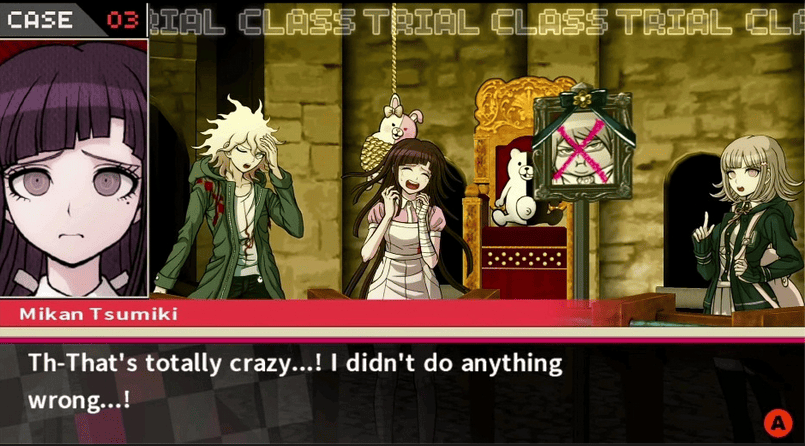
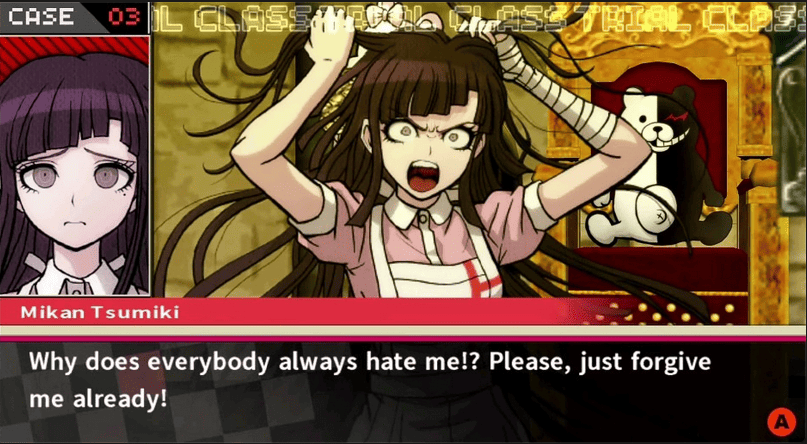
These pleas for forgiveness, for everyone to stop bothering her anymore, that this is all long done and that everyone should move on already... Doesn't that sound like it could be applied to another character too?
Tsumiki is verbalising some emotion during her breakdown that could also apply to Komaeda, especially the begging for forgiveness to a crime that she (claims) she didn't commit.
At this point, multiple weeks have passed since Komaedas "betrayal" and the only improvement in his situation is that he isn't still tied up in the old building or that his classmates didn't let him die during the Despair Disease. Even if he's the one that's spearheading this trial and helped highlight Tsumiki as a suspect, he's still treated with the utmost of suspicion, even on his deathbed.
Except Komaeda himself never asked for forgiveness. His moral compass, in contrast to Tsumiki, never revolved around interpersonal acceptance. Both his strength and major flaw, in the eyes of his classmates at least, is that he never cared about forgiveness on an individual level more than doing what he deems as 'the right thing', untill things get actually personal.
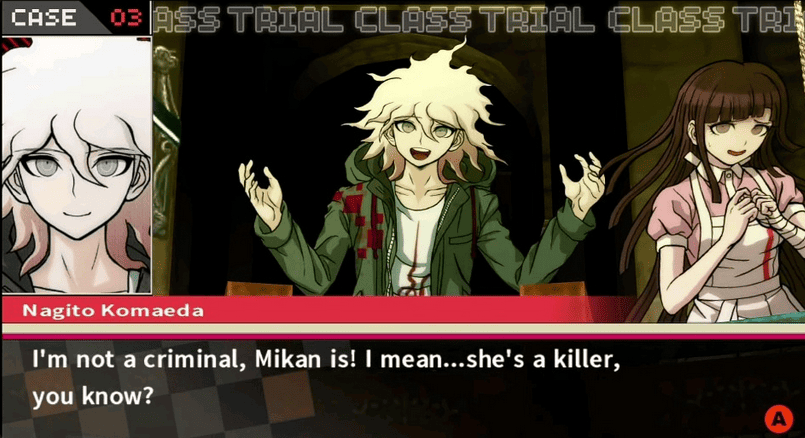
He never demanded anyone's forgiveness, not even Hinata's, even after the tying up incident; at every opportunity, he either helped move the case along or tried to further explain his reasoning. Most of the critical things he says about Tsumiki during the trial never pass the realm of the personal, it's always about her giving into despair. But what does that even mean in this case?
So, why did Tsumiki even commit the murders? She elaborates:
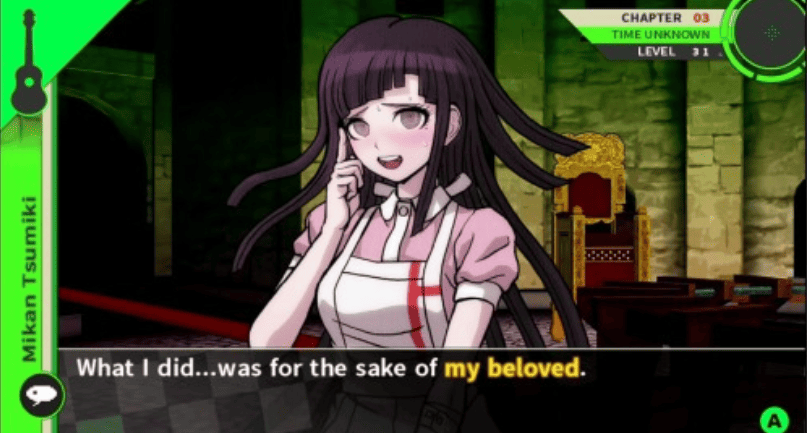
Even if the thing that made her "awaken" and commit the murders was despair, she explains that it was only because it was that emotion that connected her to her "beloved". The true reason was love itself.
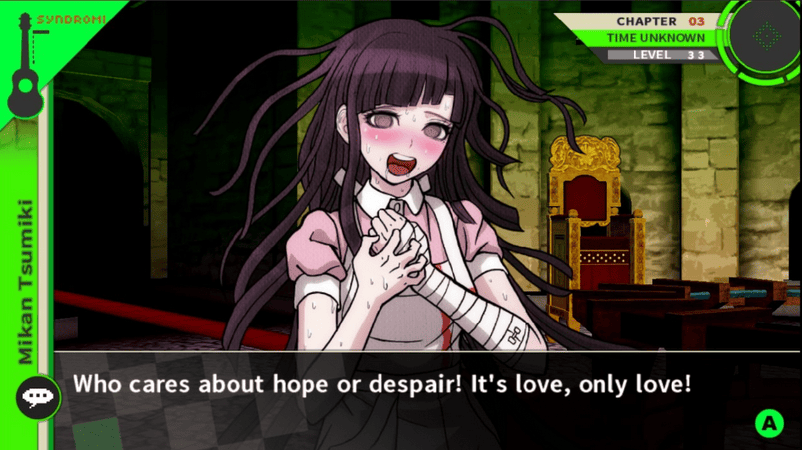
There is an interesting contrast between her and Komaeda here: while Komaeda positions his love for the Ultimates and hope as pure and selfless due to its unrequited element, Tsumiki's love is 'selfish' due to it being requited.
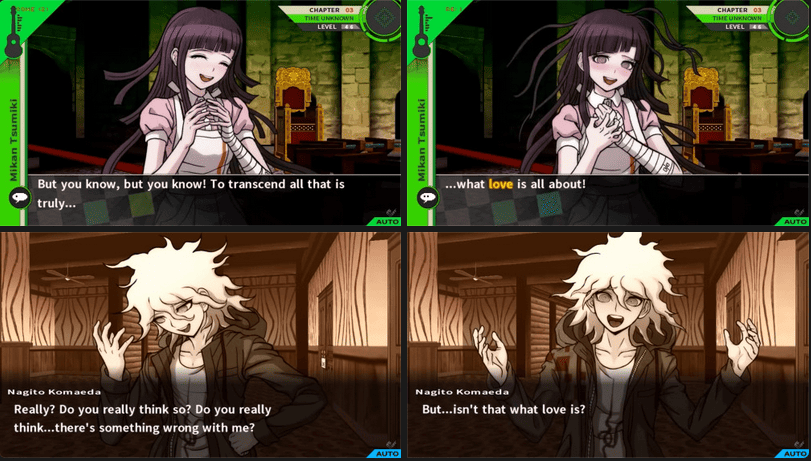
Tsumiki herself explain was that the reason she committed the murders was to uphold her own side of the deal, to show her own reciprocation.
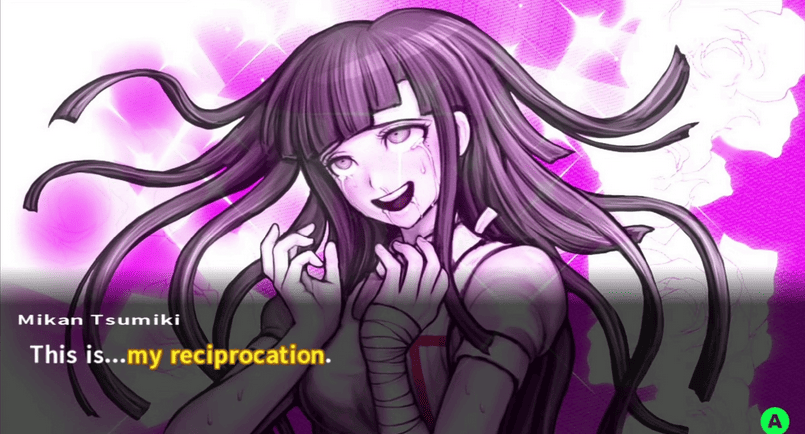
Obviously, this type of thinking is completely antithetical to Komaeda's. When it comes to 'hope' and 'despair' in this trial, Komaeda's main goal is to forgo the things that don't bear meaning. Komaeda himself at one point outlines the difference between despair and the "lesser" hope; despair is merely an obstacle to the true hope, while lesser hope directly leads to it. So, seeing Tsumiki's motivation as meaningless, it is an obstacle; therefore, to him, it is despair.
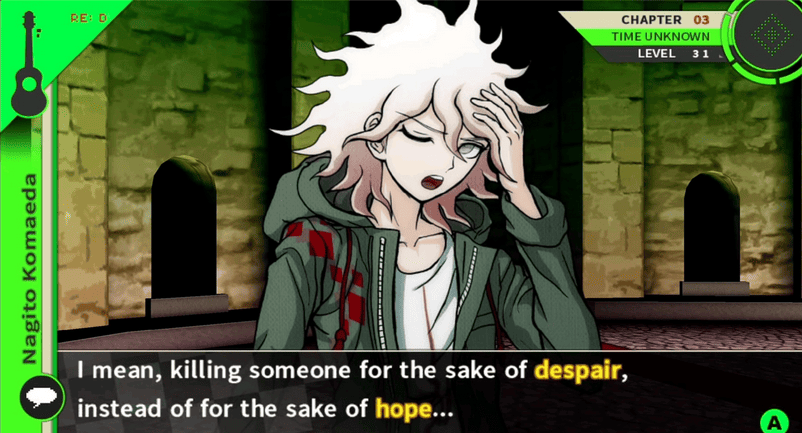
There are similarities to how both of them talk about their love, especially accentuated by "the bottom of my heart" comment:
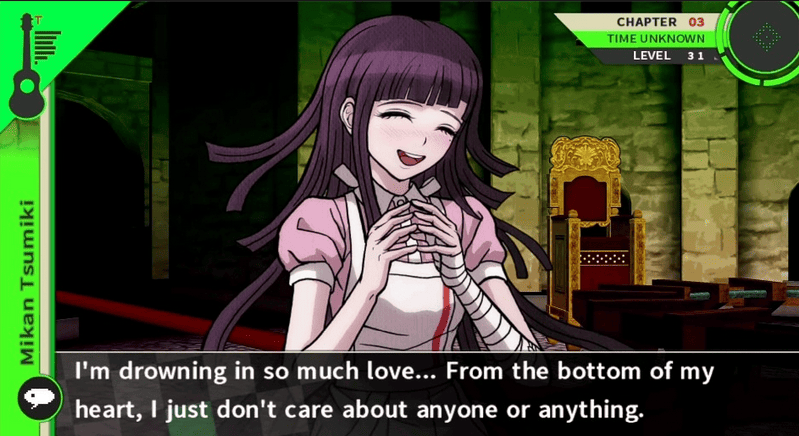
However, the main difference is still the one that was underlined in the previous trial. Komaeda continues to assert thematically speaking of Tsumiki's love being for despair, in the same way that his is for hope. But Tsumiki's is still interpersonal. She marks her success by her beloved's acceptance, and her murders become only an extension to her love. In a way, she doesn't need the rest of the cast's forgiveness anymore, but she doesn't trade it out for a completely faceless concept. This is also seen by Komaeda's failure in the interpersonal department; even while he's on the brink of death at the hospital or even when he extinguishes despair in the face of Tsumiki, she still gets the last laugh:
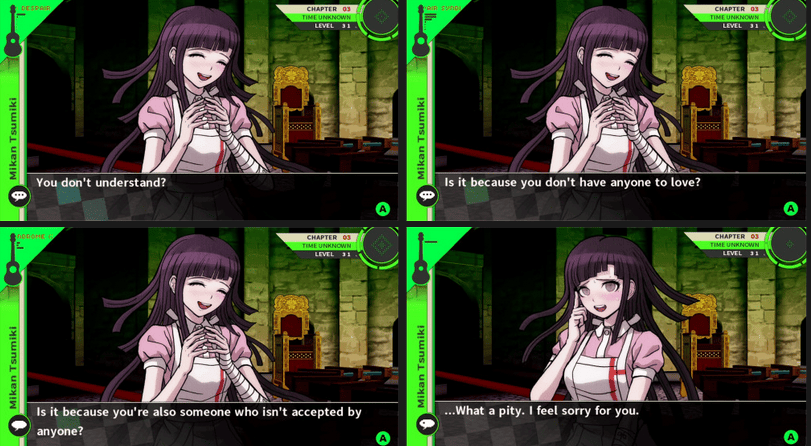
Of course, in the face of some of Tsumiki's insults, Komaeda waves them off or states that he doesn't understand, but that is an indictment of his character. Even when confronted with an unrepentant and unforgiven killer, he still ends up represented as less than human.
Once Tsumiki reveals herself, everyone immediately turns against her, much like they did Komaeda. If anything, there's more hurt and betrayal, more desire to think of Tsumiki sympathetically than they collectively did for Komaeda:
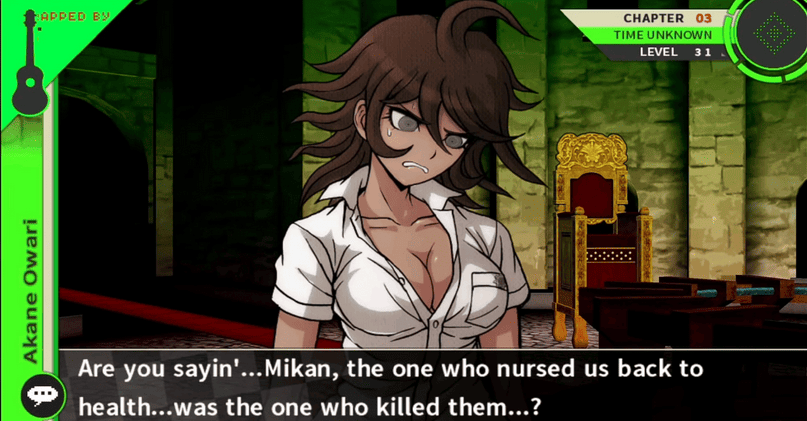
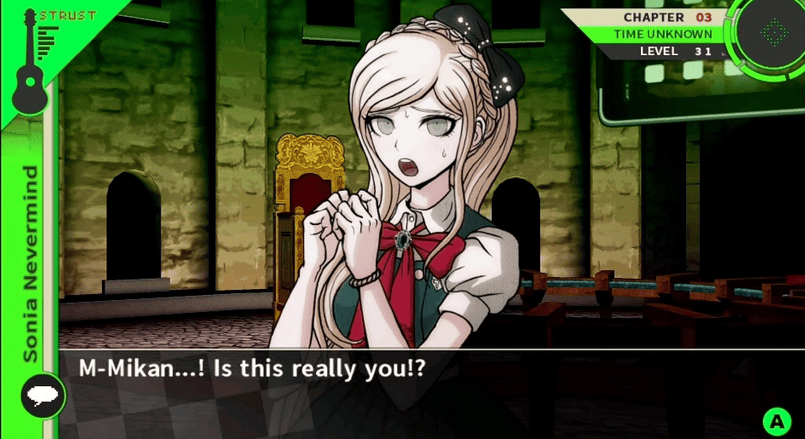
Most of the confusion and loss of sympathy lies on her mental state and lack of sanity. Kuzuryu even quips:
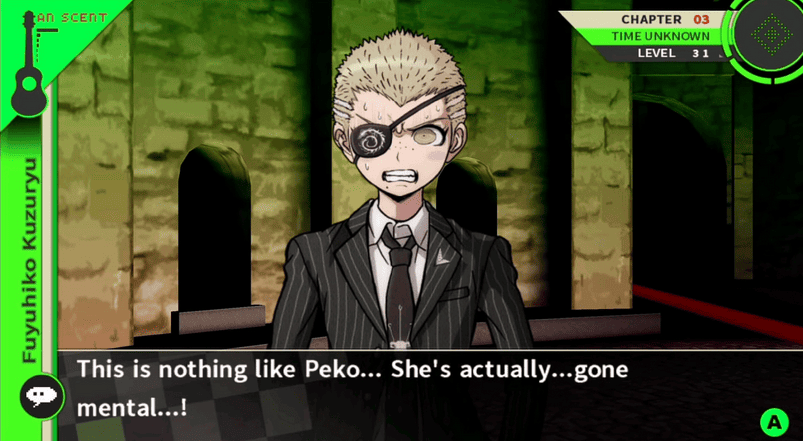
The question on their minds is clear: Is that the real Tsumiki, or just the symptom of the disease? There's even a parallel with Hinata:
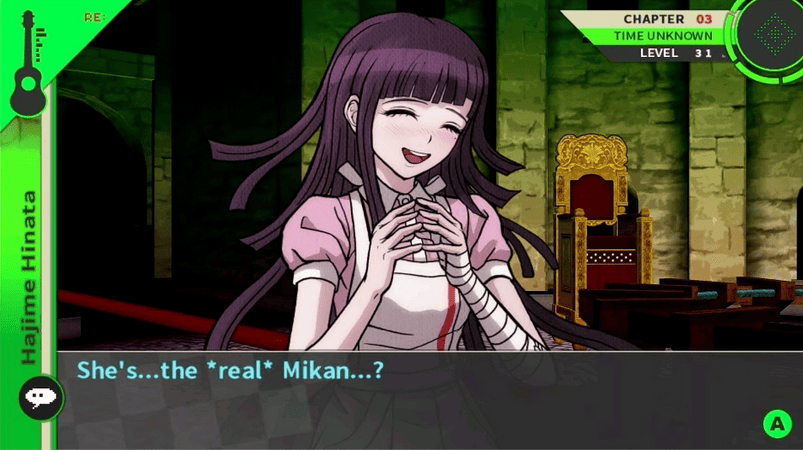
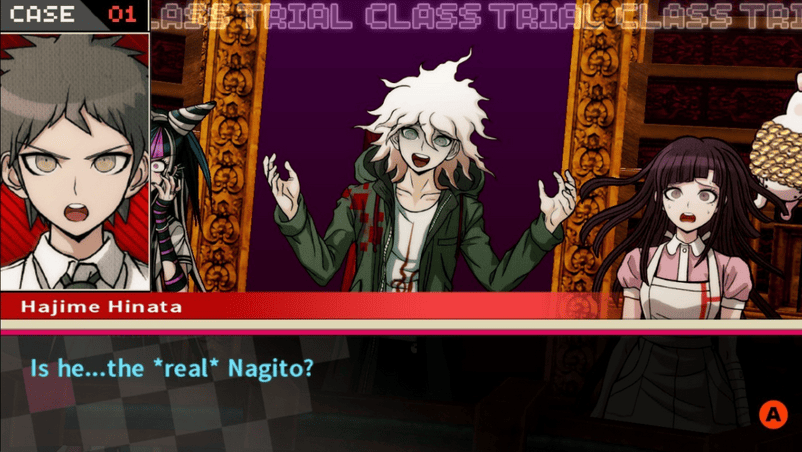
The murkiness comes from the fact that though a disease, not only it doesn't exactly impact a direct personality trait, it leads to directly uncovering her personality. Of course, it's left ambiguous how much the despair by itself has affected her or even if it's altered her perception. She explains:
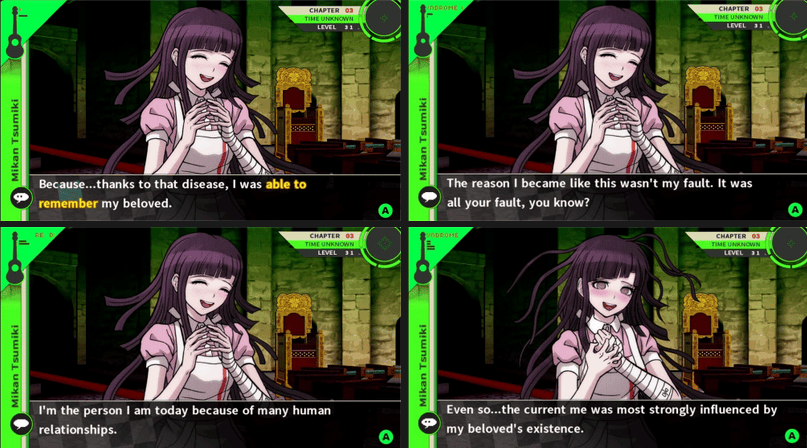
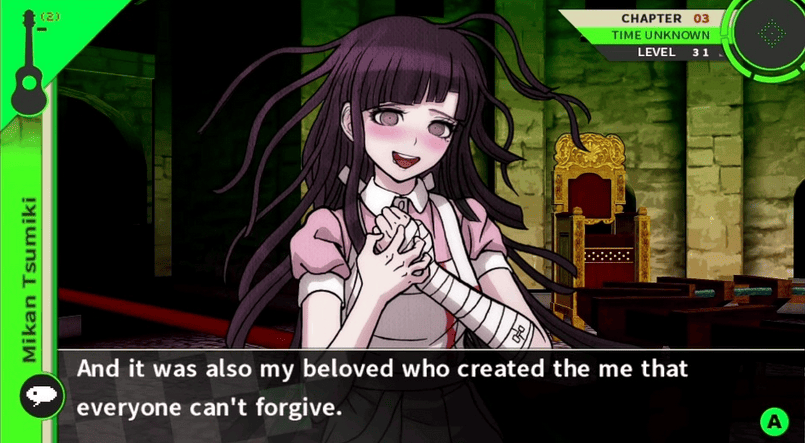
Sure, maybe it was due to the disease that those intentions were revealed. But if those were her full intentions from the start, but they were just hidden from her, its not just that she changed, but was she ever the person the others believed her to be? If she ended up that way by the way her life turned out, by her upbringing, by the way everyone else treated her, was it really her fault? Was it really her "nature"?
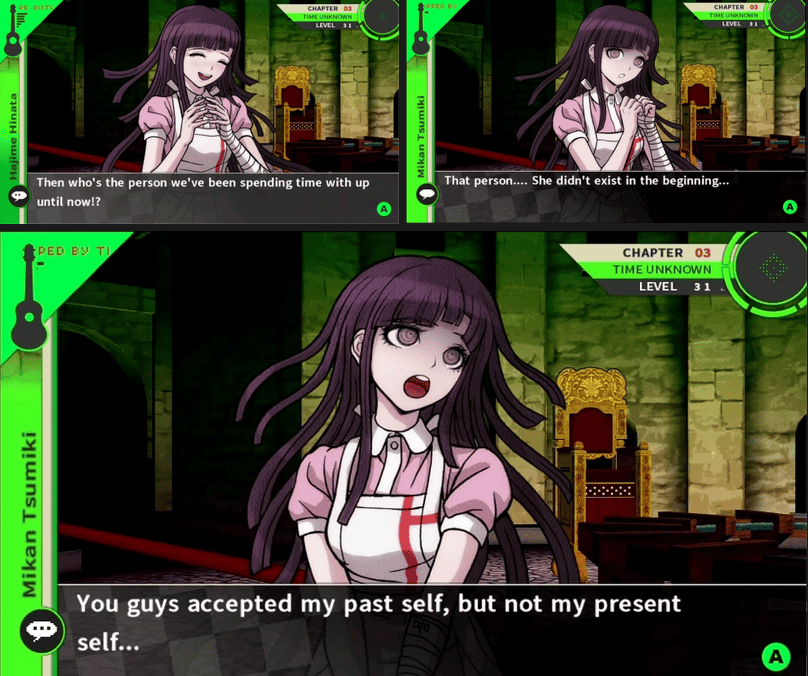
This is another parallel to both the previous trial, and a theme that stretches out throughout the game. Is it nature, nurture, or pretending?
This is also something that calls into question Komaeda's role, especially in the last parts of the trial. Even if he was one of the reasons she was discovered, even if he's on the same side as everyone else on the island, due to the subject of despair he takes it even more harsh and personally, though all others end up with a more mixed view of things. At the end, he says:
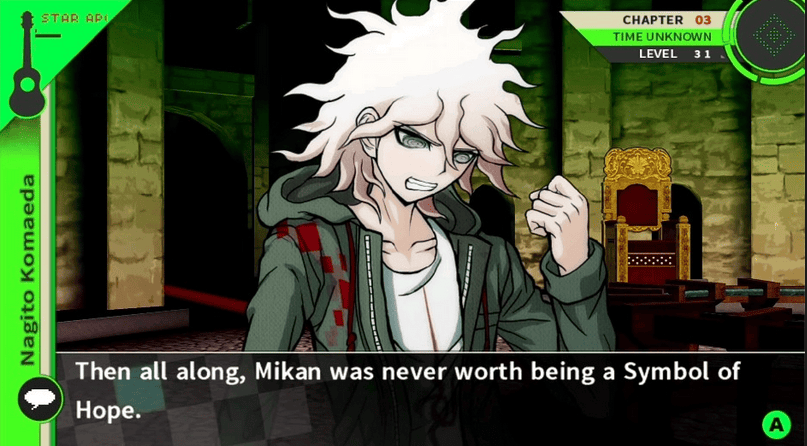
Even if by all accounts he should be on the same page as everyone else, the self-righteousness he also acquired by many events in his life, just like Tsumiki, ends up indistinguishable than cold, hard-wired "nature".
There is a theme serving as the connective tissue between Tsumiki's and Komaeda's love though: The instrumentalization of it.
From every trial we've seen since this point, there is the theme of a "wrong love", a love that has been tainted to serve a harmful cause, a love that has been instrumentalized to serve the oppressive system.
Komaeda's love for hope, Hinata's love for Hope's Peak, and Pekoyama's dehumanization in service of Kuzuryu as the yakuza heir; In part, all of them serve talent most of all and thus serve society's oppressive system.
Tsumiki's love is complicated when it comes to categorisation because it goes against that pattern somewhat; in her FTE's it is revealed that she uses her talent as a form of power but she doesn't love because of it, much less love her beloved. If anything, she loves her beloved despite herself, the way she assumes her beloved does for her. Even though it is a "wrong love", it is also a "true love".
But on the part of said beloved, Enoshima, Tsumiki's love is something for her to exploit, but to serve despair instead. Even if from the point of love of Tsumiki it is a true interpersonal love, it is very much instrumentalized to serve a corrupt interest, the same way Komaeda's more abstract love is for Hope's Peak.
In a way, it is the dark mirror to the game's final choice.
by despairsyndromeworld
ABSTRACT: The aim of this post series is the analysis of certain thematic parallels and thorough lines between Chapters 1 and 2 in Super Danganronpa 2: Goodbye Despair, with particular focus on the themes of action, intent and forgiveness. In this part, we see the case for redemption of Peko, Fuyuhiko and Hiyoko, alongside the lack of it for someone like Komaeda.
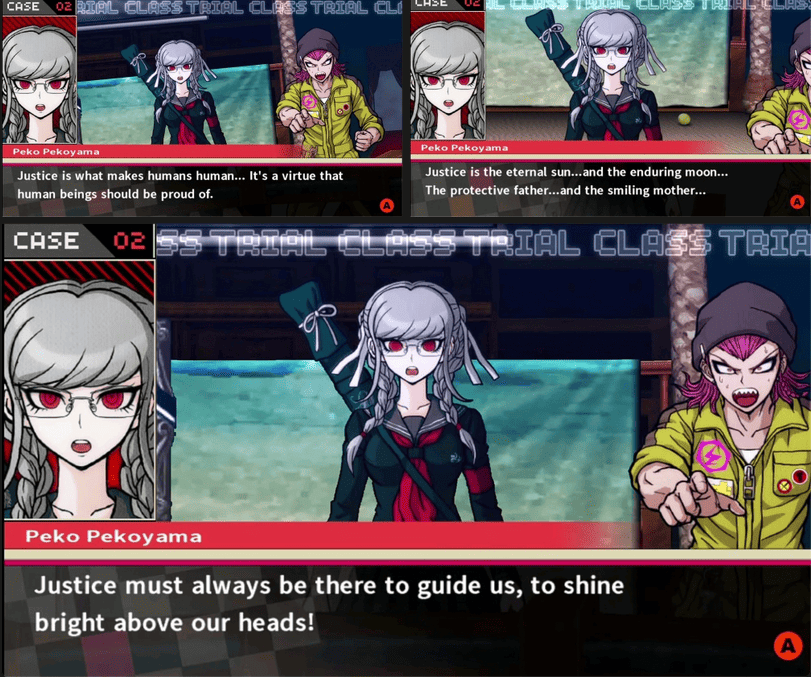
Justice is still used here as a melodramatic abstract concept, but it is more anthropomorphised: it is "the protective father" and the "smiling mother" that guide us (much like the ones she never had). An innate quality that imbues us with humanity Just before this, she said:
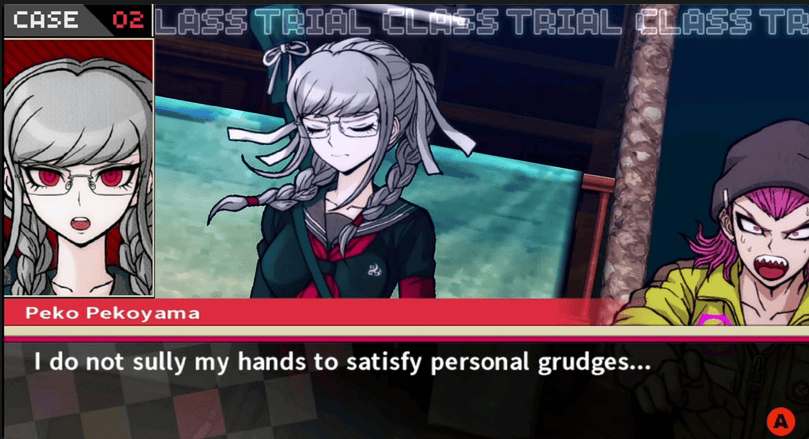
Let's add some of the things she said as a "tool" here too:
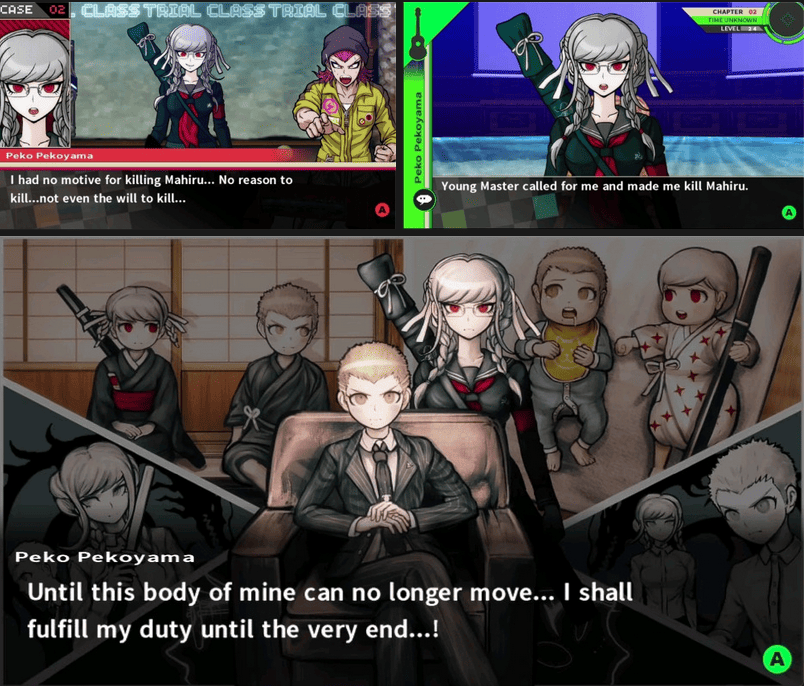
A lot of the things she says as a "tool" are recontextualised by the fact that she was the one that jumped in at the last moment and attacked Mahiru. It is the single defining thing, other than Fuyuhiko's own verdict, that turns her into an active agent culpable for the murder. Though she still tries to frame it as purely an act of duty even moments before her death, the thematic parallels are clear; it was an act of love. And in the end, it is what redeems her:
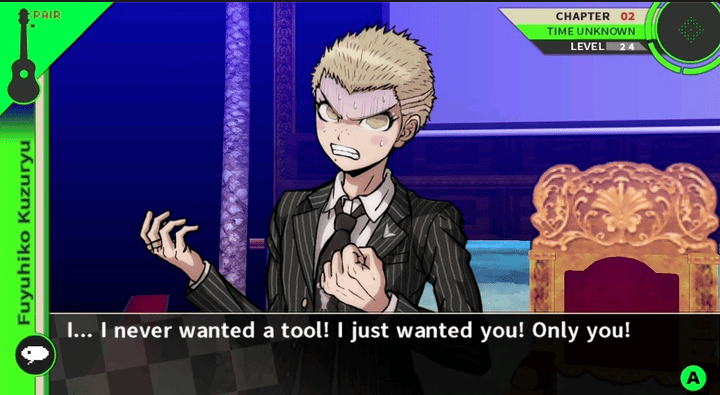
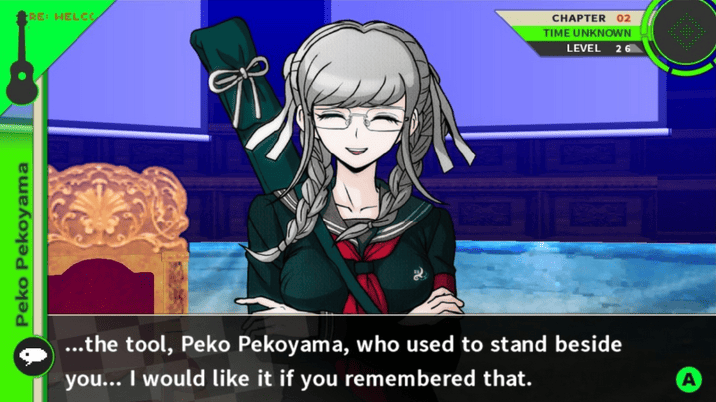
Speaking of thematic parallels:
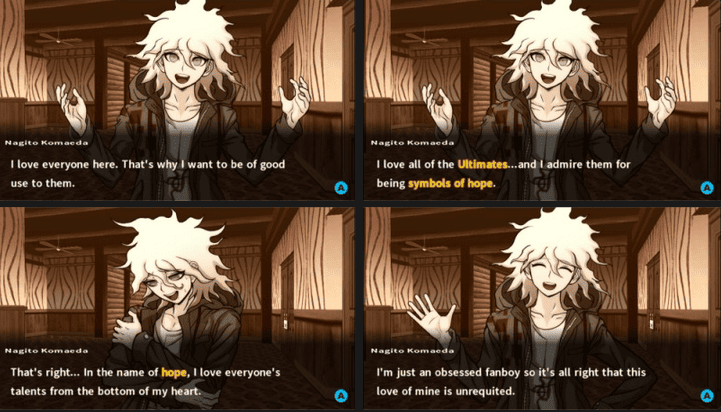
And he seems to agree! But not everyone sees it that way:
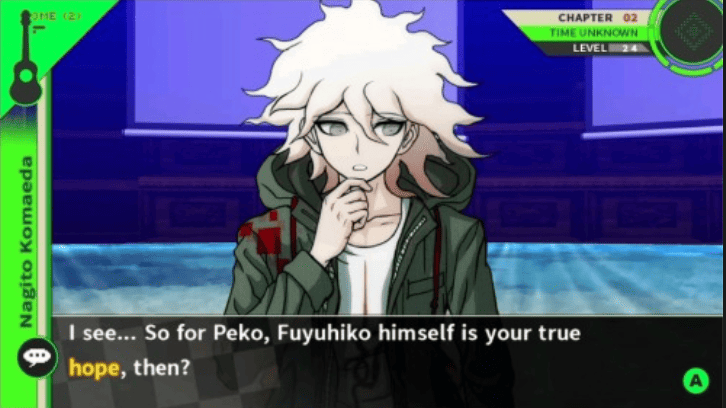
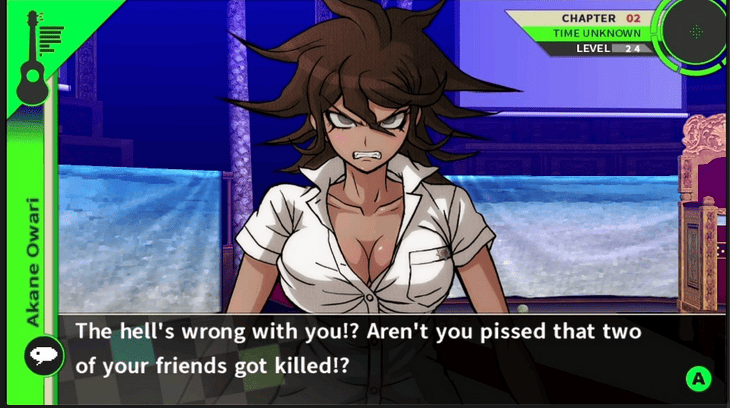
Peko's love and self-deprecation are framed as a tragedy of extraneous circumstances and her main redeeming factor, even if she was the culprit and even if that love was the reason that made her commit Mahiru's murder of her own free will. Meanwhile, Komaeda's self-deprecating love is seen as an intrusion, a self-imposed presumption, that the others don't even try to refute or even actually care that it is what he's actually saying. As seen with Akane's reaction above, they basically see it as the same type of white noise that comes out of Komaeda's mouth every other time, even if he's trying to relate to Peko, even if she ends up using the same vocabulary.
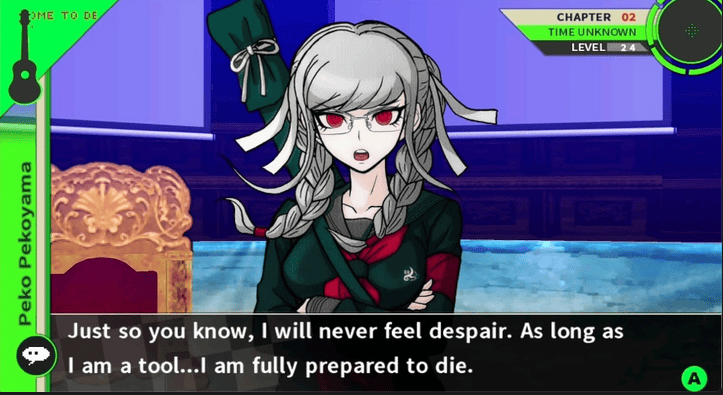
Love redeems Peko, no matter the phrasing. For Komaeda however, love seems to further distance him. "But wait!" you might say "Komaeda might not have been planning on any murder but his own, but he did instigate it!". Indeed, it means we must take a look at the treatment of the instigator of the 2nd chapter's murder, Fuyuhiko, as well.
Peko already had redeemed herself through her love, and her execution just furthered cemented that. In that execution, it was Fuyuhiko's turn to prove his love; and he succeeded.
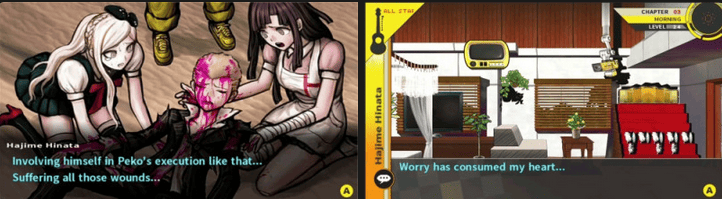
Already by that sheer act, he seems to have gained (most of) the rest of the cast's goodwill. But first, let's take an adjacent detour:
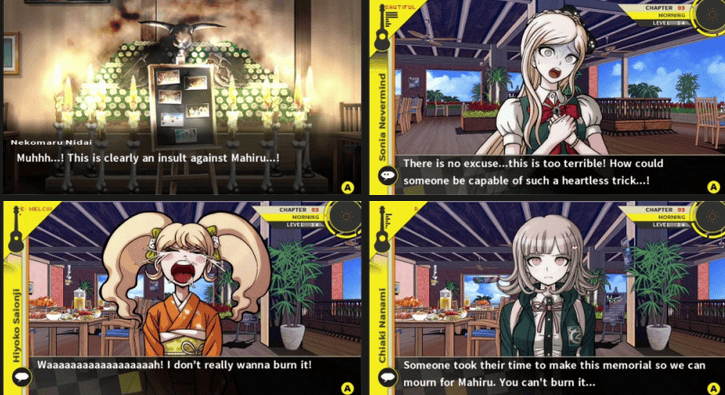
Hiyoko tries to make a shrine to honor Mahiru's memory, unfortunately looking extremely creepy. While the rest of the cast notices it, everyone immediately assumes it must be a mocking, off-putting prank, causing Hiyoko to cry and everyone to briefly self-reflect and comfort her. While this isn't outright a redemption, this is how Hiyoko, a person who has no blame in the previous murder but is harsh and easy to turn against, at least earns the cast's sympathy. And then after everything seems settled, Gundham and Komaeda walk in. Gundham merely looks horrified and spouts his usual melodramatic sayings, while Komaeda makes a much more scathing comment, immediately dissipating the peaceful atmosphere:
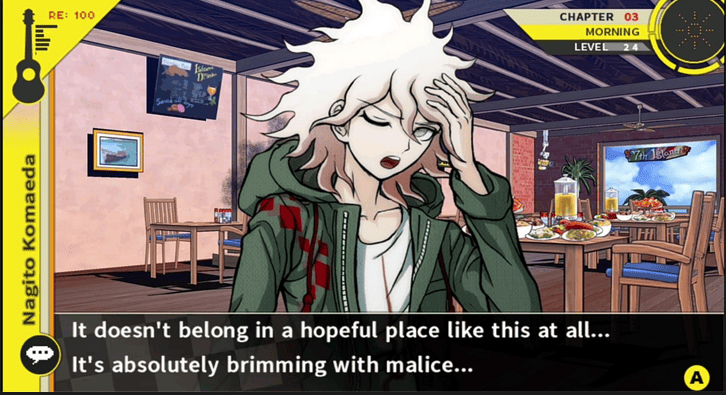
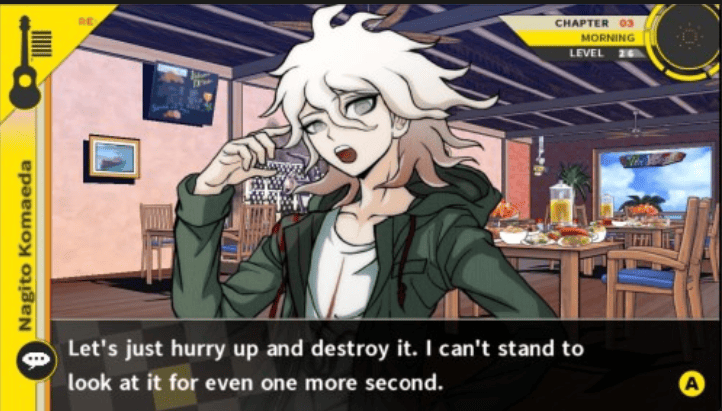
As Fuyuhiko, and more importantly Hiyoko specifically, earn their goodwill in each respective situation, Komaeda just seems to lose it.
After the cast visit Fuyuhiko's ward, the feelings of togetherness seem to just ramp up, even though he was the killer in motive, and could've easily been condemned just an in-game day ago. Everyone's attitude towards him seems to have gotten much warmer after the trial than before:
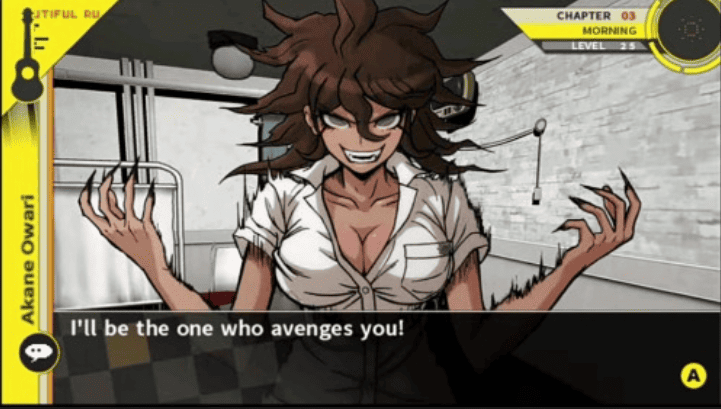
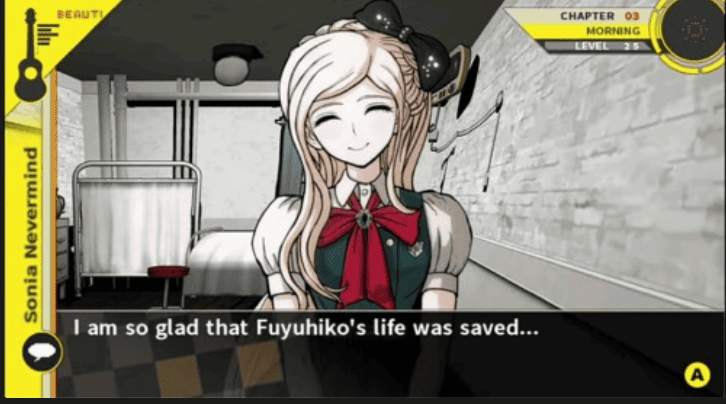
Afterwards, his making of amends through his seppuku seems more as a way for the writers to emphasise his redemption, especially to an irate Hiyoko, who wasn't treated like a voice of reason anyways. The cast immediately rush to his side once they realise what's going on:
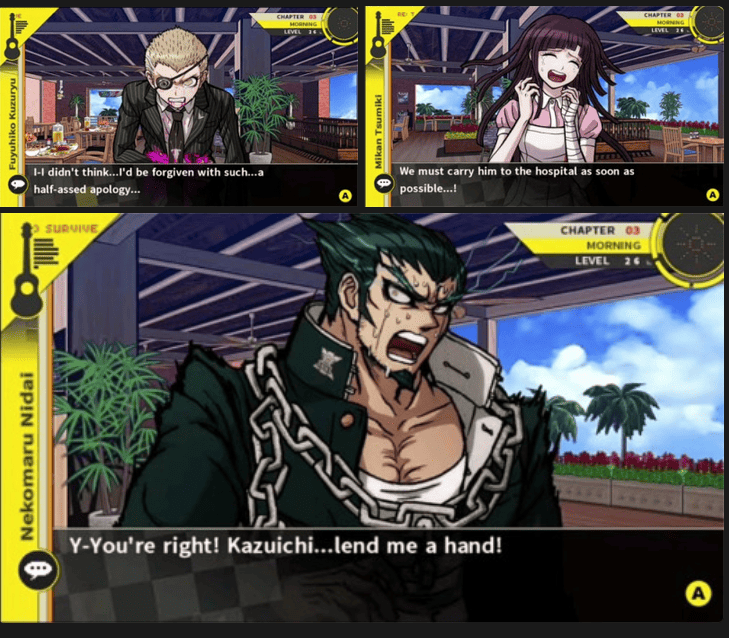
(Note the contrast in how Nekomaru and Souda treated Komaeda, as a non-killer or culprit, and neither specifically for his instigation versus Fuyuhiko)
Through nudging from Nanami, even Hiyoko forgives him:
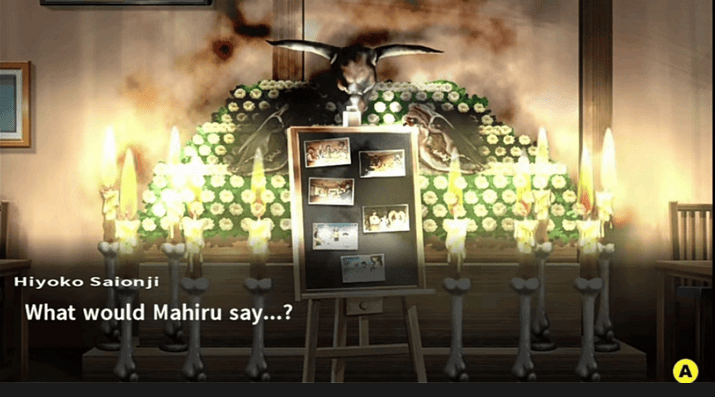
His last apology attempt was a redundancy in terms of forgiveness, because almost all the cast had perfectly forgiven and understood him. So why is that the case for someone like Fuyuhiko to instantly earn his redemption in the eyes of not just the cast but the viewers, but Hiyoko and Komaeda, who technically haven't actually done something, also needed to earn it, or not be given it at all?
The truth is that all three characters that are given fairly straightforward redemptions are shown to have one thing in common; their capacity for love, or at least, enough humility to turn towards the one they love. The reason for Peko killing Mahiru, as much doomed her in body, as saved her in the eyes of her classmates. Fuyuhiko wasn't just forgiven and taken care of merely in his proximity to Peko, but because he showed that as ruthless as he was, he was ruthless enough to even sacrifice himself for her. Hiyoko, when she forgives Fuyuhiko, who does she turn to? Mahiru.
All of them have shown love towards their fellow classmate(s), their fellow human(s).
In contrast, where is Nagito, shown above, to utter the word love?
Towards an abstract concept. The game, even if you play through his FTEs, in the main story, collapses his capacity to love purely through his capacity to love hope. Komaeda's love is seen as incomprehensible, facetious, conceited, one-sided in more ways than one, fake, harmful, not even worth considering. Even if Komaeda didn't technically do anything, even if a chance for redemption for him can be inferred from Hiyoko's own arc, he is automatically excluded from the category of forgiveness untill his death, if not the end of the game. He has not adequately shown his love in a human enough way, and thus, he is ostracized even from the ranks of people that did plan and commit a murder. By being excluded from the capacity to love, and be loved in turn, he isn't just excluded from 'redemption', forgiveness and sympathy, but also the capacity for understanding. By being excluded from the capacity to love, he is excluded from being human.
by retrorats

Replaying SDR2 after two years, one in which I was almost completely disconnected from the game, has made me feel a complicated variety of emotions. On one hand, I feel like I fell in love again with the game and the characters again and confirmed it is a story that is more thematically complex and well-written than people give it credit for, but on the other, I also realized it is a story that has a fatal flaw that almost completely ruins it.
SDR2's first five chapters are overall great, not perfect, but still good in general lines. Some people hate chapter 3 and believe it is the worst chapter, but I really disagree. I do think chapter 3's murder mystery is not really that great, but chapter 3 contributes so much to the themes of love that I find myself ignoring that. After all, I think in SDR2 it is more important that the chapters contribute to the themes than have an extremely good murder mystery. Even if chapter 3 has a lot of mistakes, I find that it's always better than the disaster the ending of SDR2 is for me. It may be a very crappy mystery, but at least it isn't contradicting any themes of the story.
When a lot of people examine SDR2 thematically, they usually explain the story as being about how people that have done unforgivable things in the past can still, with determination, choose a different future: that is, changing and becoming better people. Don't get me wrong, that is a very important part of the story, but I find that it's a little reductionist to say that is the only thing SDR2 is about. SDR2 also explores self-forgiveness, self-love, oppression, and dynamics of power, a criticism of the education system, belief in other people, and interpersonal relationships.
To be honest, I don't even think that the thematical core of the story is even clearing a path for your own future. For me, SDR2 is first and foremost a story about love. In SDR2, love is what ties all the story together. It's love that makes the character be saved from their fates over and over again. Love is what heals people; it is what makes the characters be able to clear a path for their future, because love is survival. But even if this is mainly what the story is saying about love, I still find describing what SDR2 wants to say about it as "love is survival" a little reductionist in general terms. SDR2's message about love is a little more complicated than simply "love is healing."
If we pay attention to how SDR2 portrays love in its characters, we will notice right away that a lot of the characters who are intrinsically related to the concept have a messed-up perception of what love is supposed to be (Pekoyama, Tsumiki, and Komaeda). Usually, for these characters, love is inherently related to the dehumanization and instrumentalization of the self. Komaeda believes love is to serve hope and talent, Tsumiki believes love is to serve despair, and Pekoyama believes the only right way to love Kuzuryu is by being a tool for him. In SDR2 there is a constant theme of how love is instrumentalized, how love is changed to mean to serve something, but more than anything, love is warped to serve talent. SDR2 constantly compares the warped version of love with the right version of love. It's true love the one that is supposed to be healing; it's what saves, but a warped version of it cannot do so.
I find that the first five chapters of SDR2 are very thematically interesting in this regard, while the ending is very conservative and abandons any of the revolutionary and subversive themes the story wanted to approach in the beginning. All of the themes about how love can be corrupted and instrumentalized by society are abandoned for the milquetoast resolution of "love is healing" and "love is power," and that's okay, don't get me wrong, but this story clearly wanted to say more things about love than simply that, and it's sad how it abandons the most revolutionary parts of its story for a more conservative and acceptable ending. It could even be argued that while in the beginning the story denounces the instrumentalization of love, at the end it even rejoices in the instrumentalization of it.
A lot of things can be said about love and Nanami in SDR2, but something I really notice about it is how Nanami, and by consequence her love for her friends, is constantly instrumentalized by the story. She is supposed to suffer and die for them, and even after her death, she is supposed to resolve Hinata's issues. She dies unexpressive and calm because her pain is not hers. Not even the violence she suffers belongs to her: it's Hinata's, it's the readers'. She is constantly instrumentalized with the excuse of her nature: she is an IA, she is not a real human. But regardless of what she is, it doesn't change that she represents a woman, and the way the story treats her is a direct reflection of how stories treat their female characters. It's no coincidence that the character who is made to suffer for the rest, whose personal pain is constantly erased, who is presented as completely perfect, even inhumanly so, is a woman.
In a certain way, the way the story abandons its most revolutionary themes for a more conservative resolution can be seen in the way the story completely abandons the plotline of the relationship of Komaeda and Hinata, and by consequence, Komaeda's character as a whole. In the first five chapters, the relationship of Komaeda and Hinata, and by consequence Komaeda, plays a central role in the story. Most of the plotlines of those chapters revolve around the two of them, especially Komaeda, and the themes of the story, especially love, talent, and belief in others, are intrinsically related to them. One could even argue that for most of its run time SDR2 is the story of Komaeda and Hinata. That's why when chapter 6 completely forgets about that relationship and about Komaeda as a character and instead pretends Nanami and Hinata are the true narrative core of the story, it feels extremely weird and unnatural. Hinata and Komaeda's relationship is completely abandoned by the end, and even some of the themes their relationship was supposed to explore, like the messed-up perception of an instrumental love vs. a personal love that is inherently healing and subversive, are abandoned by the story. I cannot help but wonder then if Hinata and Nanami are the main relationship, then why not spend all the time they put into Komaeda and Hinata on them? Why put so much time into a relationship you are simply going to discard at the end? It's such an obvious writing flaw I'm surprised none of the writers decided to fix it. It makes the story feel way too incoherent.
Nanami and Hinata's relationship is written in such a mediocre way that I'm honestly surprised how bad it was revisiting it. I honestly thought I was exaggerating two years ago with how badly written I thought it was, but honestly I wasn't. It really is that bad. They barely have important interactions between them, and when they have one, those interactions add absolutely nothing to their relationship. The relationship of Nanami and Hinata in SDR2 is characterized by having no conflict and no complexities. There's absolutely nothing going on between them. They are just good friends, and the story doesn't even spend time developing that friendship or Hinata's romantic interest in her. The story decides after chapter 2 that the reader knows Hinata's main partner is Nanami and that he is in love with her and stops developing it in any meaningful way until the climax of the story comes around. SDR2 is mortifyingly scared of giving any sort of minimal conflict or complexity to them.
I feel this is because SDR2 wants to portray their relationship as perfect. That's why they have no conflicts and no complexities, because what do they have to feel conflicted about if they are perfect? But instead of feeling perfect, they feel shallow. They feel like they have absolutely nothing going on. I'm not someone who thinks there are absolute rules in writing fiction, but I think for most works and their relationships, there needs to be conflict for the relationship to feel alive. There may be a work where a perfect relationship makes sense and is well written, but I don't think that was done well here or that it suits the kind of story Danganronpa is supposed to be. In most cases conflict, even a minimal one, is absolutely necessary to write a compelling relationship.
SDR2's fatal flaw is how in the ending it puts all of its themes and the resolution of its story in a relationship that was neither properly developed nor written, and because that relationship doesn't work, the messages of the story also don't. The importance the story gives to it in the ending almost completely ruins the story and what it wants to say. It gives to what was supposed to be a subversive story a conservative ending where perfect and normal heterosexual love is what saves the day, while queer love is buried and killed, figuratively and literally, along with the character that symbolized it.
by retrorats
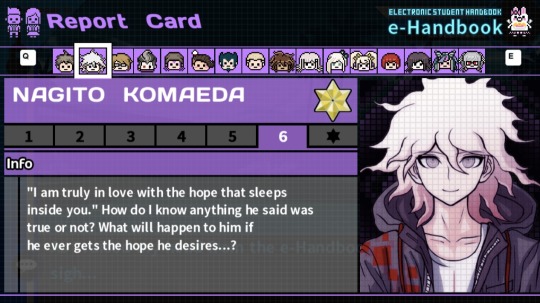
The fifth Komaeda free time event has always been very popular between Komahina fans, specially because the event was where the romantic tone of their relationship was consolidated for a lot of people. But even if the focus is usually on Komaeda's love confession, I have always felt that this free time event is way more important and meaningful besides that. This event has on it a lot of important moments that say a lot about their relationship, and that make very clear the most prevalent themes of it.
The free time event starts with Komaeda wondering why Hinata is still going out in his way to talk to him. Hinata answers that he is doing it so he can hear the rest of his story, in his typical fashion of rationalizing and dismissing his feelings for Komaeda. While Komaeda tells the rest of the story, he says one of the most important things for this free time event, and in general for the relationship of Komaeda and Hinata:
"Hajime... you and I are a lot alike...That's why you understand my feelings... I felt that from the start. I don't feel the unique aura that exists in those who have talent from you... I only detect the scent of a miserable bystander... just like me."
This dialogue reveals to us the important information about how Komaeda not only perceived the similarities between them since they first met, but also how since that moment, he deeply believed that Hinata would be able to understand him. All of the things that this scene explains are the fundamental basis of the relationship of Komaeda and Hinata. Komaeda's attachment towards Hinata comes from a place of feeling like he had finally found a person that could get to understand him and as we will see with other parts of this free time event, he thought he had finally found a person that could love him.
Hinata's response towards Komaeda is also important to mention. He tells him:
"That...may be so, but... I'm not miserable. I'm...different from you!"
Hinata negates to be not like Komaeda, he rejects their similarities and also in certain way he rejects the connection Komaeda feels between them, something that's accentuated even more considering how Komaeda responds inmediatly after saying that it seems there is no one willing to inherit his soul. But even in his negation, there's something deeply interesting in the way Hinata phrases certain things in it. If we look well at what Hinata is saying, we can see how while he negates being similar to Komaeda, his negation is mostly focused on negating his misery, and he seems to silently accept being a bystander that is devoid of any unique aura possessed by the talented.
In a certain way, Hinata's negation in this part has always read to me as being a last resort to try to distinguish himself in some way from Komaeda. Compared to other parts where Komaeda alludes to him and Hinata being similar, here the negation of Hinata doesn't feel so unaware like in the other times that he negated it, here it feels more like Hinata is legitimately aware of how similar they are; He says that he's not miserable, and that he is ultimately different from Komaeda as a last resort to negate what he already knows, and to dissociate himself from him.
Komaeda then talks about how he doesn't have anyone in this world and how absolutely lonely his existence is. Something very interesting that Komaeda says, is that he mentions his ideologies as the main reason for being alone:
"I have no parents, no siblings, no relatives... Not even friends or acquaintances... Because of my self-righteous thoughts, everyone distanced themselves from me."
This moment is not only interesting because it puts Komaeda loneliness to be something that is a lot about his way of thinking being completely incomprehensible for other people, but also because it provides us with certain information about the relationship between Komaeda and Hinata. People distancing from Komaeda because of his beliefs is not something that is only mentioned here, but it is very explicitly the main reason why Hinata distanced himself from Komaeda since chapter 1. Because of this, it's not hard to read this to be a certain reference to his relationship with Hinata -a person that Komaeda really felt he could connect with- and how he also ended up distancing himself because of his way of thinking, like other people Komaeda knew.
This seems to be the principal reason of why Komaeda seems to be so focused on believing that he and Hinata are similar, and also in the belief of Hinata being able to understand him. Komaeda has been misunderstood by everyone all his life and his ideologies have isolated him from the rest of society. All of this has resulted on Komaeda having the fixation on finding someone that would be able to understand him, this fixation ultimately leading him to have a very intense attachment towards Hinata even when they barely really knew each other, because it was probably the first time he had known someone that was similar enough to him to understand him.
There is also a certain connection between Komaeda thinking that they are similar, Hinata distancing himself from him and Komaeda's surprised reaction in chapter 1 seeing Hinata had started to think lowly of him. When Komaeda thought that he and Hinata were similar, he probably also believed that Hinata had a similar way of thinking, and because of that, he wouldn't just distance himself from Komaeda like the others when discovering the truth of the murder.
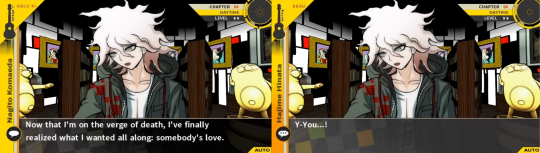
Considering how Komaeda talks about feeling that Hinata was able to understand his feelings, how he implied that he wanted Hinata to "inherit his soul" and in general considering how much this free time event talks about their connection, is not hard to think that in certain way this line is also a little bit about Hinata. Obviously, Komaeda's desire to be loved wasn't born because of Hinata, but I do think considering all we have seen before, is logical to think that one of the reasons Komaeda was so attached to Hinata is because he saw in him -because of their similarities- someone that he could connect with, and for that same reason, someone that could love him.
This is specifically accentuated considering the very strong reaction that has Hinata regarding this statement, literally considering throwing everything he has believed about not forgiving Komaeda until that point. I don't think that his reaction is because he was aware of that fact, but I do think it was written in that way to accentuate how this was talking in a certain way about Hinata.
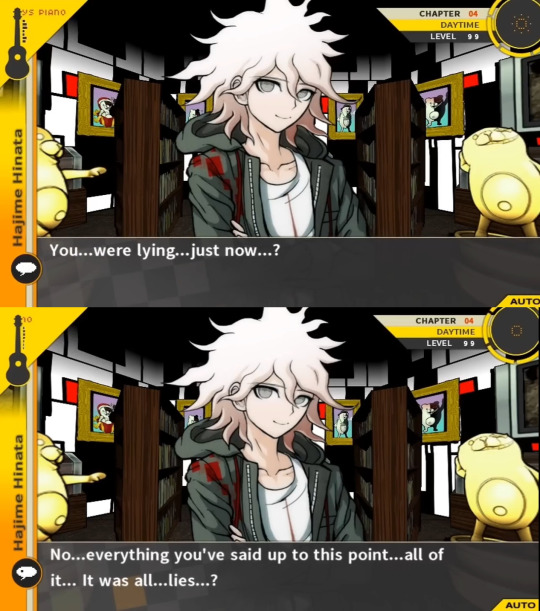
Hinata's extremely heartbreaking and intense response towards Komaeda "lying" could also be easily considered a hint towards this being in a certain way about Hinata, but his response to this is also about way more than just that. His reaction is due to a lot of things, for one part it's about how Hinata feels like he was just deceived by Komaeda again, after having spent so much time trying to actually understand him. But is also about how Hinata wanted to believe in the existence of the Komaeda he once knew. Both of these very strong reactions -this one and his reaction towards Komaeda wanting to be loved- are born from that, from the need to believe him and to have a proof that after all, there existed some truth about the Komaeda he once knew, that there was some logic behind Komaeda, that there existed a reason behind his behavior.
He specially wanted to believe on that line because of how human it makes Komaeda. His biggest desire being something as sensible and human as connection, and this desire, being only realized when on the verge of death, is something that makes Komaeda look very tragic. That makes, Komaeda, human and sensible, and his actions, suddenly are more understandable. Hinata wants to believe on this because he wants to make reason of Komaeda, and give a logic, a very human and sensible logic, to the way he acts.
To finalize, I really love this event because I feel that in it is conveyed all of the main themes and important parts of the relationship of Komaeda and Hinata. It's very beautiful for me to see all the little parts that make them themselves being presented so strongly and explicitly on a full event.
by despairsyndromeworld
ABSTRACT: The aim of this post series is the analysis of certain thematic parallels and thorough lines between Chapters 1 and 2 in Super Danganronpa 2: Goodbye Despair, with particular focus on the themes of action, intent and forgiveness. In this part, we see how the case made for the red herring suspects of the two cases are developed mainly through the aesthetics of their behaviour, a myopic viewpoint that was used in favor of the perpetrator in both trials, barely succeeding in the 2nd.
Almost every trial in Danganronpa thrives on the misdirection of the identity of the actual suspect, making it more shocking when the real killer and their motives are revealed. To present a person with suspicious behavior, only for them to turn out not to be the culprit, is called a 'red herring' and is a well known staple in the mystery genre. So why am I focusing on the use of this convention on two very particular trials of the second game of the Danganronpa series, considering that this wasn't the first, neither the last time even the series would employ this trope? Because I believe the way that not only that trope, but the way in which the trope was employed, has a very clear thorougline between the two trials that actively prey on the characters' (and by extension, the players') prejudices in an almost self referential manner from and to one another.
*Note: By 'culprit' in a Danganronpa context, I do mean the blackened, not necessarily the one and only killer as per the title.
All the red herrings in both trials (and even the culprit of the 2nd which we will get to later) are initially pinned as the prime suspects mostly due to their unsettling or "creepy" behavior.
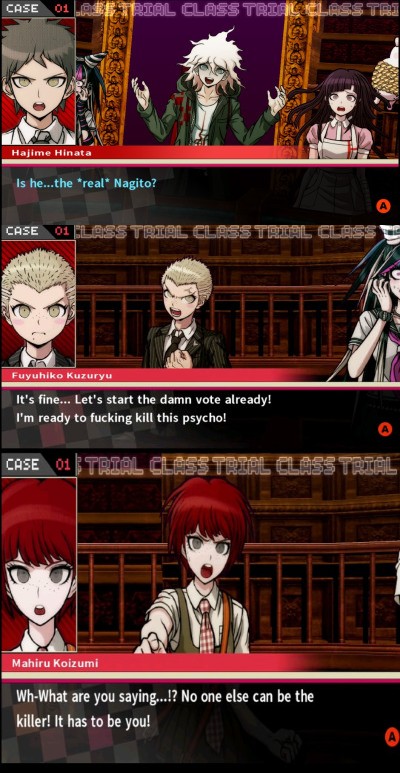
For example, in the 1st trial Komaeda starts laughing maniacally, accentuated by the big cg with the spirals, and uses ambiguous wording to say that "it was all his doing". Immediately, Ibuki perks up to say that "he looks kinda nuts": cue Hinata spiraling himself and everyone being convinced of Komaeda's guilt, needing Mikan to intervene to point out the contradiction of the murder weapon.
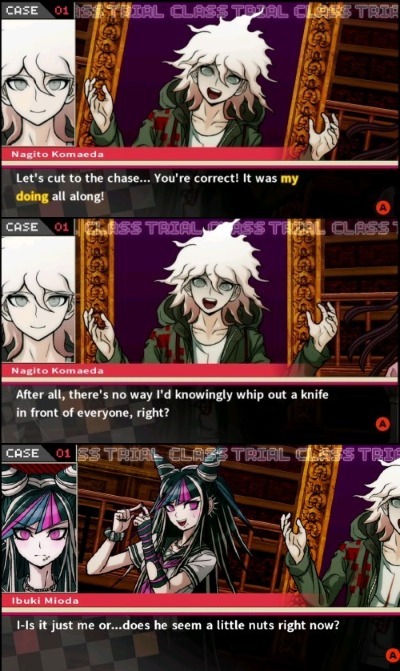
Though if one is paying attention, they can see Komaeda never outright admits his involvement in the murder as a killer directly or further than that; if anything, the way in which he relayed that information, his presentation and phrasing was enough to lead the rest of the cast, even Hinata, to immediately assume his guilt. Even when absolved of it, Ibuki continually emphasizes his "creepiness" and even the reason why Nekomaru and Souda knocked him was simply for him to stop talking, which leads to why they aim to conceal it later; they fail to actually justify it on his views directly.
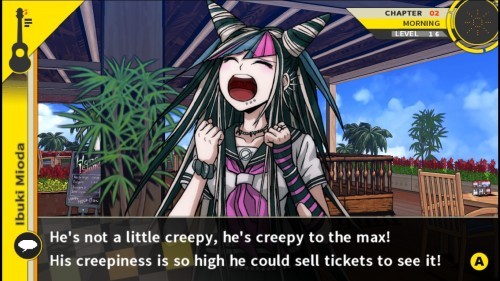
In the 2nd trial, there are mainly two red herrings who are treated in a similar manner: Hiyoko and Fuyuhiko. However, unlike Komaeda, neither of them outright oust themselves or deemed as outright insane. If anything, their already ingrained anger issues and well known 'nasty' behaviour among the cast was already reason enough for their condemnation. In a darkly ironic manner, both of them blame one another at one point, because if not their own, they are at least aware of the other's poor reputation.
Reactions towards Hiyoko's presumed guilt:
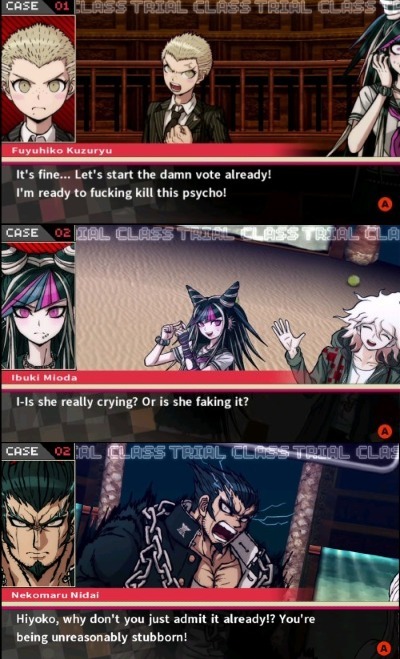
Reactions towards Fuyuhiko's presumed guilt:
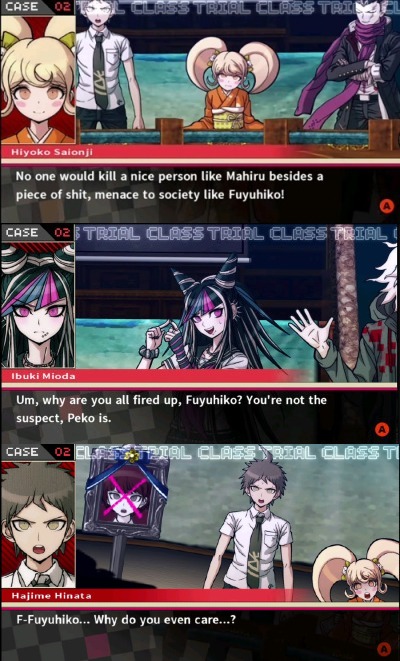
Theres also another reverse similarity between the two of them: Even if Hiyoko was innocent, the case against her was well structured, and even if Fuyuhiko had more involvement than he let on, the things he said that aroused suspicion were pretty ambiguous tough guy things that he could have handwaved if he insisted more on his role in the game being purely Monokuma's invention. Nevertheless, on both cases people immediately got swept up and asked for the voting to start. Hell, Fuyuhiko even got the Panic Talk Action!
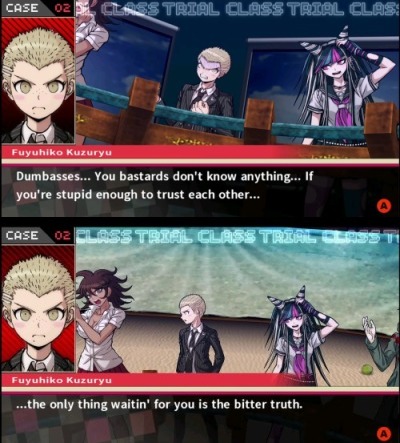
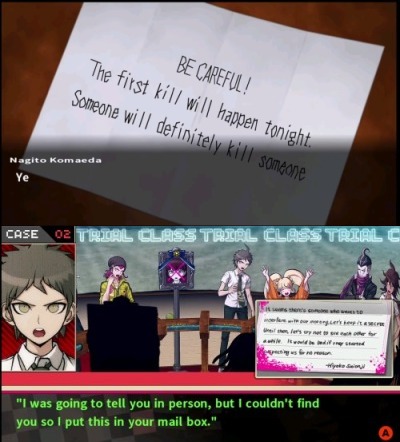
We continue into more of the similarities between the two trials: both included letters that aimed to misdirect the people involved into constructing the killing, both involved a monokuma theater after the supposed reveal of the true killer that aimed to highlight the supposed killers unpredictable nature but also that it might not be telling the whole story, and that the two most memorable suspects from each trial were partly lying to protect the (other) killer.
Considering the 2nd trial follows the 1st, it is not without merit to assume that the similarities weren't merely intended outside the game's scope for analysis of thematic parallels, but were also used by the characters themselves, drawing on the reception of their previous uses. Case in point: Sparkling Justice.
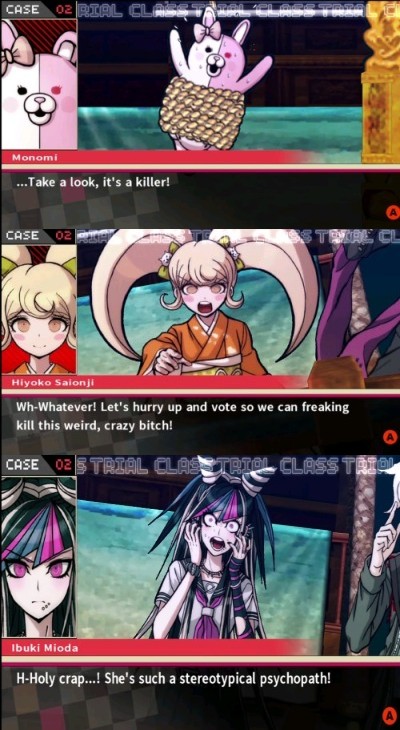
Sparkling Justice could be seen as a short of non-sequitor; even if her true purpose gets revealed later in the trial, her role within it is pretty random. However, if one looks closer they can see parallels: her theatrical performance, the way she constantly repeats the abstract concept of justice, the fact that she still didn't actively admit her being a murderer, the way the rest of the cast clamored to vote her off without hesitation, even if conflicted calling her crazy, that Peko didn't actually know anything but the two most basic facts about Sparkling Justice even if she was right there when Sonia was explaining them to her. Peko's performance wasn't drawing from Sparkling Justice: she was drawing from Komaeda.
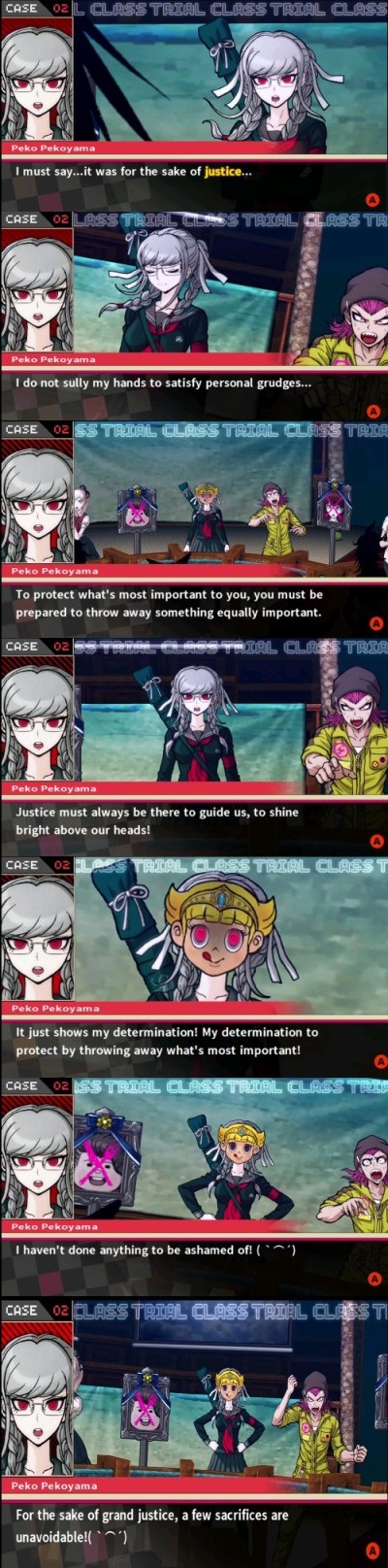
Even from her letters, and even from the way she used the performance to shield Fuyuhiko, from the way she was initially mild-mannered and helpful in the investigations and her reveal blindsiding everyone and yet them immediately voting from her, it's clear that Peko took a lesson from the first trial, and used the panicked atmosphere and her classmates myopic assumptions to her advantage.
Reactions toward Peko's presumed guilt:
Reactions towards Komaeda's presumed guilt:
For this to make more sense, let's go back to the Komaeda segment of the 1st trial: First of all, a lot of what he said in the first trial and to Teruteru was also partly a performance. In both cases, that he was an unstable threat to be quelled. Though his wording was ambiguous and threatening, he never actually said he murdered or wanted to murder someone, he never actually lied about his intentions, he just obfuscated them to achieve them accordingly in both situations.
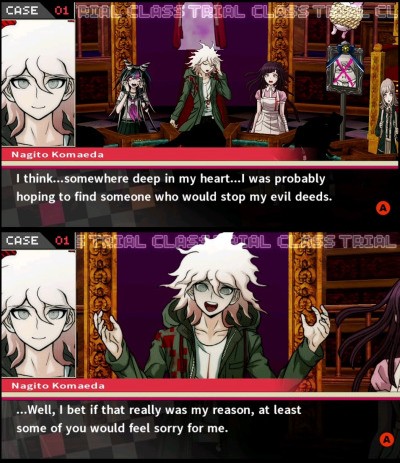
However, the damage had already been done: Even if the only, or at least main casualty he had calculated was himself, even if Teruteru did kill and afterwards take his offer for cover up, Komaeda's position was somehow more detested than if he was the culprit, or maybe precisely because he wasn't the culprit. He wasn't killer neither in execution... Neither really in intention. Semantics, semantics, but since the main separation between those two types of killers being the climax of the 2nd trial, I do feel somewhat justified in making that assertion.
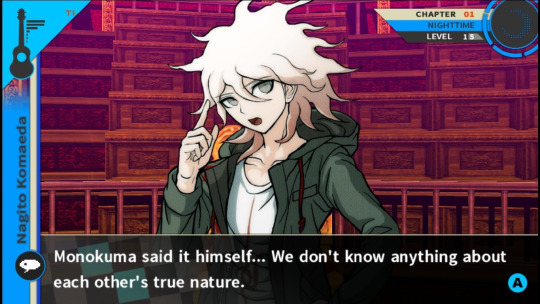
Although, there is a main difference between Hiyoko/Fuyuhiko/Peko and Komaeda, even if him and Fuyuhiko/Peko occupy a similar grey zone: Hiyoko/Fuyuhiko/Peko get humanised and 'redeemed' in the eyes of both the characters and players... While Komaeda does not.
by retrorats
One of the most interesting scenes from chapter five's trial happens when Monokuma jokes about how Komaeda's ghost is whispering to Hinata. While this is often interpreted as Monokuma simply joking about how the emotional connection Hinata and Komaeda had really shined in chapter five's trial, the more I think about the context in which Monokuma says this, the more it makes me feel like there may be a possibility that what Monokuma is saying is not as ridiculous as it sounds. In this post I want to talk about how death seems to work in the Neo World Program, the context of this line, and how Komaeda's ghost talking to Hinata may be a possibility.
The first thing I want to talk about is how death seems to work in the NWP. It seems like dead people, especially in the last chapters when the world is getting corrupted and starts to present glitches, can interact with the ones who are alive and even seem to have knowledge of things that have happened in their absence. This is demonstrated by the dead characters appearing again in the ending of chapter five, and Hinata and Kuzuryu communicating with Nanami and Pekoyama, respectively, in the ending of chapter six.
There is a lot of ambiguity in the story around what exactly is happening here and what it means that the dead characters are appearing again. You could argue they are hallucinations the characters are having as a consequence of their grief and the simulation getting corrupted, or that they are not exactly the actual dead characters talking but instead the simulation using their stored data and replicating their behavior. Neither of those theories is necessarily wrong or right because the story doesn't give a definitive answer. But even so, I do still think some of the evidence presented leads me to think those are actually the actual dead characters appearing again and not a glitch or a hallucination:
If they are supposed to be projections/hallucinations/not the actual dead characters and just "replicas," they are too faithful to the internal feelings and characterizations of the characters. Usually a "fake" would have differences between the original person and what is replicating, and only the most superficial parts of the characterization would be retained. The characters here speak of things that, while they may have expressed in some way or another before they died, don't just feel like them repeating things they said before. The things the characters say here feel like them actually speaking their feelings. This applies to what Pekoyama is saying about Kuzuryu, but it especially is true to what Nanami is saying. How would a projection/glitch replica/hallucination know that the door leads to the future? She may have talked about the future moments before her death, but this doesn't sound like a replication of what Nanami said before. She gives new and specific information, and that's why it sounds like her actually talking.
The story may play with the idea that the dead characters appearing again are a projection. After all, one of the things Hinata remarks after Nanami appears in the ending is that she is "maybe the Nanami in his memories." Nanami doesn't confirm or negate Hinata's affirmation, but while the text may like to present Nanami's apparition with ambiguity, it's clear that the Nanami Hinata talks to is probably actually her since Monomi at the end appears and executes Enoshima, and unless you argue that Naegi also hallucinated it, it's very clear that actually happened in reality. Monomi confirms that people that were previously dead can appear again in the NWP.
what is happening with the dead characters is very ambiguous. I think there can be a lot of different interpretations of this, and I think even the evidence is contradictory on a lot of points. But while I think that the text may be ambiguous, there is still a strong possibility the dead character can actually communicate with the alive students.
So, you will be wondering, what does all of this have to do with Monokuma's comment? Well, to see that, we first have to explain a little bit of the context of the line. Monokuma says that when Hinata explains to the others that he is feeling like Komaeda is seeing through them and that they are trying to label it a suicide so no one gets hurt. He continues by saying that if Komaeda were with them, he'd be sneering at the group. Just after that, Monokuma says his famous line. There is nothing suspicious about what Hinata says before Monokuma's line. The reason why Hinata is able to characterize Komaeda correctly is because of the attention he always paid to him and, by consequence, because of the emotional connection Hinata had with Komaeda. However, there is something that happens almost right after that that truly makes me think that Monokuma may have been into something when he asked Hinata if he was communicating with Komaeda's ghost.
The characters are questioning what Hinata is saying, telling him that in the end it would still be a suicide and that there is no reason to search for an accomplice. Owari then says that there are things that are better not known and that maybe the container for the poison was hiding with the fire grenade fragments. After she says that, Hinata has the following moment:
"...!" "..." "Wh-what...is this feeling just now...?!Even though it was brief...it was like a strong flash of light running through the back of my head"
This moment is very particular and interesting, especially as it happens very little after Monokuma jokes about Hinata communicating with Komaeda's ghost. While superficially it may seem like this is just Hinata's intuition telling him that indeed, a big clue is hidden in Owari's words, I feel like carefully observing Hinata's description of what happened reveals that, maybe, there is something other than intuition happening here. I think Hinata's intuition has guided him a lot through the game, but the way that intuition is presented through the game isn't really similar to what Hinata is describing here. Hinata looks completely confused as to what is happening: he doesn't understand what that feeling is, and his description of it seems to indicate that he also has a lot of trouble even describing what just happened. If what Hinata is truly feeling here is just intuition, something Hinata has experienced plenty of times before, it is weird he feels so confused by it. But more than anything, Hinata's description seemed to recall something almost superstitious about what he was describing, as it was almost an outside force that was making him realize what Owari was saying was true.
I think if it's just intuition, it's weird how it's described as Hinata seeing a light, a description that sounds almost supernatural. Furthermore, Hinata's wording seems to be similar to the way Sonia describes hearing the voice of someone in chapter 6:
"It was at that moment, I somehow heard Hajime's voice... and though it was just a flash, I saw it. Like a lighthouse beacon shining across an ocean of darkness... a warm, yet resolute, light...The one who shined that light... it was probably...You saw it too, right Hajime?"
Sonia describes seeing a light when she is talking about how she saw someone (who is probably Nanami), just like Hinata and Kuzuryu did before. The descriptions are not the same, but I find it very interesting how when she describes seeing someone who was previously dead, she describes a similar sensation to the one Hinata described previously.
Does this mean Komaeda's ghost communicated with Hinata? No, but I still think it is a possibility. There is no definitive evidence to argue this is the case, but still there is certain evidence that may indicate that it may not be just a joke Monokuma was making. But in any case, I still think that it is very curious how Monokuma, who definitely is aware something like that can happen in the NWP, makes a joke about Hinata talking with Komaeda's ghost just before Hinata describes something that definitely sounds like a supernatural experience.
by retrorats
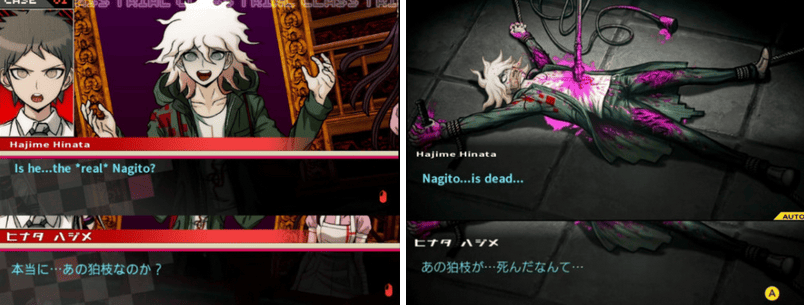
While I was checking how Hinata's reaction to Komaeda's death was in its original language, I noticed some interesting details in the wording Hinata uses when referring to Komaeda in that scene that seem to recall to mind his reaction to Komaeda's "reveal" in chapter one.
When the characters say their first reactions to Komaeda's corpse, Owari questions whether Komaeda is truly dead or not, and Hinata says in his mind in the localization, "That's right, it's Nagito..." It's not exactly a mistranslation, but it ignores that in the original version Hinata doesn't just say, "It's Komaeda"; he says, "It's that Komaeda." As some of you may know, one of the most interesting details of Hinata's reaction to Komaeda's breakdown in chapter one in the original language is how he starts referring to the Komaeda he knew before as "that Komaeda" (あの狛枝), and curiously, he starts to refer to the once-alive Komaeda the same way here.
An important clarification: I'm still learning Japanese, so I may make some mistakes. I try to research what I say as much as I can, but it's always possible I may say something that is wrong. Please don't take what I'm saying as the absolute truth.
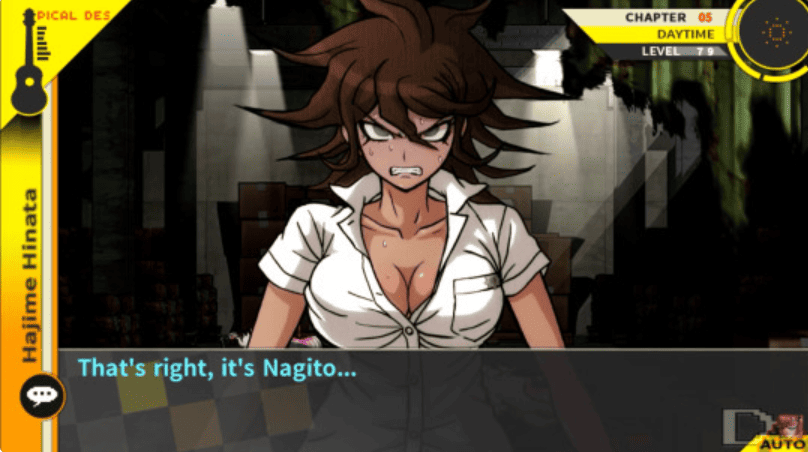
Hinata refers to Komaeda here as "that Komaeda" (あの狛枝).
But this is not the only time he refers to Komaeda as "that Komaeda" in his internal thoughts. After discovering Komaeda's body, he does that multiple times. The second time he does that is right after he says it the first time. In the localization it was translated as "He always messed with us, he always tried to confuse us...that's why..." In Japanese the line is as follows: [俺達を散々引っかき回して、いつも混乱させ続けてきたあの狛枝だからこそ・・・] While there are some differences apart from the omission of "that Komaeda," in general lines, the localization works well in transmitting the overall message. But for visualization purposes, a literal translation of the line would be something like:
"It's precisely because it'sthat Komaeda , who's always been stirring things up and keeping us in a constant state of confusion. That's why…"
When we see the original line, we will notice the "that Komaeda" Hinata is talking about here has a completely different meaning than the one he mentions in the first chapter. Originally, Hinata used that term to refer to the Komaeda he knew at the beginning: the one who helped him investigate, the one that was so kind. So it's curious how now that Komaeda is dead, he uses the phrase to refer to the opposite of what Hinata was talking about originally: the "malicious Komaeda.
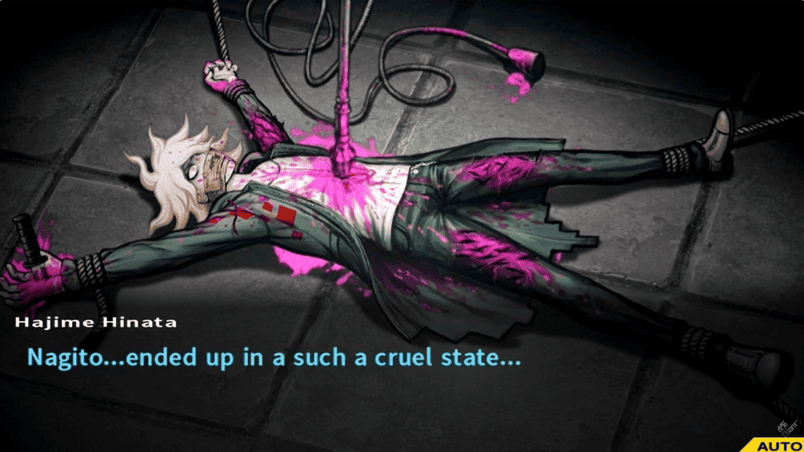
When Hinata says the dialogue depicted above in Japanese, he refers to Komaeda again as "that Komaeda," meaning that he can't believe that the Komaeda who confused them so much and caused so many problems got killed by someone, especially in such a horrible way. After this, in the localization, Hinata repeats something he said before: "Nagito...is dead..." A lot of people will be interested to know that in the original language, Hinata doesn't repeat word for word his first "Nagito...is dead..." line; in fact, the two lines are quite different. The first time Hinata remarks Komaeda is dead, he says: [ 狛枝が・・・死んだ……………………………]. This first line is characterized by not only having an ellipsis after Hinata says "Komaeda is" but also a very, very long one after he remarks "dead." This first line is characterized by a feeling of unbelief. It's the first time where the realization that Komaeda is dead dawns on Hinata, and he clearly seems to be in a complete state of negation.
The second time has a different feeling. Hinata says: [あの狛枝が・・・死んだなんて・・・ ]This time the sentence doesn't have as many ellipses, almost as if this time, Hinata is more sure of the fact that Komaeda is truly dead. Another big difference is that the sentence ends in [なんて] to remark emotion. But the biggest difference is that here, Hinata refers to Komaeda as "that Komaeda," something he didn't do the first time he remarked that Komaeda is dead. This time Hinata is not only remarking that Komaeda is dead with less doubt but also specifically remarking that it is "that Komaeda" who is dead.
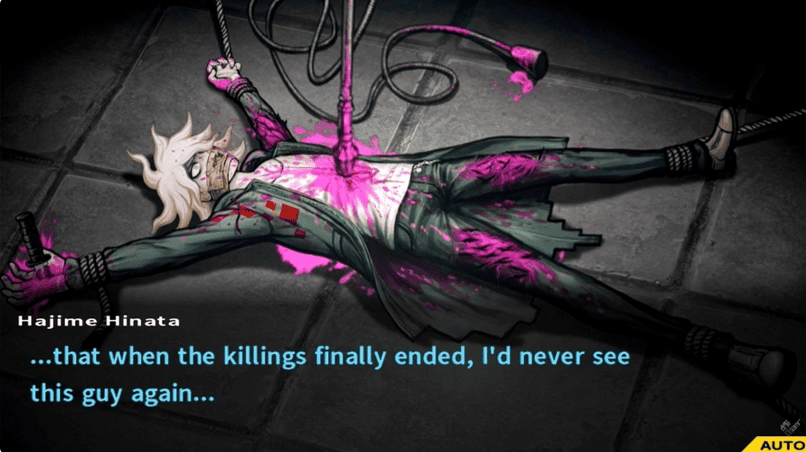
There is something very interesting in how the line above is worded in Japanese. Hinata says: [こいつがいなくなるのは,このふざけたコロシアイに終止符が打たれる時だと・・・] I'm not going to retranslate the line, but what you need to know is that here Hinata is referring to Komaeda as "koitsu" (こいつ), which is very curious considering Hinata referred to Komaeda just before this as "ano Komaeda." This is very interesting at a grammatical level because "ano komaeda" (あの狛枝), because of the demonstrative "ano," implies that the Komaeda Hinata is talking about is someone who is far away, but "koitsu," which he uses later when talking about him, implies that Hinata is talking about someone who is near him. It doesn't make sense to say the Komaeda Hinata is talking about is simultaneously near and far at the same time, so this means that Hinata has to be referring to two Komaedas: one that is near (the corpse) and another one who is far away (the Komaeda that once was alive).
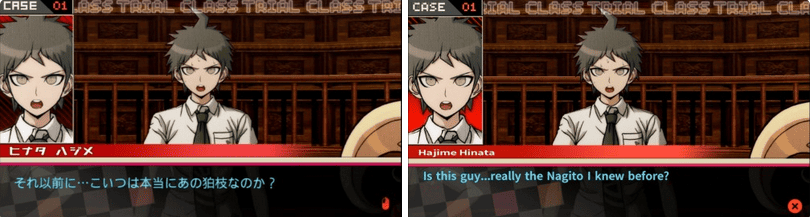
If Hinata's use of "that Komaeda" wasn't enough to make the chapter 1 parallels clear. The fragmentation of Hinata's perception of Komaeda being separated into Koitsu (Komaeda) and Ano (Komaeda) also happens in chapter one when Hinata is questioning if the Komaeda who is acting like that (Koitsu) is truly the Komaeda he knew before (Ano Komaeda).
After all is said and done, what does all of this mean? Why is Hinata referring here to Komaeda as "that Komaeda" again? Why is Hinata shifting the meaning of "that Komaeda" to mean the Komaeda who tormented them when that term was originally used to describe the kind Komaeda Hinata knew in the first chapter? I think Hinata's feelings here are very complex and have a lot of different reasons and interpretations.
I think one of the main reasons Hinata starts referring to the "malicious" Komaeda as "that Komaeda" and consequently abandoning completely the idea that a "kind Komaeda" once existed fits the plot point of how in chapter 5 Hinata gets completely disappointed in him. While I don't think Hinata ever completely lost the love he felt towards Komaeda, it is also true that in chapter 5 the resentment and anger Hinata had towards Komaeda multiplied. It is fitting that in a chapter where Hinata becomes completely disillusioned with Komaeda and starts referring to him as "malicious" to the point he demonizes the person he was to an almost cartoonish degree, Hinata rebrands a concept that was used to refer to the Komaeda he held in high regard and uses it to refer to the Komaeda he feels conflicted about.
But while what I described definitely is one of the main reasons why Hinata uses that wording, I believe there are also other reasons. I think Hinata also starts referring to Komaeda as "that Komaeda" after his death because of the unbelievability and negation Hinata feels about the fact that he has died. Hinata separates the Komaeda that tormented them (that Komaeda) from the dead Komaeda (koitsu) because he is unable to process that someone like Komaeda, who was so troublesome and also someone he loved, was murdered. The negation shaping Hinata's dialogue is even more accentuated when we remember that even the first iteration of "that Komaeda" is already based on disbelief. Hinata separated the Komaeda he was seeing from the Komaeda that was kind becausehe is unable to accept the reality that they are the same person.
Last but not least, I think that while Hinata mainly uses "that Komaeda" here to refer to the Komaeda he would later call "malicious," I don't think it is incorrect to say "that Komaeda" also refers here to the same Komaeda Hinata talked about in the first chapter, at least to a certain extent. When Hinata says, "That Komaeda... is dead" He isn't just expressing surprise about how the troublesome, problematic Komaeda was able to be killed by someone. When the reader sees Hinata use "that Komaeda," while it may be used here to refer to the opposite of what it meant in the beginning, it still evokes the image of what it was originally used for: the Komaeda Hinata knew. Hinata may be talking about the "malicious Komaeda," but the association that term has in the reader remains intact. When Hinata says "that Komaeda is dead," the reader's first association will not be that the "malicious Komaeda" is dead: it will be that Hinata is talking about how the Komaeda he once thought he knew is too. Hinata may shift the meaning of "that Komaeda" in chapter five, but the association the reader has with the term reveals to us another underlying implication of Hinata's painful remark about the death of that Komaeda: it's not just the "malicious Komaeda" who has died; the kind, helpful Komaeda that Hinata loved so much also did.
by retrorats
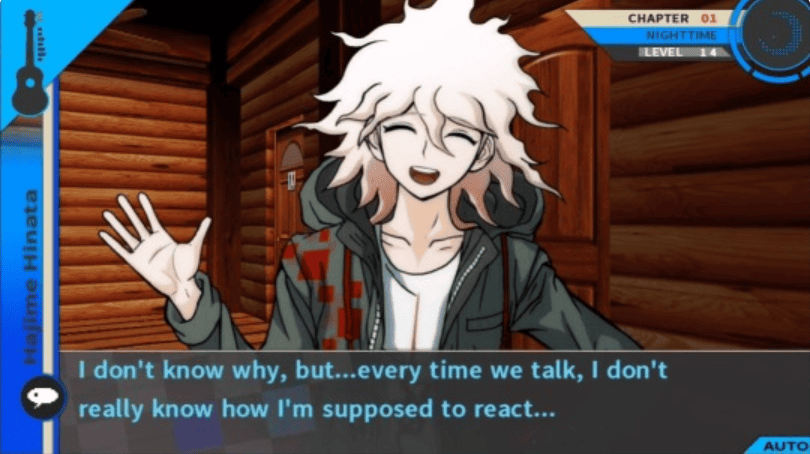
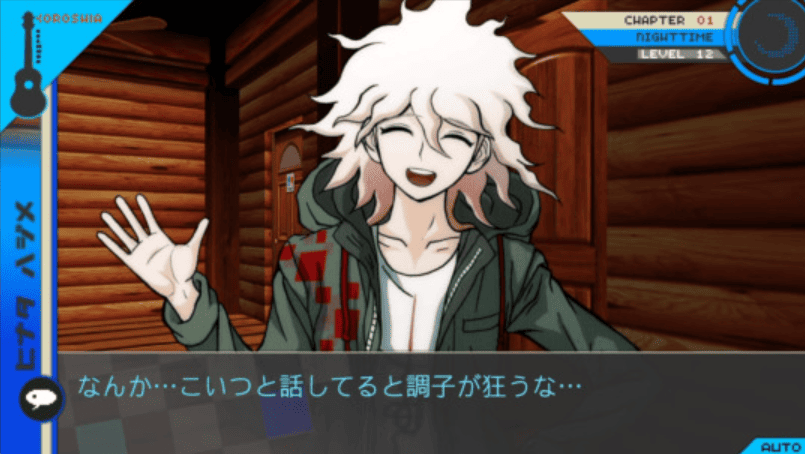
I remember that some time ago, there was a discussion about whether this line Hinata says here has romantic connotations or not. The confusion seems to stem from the fact that the line is very vague in itself, and while the line is used with a romantic connotation in some Japanese forums, even the information those forums give is very confusing. It's hard to understand if the phrase is really used commonly on that way or not since there is not a lot of information online.
I don't remember how the discussion ended, and maybe I'm saying something everybody already knows. But In any case, I want to talk a little about this line, and also share a dialogue that I found with that expression being used in a romantic sense. I found this dialogue more reliable to confirm that this expression can be used in that way than the forum entries.
To start, as you can see in the screenshot, this is the line in Japanese: [なんか・・・こいつと話してると調子が狂うな・・・ ] let's break it down:
なんか(nanka)・・・ = somehow/for some reason
こいつ(koitsu) = that guy/this person (very informal and sometimes rude, but that's how Hinata speaks, so it's not meant to be rude, I think)
と(to) = particle, used in this case to indicate "together with."
話し(hanashi) = talking.
てる(teru) = indicating that the action is ongoing or continuous.
と(to) = particle, explained before.
調子が狂う(choushi ga kuruu) = this is the phrase that generates the confusion. This is how it is defined:
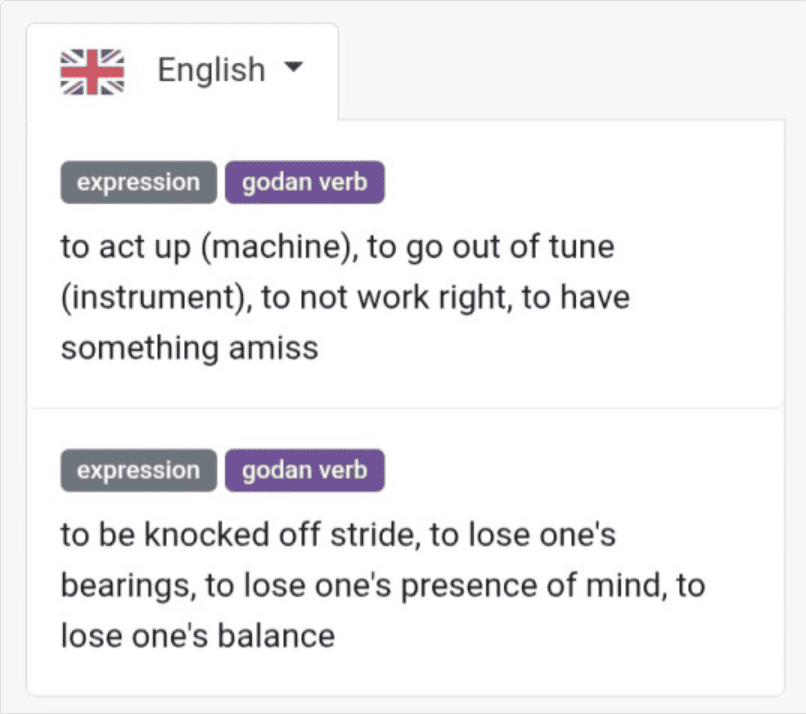
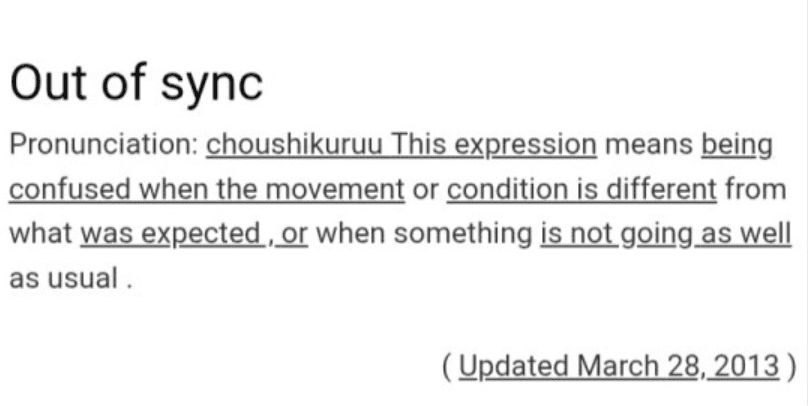
The phrase can be used in a lot of different situations, so it's hard to know exactly in what sense is being used here. I would argue, like the first post that talked about this line, that the use in here has a romantic connotation since it's being used by Hinata after being praised by Komaeda. But I also can not completely discard that this wasn't used with some kind of negative connotations here. It may be possible Hinata saying this was a way to “foreshadow” that something was “off” with Komaeda, but it doesn't really convince me. Hinata says so after being praised, and when he was praised by Komaeda in island mode, he said something that was kind of similar:
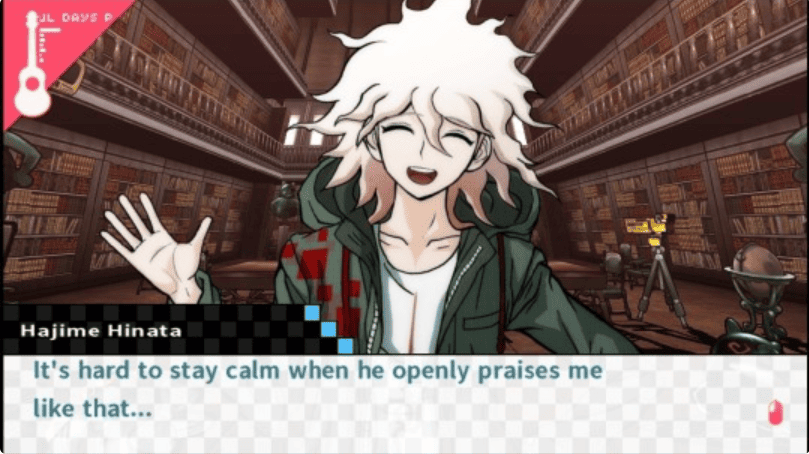
It's also worth to note, that Hinata says he feels that way every time he talks to Komaeda. And if he meant that negatively, it would be contradictory towards the other pieces of dialogue that imply that Hinata feels calm around Komaeda and enjoys his company.
な(na) = Sentence ending particle, used to soften the sentence a bit. It's a more masculine/rough version of ね(ne).
So the English translation would be something like: “For some reason… always that I talk with this guy, I get thrown off balance”
As I mentioned earlier, I found out something that assured me that this phrase could have romantic connotations. It was this dialogue from the gameAngelique trois (2000) where one of the characters, Zephel, uses the same phrase Hinata used, but with some grammatical differences. Let's look at it:
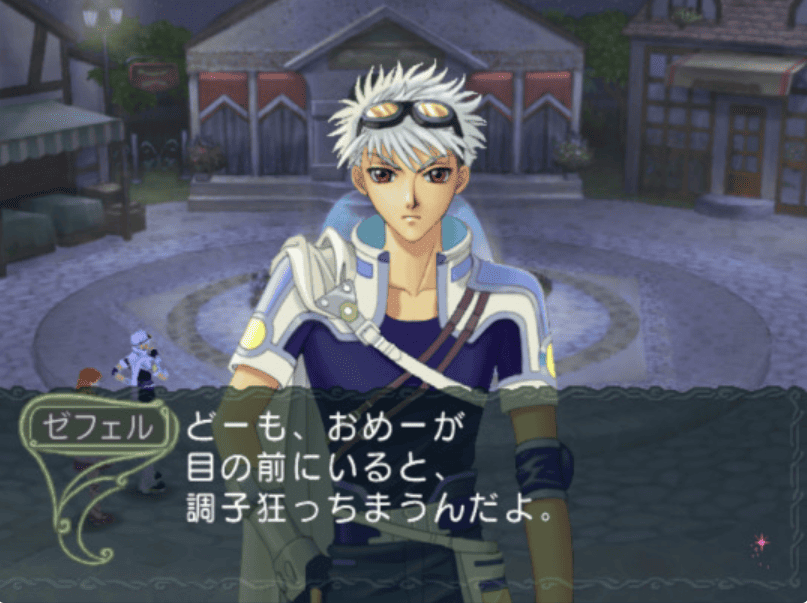
“Somehow, when you're right in front of me, it messes with my head.”
The phrase Zephel uses here (調子狂っちまう) is the same as Hinata's, just with some differences in the level of formality (Zephel is much more informal) and also Zephel adds “shimau” As a way to signal he acted in the way he did unintentionally. The context of this is 100% romantic. This dialogue happens in one of the more advanced love events in Zephel's route, and not only this dialogue but all the other things Zephel does and say indicate that he is in love with the protagonist, Collett.
Obviously, having an example of the phrase being used in a romantic context doesn't indicate that Hinata said so in that way, but it does give us a reliable precedent to say that it is a possibility. It's good having a precedent like this since the forum entries that were usually used when discussing this weren't very clear, and even the people commenting weren't sure if the phrase meant something romantic or not. But in this case, we know that this character was definitely saying it in that way.
by retrorats
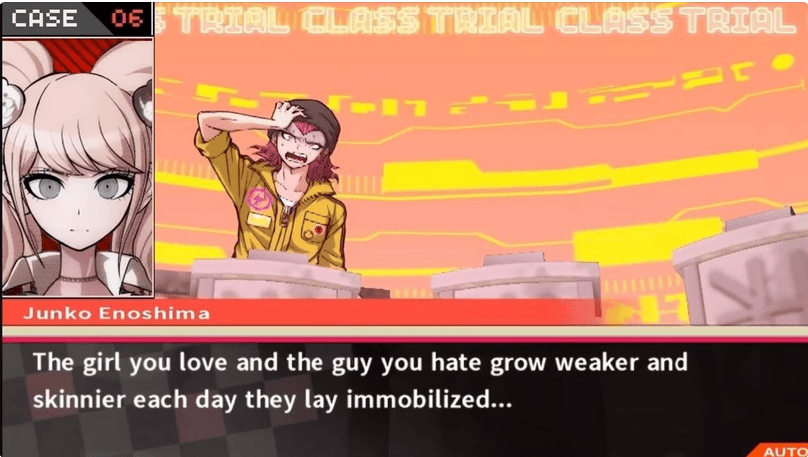
I remember a long time ago I saw a post (that I sadly cannot find again to credit the person) talking about how this line of dialogue, specifically the part of "the guy you hate" is talking about Komaeda and referencing specifically the relationship between Komaeda and Hinata. I really don't know what to think about this. If I'm honest, there's not enough evidence to say this is about Komaeda, but also not enough to say this isn't about him. But, I do really like to entertain the idea, even if I find it may be unlikely, so here are some various thoughts I have regarding this line of dialogue:
《大好きな彼女は動かないまま衰えていって、 大嫌いな彼も動かないままやせ細っていって…》
Daisukina kanojo wa ugokanai mama otoroete itte, daikiraina kare mo ugokanai mama yasehosotte itte…
My English translation (remember that I'm not fluent or a professional, so take this with a grain of salt):
"The girl you really love remains still and keeps getting weaker. The guy you really hate also remains still and keeps getting skinnier. "
As we can see, there are a few differences between the two versions. The Japanese version makes more clear the comparison between the man and a woman by making two different sentences that are very structurally similar, if not almost identical. They are also paralled by making the feelings associated with these characters both have the word dai [大] that means big, that in this context is used to indicate that they really love/hate that person.
But by far, the most interesting part of the original version, is that the things that are happening to each person are different. Yes, they are both immobilized, but the girl is getting weaker, and the guy is getting skinnier. The sentences are so similar that this being one of the only differences seems honestly very curious, and it almost feels like the text really wanted the reader to notice that detail. I'm aware I'm probably reaching, but it makes sense the emphasis on getting weaker and getting skinnier if we assume Junko is talking about Pekoyama and Komaeda, respectively. It makes sense that she points out that Pekoyama is getting weaker since she is a very strong person, and it makes sense that she points out that Komaeda is getting skinnier since he already is quite skinny due to his poor health.
I'm not that convinced of this theory, but it is quite entertaining to think about, so I wanted to share my thoughts about it. I'm very curious about what you guys think. Do you think this is about Komaeda? If not, then who is it about? Or do you think Junko is not talking about anyone in particular? We have very little evidence to work with, and the answers could be many!
by retrorats
Something that I noticed on my most recent SDR2 playthrough and that I haven't seen a lot of people bring up is that there's a lot of interactions between Nanami and Hinata that seem to be suspiciously similar to interactions between Komaeda and Hinata and seem to make a parallel between both relationships and to the role both Nanami and Komaeda have in their relationship with Hinata.
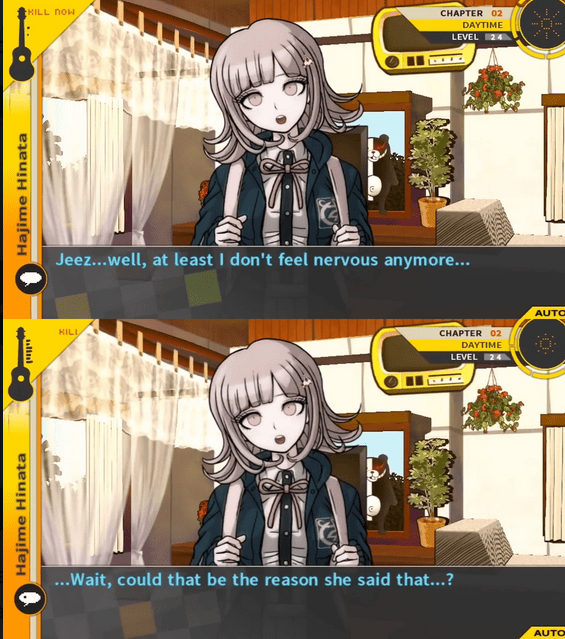
The earliest example of this parallels can be found in the Chapter 2 investigation when Nanami and Hinata are investigating Koizumi's cottage, here an interesting interaction between Nanami and Hinata can be found: Hinata is very nervous and depressed during the investigation and Nanami to cheer him up makes a joke about looking for dirty books. This scene has a lot of resemblance to the interactions that Komaeda and Hinata had during the prologue and in chapter 1, in which Komaeda made jokes (often of a similar style of the one Nanami did) to ease Hinata's mood. While it seems like a stretch, what really convinced me of it possibly being a parallel is how the structure of both interactions is suspiciously similar, in both these of interactions Hinata recognizes that the jokes that both of them made make him feel less nervous and then he wonders that if perhaps that actually was their intention.
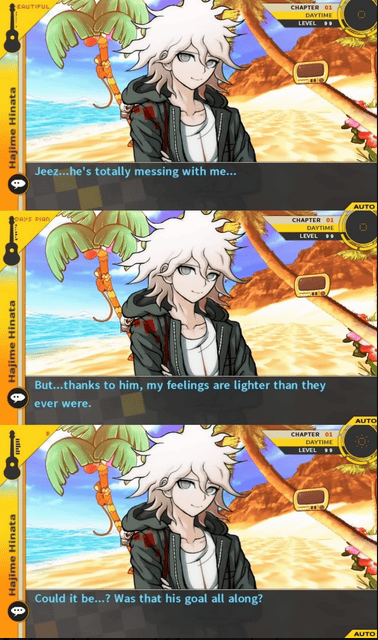
Other scene that happens with Nanami and Hinata that has a resemblance with interactions that Komaeda and Hinata had prior, is when Hinata asks Nanami if she's going to follow him and Komaeda to the beach house, Nanami answers that she isn't, she leaves and Hinata feels disappointed. This scene has a certain resemblance to a scene on chapter 1 on where Hinata asks if Komaeda is going to follow him back to the old building. Like in the other example I gave both of this scenes are structured on a very similar manner, Hinata asks if they are going to keep working with him, they say that they are going to do something else and Hinata answers with only silence indicating disappointment because he couldn't keep working with them.
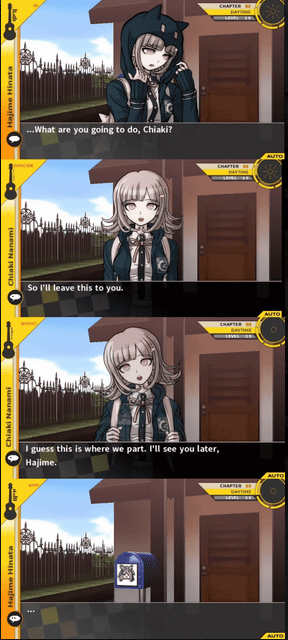
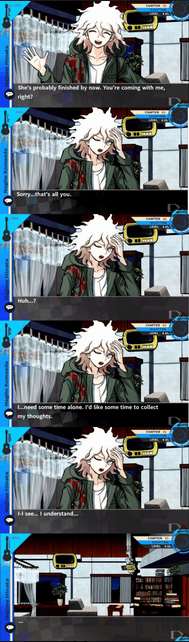
While I understand that a lot of people will just classify all of this similarities as coincidences, the reason why I feel that they were put there on purpose is because it makes sense that those parallels are there because they seem to complement the narrative. The Chapter 2 of danganronpa 2 is one where the roles that we were presented in chapter 1 shift, it's a chapter where the character that we believed was going to be our investigation partner changes. Because Komaeda's role in chapter 1 gets replaced by other character it makes sense that there exist comparison between these two relationships because it helps to stablish Nanami as the new companion to the reader, as well to add more complexity to the narrative.
But even if the scenes in Chapter 2 could be justified by being pure coincidence, something that convinced me completely that this was most likely intended is a certain interaction that happens between Nanami and Hinata in chapter 4 when we make the transition from Komaeda's point of view.
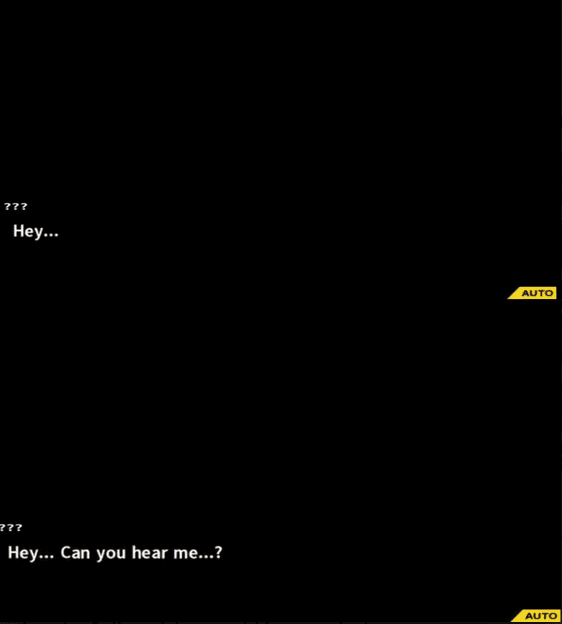
Does this dialogue seem familiar? That's probably because it is the exact same thing Komaeda tells Hinata when they first meet and is the first thing you hear on the game.
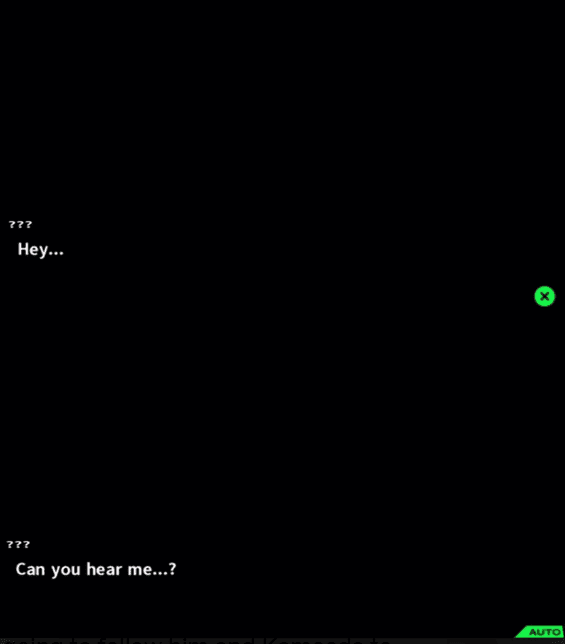
You could maybe argue that it's just a coincidence that happened and that it doesn't mean much, but just looks at what Kuzuryu says even when having the same role:
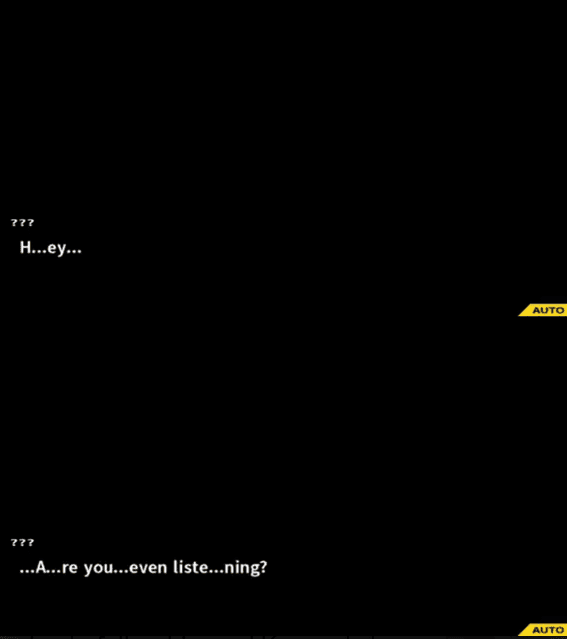
The way Kuzuryu says this is completely different from the prior examples and while this could be easily justified with the fact that he has a different way of speaking than both Nanami and Komaeda, what definitely convinced me that the dialogue was made purposely as different as possible from the other dialogues to highlight their similarities is the general way it's written. The addition of the ellipsis in all of the sentences feels extremely weird and unnatural, It seems to definitely have been made with a very clear intention on mind and not something that was added without much thought.
To finish this, I want to add the parallels that I noticed in chapter 5. I find that in this chapter is when it's more clear how much Nanami and Komaeda parallel each other in the role they take not only in the relationship they have with Hinata but in the story as a whole.
The role they take in Chapter 5 seems to have been purposely made to be two completely opposite forces, Komaeda sacrifices his life to kill the rest of the cast except the traitor and Nanami, the traitor, also sacrifices her life but for saving the same people Komaeda wanted to kill. The theme of the belief also seems to be paralleled between the two relationships. While this theme in general is relevant for trial 5 and not only for Komaeda and Nanami, I found it interesting how both of them had the concept of belief deeply attached to their characters in this chapter, specially in correlation of Hinata's belief on them.
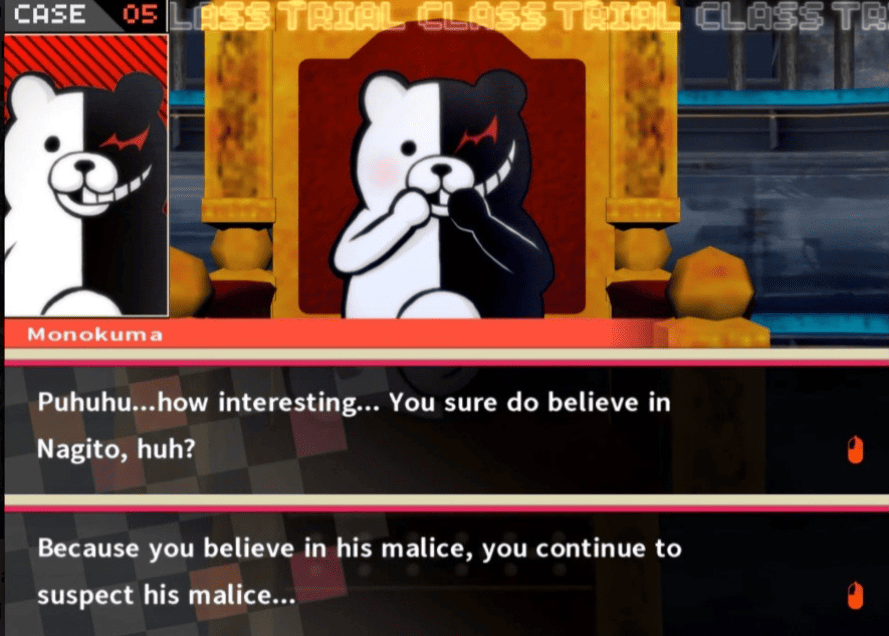
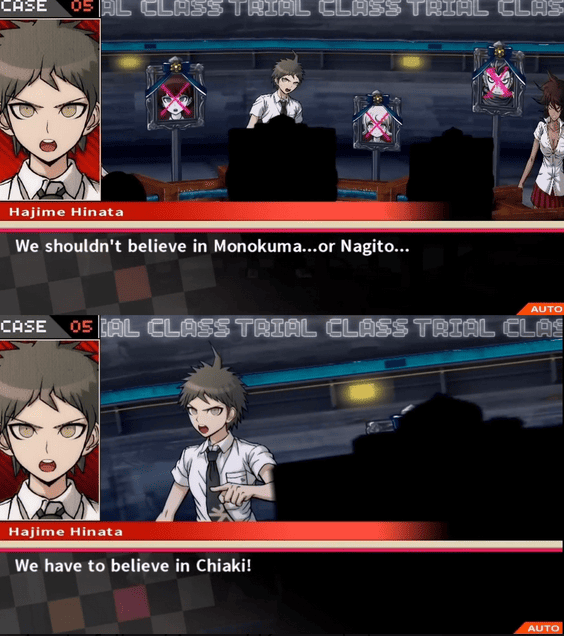
While probably there are more things out there in the text that could be used to justify this interpretation, I think these ones make well the job of explaining why I think this may have been intentional.
Since I first noticed these parallels, I have been thinking about what they could possibly mean, and while I do have an opinion about the possible meaning, I prefer to not tell it in this post since is not really a positive interpretation and it may be have been made because of my biases. That's why I prefer to leave this post as only a collection of all these possible parallels and give my opinion on their meaning in a moment where I'm more certain about it.